Role of Knowledge in AI – From Raw Data to Meaningful Machine Intelligence
Published: 4 Nov 2026
When I look at how AI systems work today, it’s clear that knowledge is the backbone of artificial intelligence. AI doesn’t just rely on raw data, it uses structured knowledge to reason, make decisions, and act intelligently.
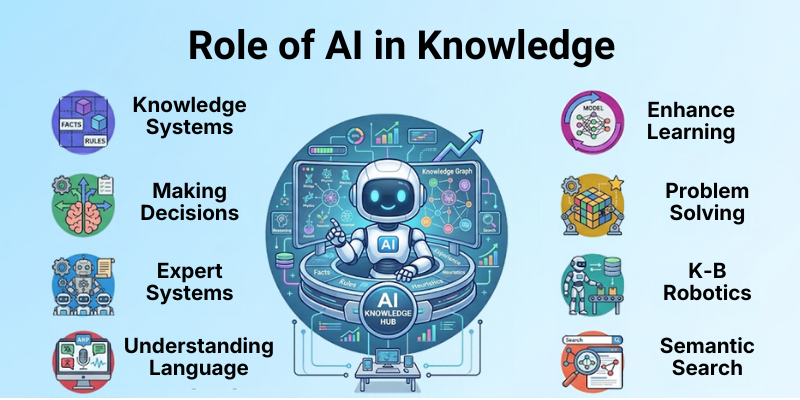
In simple words, knowledge in AI refers to information, rules, and facts that an AI system uses to understand the world and solve problems. Knowledge enables AI systems to go beyond pattern recognition and apply reasoning, logic, and context to complex scenarios.
In this guide, I’ll explain the role of knowledge in AI, how it supports reasoning, learning, and problem solving, and why it is crucial for building intelligent systems.
Mostly, our focus will be on understanding how knowledge underpins AI applications in real world tasks.
Impact of Knowledge in Artificial Intelligence
To properly understand the role of knowledge in AI, you need to see how it is applied in systems to support reasoning, decision making, and intelligent behavior. Below are the top 10 key roles knowledge plays in AI.
After listing them, I’ll explain each role in detail so you can clearly understand its impact on AI capabilities.
- Knowledge Representation
- Reasoning and Decision Making
- Expert Systems Development
- Natural Language Understanding
- Machine Learning Enhancement
- Problem Solving
- Knowledge Based Robotics
- Semantic Search and Information Retrieval
- Knowledge Sharing and Collaboration
- Supporting Explainable AI
Let us cover all in detail.
1. Knowledge Representation
Knowledge representation is how AI systems store and organize facts, rules, and relationships about the world.
It allows AI to understand complex information and apply it to real situations. Without structured knowledge, AI would struggle to reason beyond simple data patterns.
How It Works: Knowledge is stored in forms like ontologies, semantic networks, or rule based systems.
Benefits:
- Provides a structured framework for reasoning
- Enables efficient decision making
- Supports complex problem solving
- Enhances AI interpretability
This structured approach gives AI a foundation to understand information, connect ideas, and reason more effectively.
2. Reasoning and Decision Making
Knowledge allows AI systems to reason and make decisions based on available information.
For example, a medical AI system uses knowledge about diseases, symptoms, and treatments to recommend appropriate care.
How It Works: AI applies logic, inference rules, and knowledge bases to reach conclusions or predict outcomes.
Benefits:
- Enables intelligent decision making
- Reduces reliance on trial and error
- Improves prediction accuracy
- Supports autonomous systems
These capabilities help AI reach informed conclusions, make reliable decisions, and handle complex situations with greater accuracy.
3. Expert Systems Development
Expert systems are AI programs that mimic human expertise in specific domains. Knowledge is at the core of these systems, allowing them to provide expert advice and solutions.
For example, AI in finance, law, or healthcare uses expert knowledge to assist professionals.
How It Works: AI encodes domain specific knowledge into rules and facts to guide recommendations.
Benefits:
- Provides expert level guidance
- Reduces dependency on human experts
- Accelerates problem solving
- Enhances decision support
This knowledge driven approach allows expert systems to deliver valuable guidance and support better decisions across specialized fields.
4. Natural Language Understanding
AI relies on knowledge to understand and interpret human language accurately. Knowledge of grammar, semantics, and context allows systems to comprehend questions, instructions, and documents.
How It Works: AI combines linguistic knowledge with contextual information for natural language processing.
Benefits:
- Improves communication between humans and machines
- Supports chatbots, virtual assistants, and translation systems
- Enhances text comprehension and summarization
- Enables contextual reasoning in AI
This combination of language and contextual knowledge makes human machine communication more natural, accurate, and meaningful.
5. Machine Learning Enhancement
Knowledge enhances machine learning by providing context, constraints, or domain specific rules.
Instead of learning solely from raw data, AI can combine prior knowledge to improve learning efficiency and accuracy.
How It Works: Knowledge based constraints guide model training and prevent irrelevant patterns from affecting outcomes.
Benefits:
- Reduces data requirements
- Improves model accuracy
- Speeds up learning processes
- Enhances interpretability of machine learning models
By combining learned patterns with existing knowledge, AI models can achieve more accurate, efficient, and understandable results.
6. Problem Solving
AI uses knowledge to solve complex problems systematically.
For example, in logistics, AI can optimize routes using knowledge about traffic patterns, regulations, and delivery priorities.
How It Works: AI applies reasoning over knowledge bases, rules, and heuristics to generate solutions.
Benefits:
- Provides optimal and practical solutions
- Handles complex multi step problems
- Reduces human intervention
- Supports adaptive problem solving
These capabilities help AI tackle challenging problems, develop practical solutions, and adapt to changing situations.
7. Knowledge Based Robotics
Robots rely on knowledge to navigate environments, interact with objects, and perform tasks safely.
Knowledge allows AI robots to recognize objects, understand spatial relationships, and adapt to dynamic situations.
How It Works: AI integrates sensory data with world knowledge to guide robotic actions.
Benefits:
- Enhances autonomy of robots
- Improves task accuracy
- Reduces errors in dynamic environments
- Supports intelligent decision making in robotics
This integration of knowledge and sensory information enables robots to perform tasks more safely, accurately, and independently.
8. Semantic Search and Information Retrieval
Knowledge enables AI to perform advanced search by understanding meaning, context, and relationships.
For example, AI search engines use knowledge graphs to deliver accurate and relevant results beyond simple keyword matching.
How It Works: AI uses semantic knowledge structures to link concepts and improve search results.
Benefits:
- Provides more accurate search outcomes
- Understands user intent
- Connects related information intelligently
- Enhances decision making with relevant knowledge
This knowledge driven approach makes search more meaningful by connecting concepts, understanding intent, and delivering relevant information.
9. Knowledge Sharing and Collaboration
AI systems can store and share knowledge across platforms and organizations.
This enables collaborative problem solving, learning from prior experiences, and building collective intelligence.
How It Works: Knowledge is encoded in accessible databases or knowledge graphs for AI systems to query and learn.
Benefits:
- Promotes organizational learning
- Reduces redundancy in tasks
- Supports cross domain collaboration
- Improves efficiency in complex projects
This shared knowledge creates opportunities for stronger collaboration, continuous learning, and more efficient problem solving.
10. Supporting Explainable AI
Knowledge helps AI explain its reasoning and decisions.
Explainable AI is critical in industries like healthcare, finance, and law, where understanding how decisions are made is important.
How It Works: AI traces its decisions to knowledge based rules, facts, and reasoning chains.
Benefits:
- Enhances trust in AI systems
- Supports transparency and accountability
- Helps users understand AI recommendations
- Reduces risks of errors and bias
By making decisions easier to understand, knowledge helps build AI systems that are more transparent, accountable, and trustworthy.
Future of Knowledge in AI
The future of AI will rely increasingly on integrating knowledge with learning algorithms. Knowledge based AI will improve reasoning, problem solving, and explainability, enabling smarter and safer AI systems.
AI systems will not just learn patterns, they will understand context, apply logic, and provide actionable insights across industries.
Conclusion
In this guide, we explored the role of knowledge in artificial intelligence. Knowledge underpins reasoning, learning, problem solving, expert systems, natural language understanding, and decision making.
By combining data with knowledge, AI systems become more intelligent, adaptable, and reliable. Understanding the role of knowledge is key to designing and using AI effectively across industries and applications.
FAQs: Role of Knowledge in AI
Want to understand why knowledge is essential for artificial intelligence? These frequently asked questions explain how knowledge helps AI systems learn, reason, understand language, and make better decisions.
1. What is knowledge in AI?
Knowledge in AI refers to organized facts, information, rules, and relationships. It helps machines understand situations, connect information, and make intelligent decisions instead of relying only on raw data.
2. How does knowledge improve AI systems?
Knowledge strengthens AI systems in several ways:
- Provides context for understanding information.
- Improves reasoning and decision making.
- Helps solve complex problems.
- Makes results more accurate and reliable.
3. Can AI operate without knowledge?
Yes, some AI systems can learn patterns directly from raw data. However, without relevant knowledge, they may struggle to understand context, apply logical reasoning, and handle complex situations. Knowledge helps them produce more meaningful results.
4. How does knowledge support machine learning?
Knowledge guides machine learning models towards useful information and patterns.
Here is how it helps:
- Provides relevant facts and background information.
- Guides algorithms towards important patterns.
- Reduces the influence of irrelevant information.
- Improves learning efficiency and model accuracy.
5. What is knowledge representation in AI?
Knowledge representation is the process of organizing information so AI systems can understand and use it.
| Method | Purpose |
| Ontologies | Define concepts and their relationships |
| Semantic networks | Connect related ideas |
| Rule based systems | Apply facts and rules to reach conclusions |
These methods provide a structured foundation for AI reasoning and decision making.
6. How does knowledge help in natural language understanding?
Knowledge helps AI understand the meaning and context behind human language. It allows systems to:
- Interpret words and sentence relationships.
- Understand questions and instructions.
- Recognize context and intended meaning.
- Improve communication and text comprehension.
This makes interactions between humans and machines more natural.
7. What are knowledge based expert systems?
Knowledge based expert systems are AI programs that use specialized information, facts, and rules to provide expert guidance.
Their main functions include:
- Analyzing information in a specific field.
- Applying expert knowledge to problems.
- Recommending suitable solutions.
- Supporting informed human decisions.
8. Can knowledge help in robotics?
Yes. Knowledge helps robots understand their surroundings and perform tasks more effectively. For example, a knowledge based robot can:
- Recognize objects using sensory information.
- Understand spatial relationships.
- Choose suitable actions for a task.
- Adjust its movements when conditions change.
This improves robotic accuracy, safety, and independence.
9. How does knowledge support explainable AI?
Knowledge helps make AI decisions easier to understand by connecting conclusions to relevant facts, rules, and reasoning steps.
| Explainability feature | How it helps |
| Clear reasoning | Shows how conclusions are reached |
| Traceable rules | Connects decisions to supporting facts |
| Transparency | Helps users understand recommendations |
| Accountability | Supports the review of AI decisions |
This can strengthen user confidence in AI systems, especially in important fields such as healthcare and finance.
10. What is the future of knowledge in AI?
The future of AI will increasingly combine structured knowledge with machine learning to create more capable and reliable systems. Key developments may include:
- Better reasoning and problem solving abilities.
- More accurate and context aware decisions.
- Greater transparency and explainability.
- Improved collaboration between knowledge based systems and machine learning.





- Be Respectful
- Stay Relevant
- Stay Positive
- True Feedback
- Encourage Discussion
- Avoid Spamming
- No Fake News
- Don't Copy-Paste
- No Personal Attacks
- Be Respectful
- Stay Relevant
- Stay Positive
- True Feedback
- Encourage Discussion
- Avoid Spamming
- No Fake News
- Don't Copy-Paste
- No Personal Attacks
