Role of AI in Manufacturing in 2026 – Future Tech in Modern Production
Published: 30 Oct 2026
The role of AI in manufacturing is changing how factories work. I will explain how AI helps machines, tools, and systems run smarter. AI in manufacturing means using technology to improve production, reduce errors, and save time.
In this guide, I will show you how AI is used in different areas like quality control, maintenance, and supply chains. I will also cover the benefits, challenges, and future trends. By the end, you will understand how AI can make manufacturing faster, safer, and more efficient.
What are the Major Roles of AI in the Manufacturing Industry?
Guys, to understand the role of AI in manufacturing, we need to focus on how AI is used in real life factories. This means seeing the use cases of AI in manufacturing.
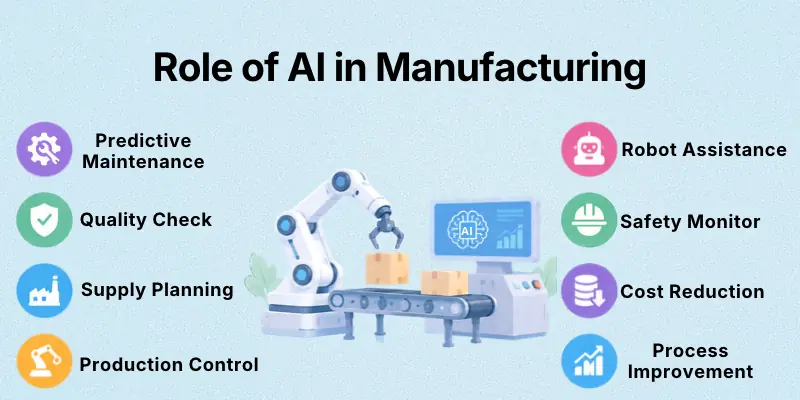
AI helps the industry run faster, reduce mistakes, save money, and improve product quality. It makes machines smarter and processes easier to manage.
Here are the main applications of AI in manufacturing:
- Predictive Maintenance
- Quality Check
- Supply Planning
- Production Control
- Energy Saving
- Robot Assistance
- Safety Monitor
- Cost Reduction
- Process Improvement
- Data Analysis
- Demand Forecasting
- Equipment Optimization
- Material Tracking
- Waste Reduction
- Design Support
Let us cover all these roles in detail.
1. Predictive Maintenance
I always check machines because even small problems can stop work. Predictive maintenance helps me know when a machine might fail. I plan repairs before anything breaks. This keeps the production line running smoothly. I feel confident knowing nothing will stop work suddenly.
Benefits:
- Reduces downtime
- Saves repair costs
- Extends machine life
Examples:
- Sensors on conveyor belts alert before breakdown
- Machines in car factories schedule service automatically
These benefits make predictive maintenance a valuable AI application in manufacturing. It helps factories reduce unexpected breakdowns and keep machines working efficiently.
2. Quality Check
I want every product to be perfect before it reaches the customer. Quality check helps me catch mistakes I might miss. I find defects in seconds that humans may not notice. This keeps products consistent and reliable. I feel proud when our products meet high standards.
Benefits:
- Reduces defective products
- Increases customer satisfaction
- Saves material costs
Examples:
- Cameras inspecting phone screens
- Systems spotting scratches on bottles
These benefits make AI-powered quality checks useful for maintaining product quality. They help manufacturers detect defects early and deliver more reliable products.
3. Supply Planning
I like to make sure every part is ready when we need it. Supply planning helps me keep the right stock without waste. I see which materials are needed soon and order them in time. This avoids production delays. I feel in control when everything is organized.
Benefits:
- Avoids shortages
- Reduces extra inventory
- Improves production speed
Examples:
- Tracking raw materials in electronics factories
- Suggesting steel orders in car production
AI-powered supply planning helps manufacturers manage materials more efficiently. It keeps production moving while reducing shortages, delays, and unnecessary inventory.
4. Production Control
I enjoy keeping the production line organized. Production control tells me what task comes first. I make sure workers and machines do not wait. This avoids confusion and delays. I feel confident everything runs smoothly.
Benefits:
- Reduces waiting time
- Increases output
- Improves workflow
Examples:
- Scheduling assembly tasks in electronics factories
- Managing multiple machines in packaging
AI-based production control helps factories organize tasks, machines, and workers more effectively. It supports a smoother workflow and helps improve overall production efficiency.
5. Energy Saving
I want to reduce electricity use in the factory. Energy saving shows me machines or lights that waste power. I adjust settings or switch them off when not needed. This cuts bills and helps the environment. I feel proud of saving money and energy.
Benefits:
- Reduces electricity cost
- Lowers environmental impact
- Optimizes machine efficiency
Examples:
- Switching off idle machines automatically
- Optimizing lighting schedules in factories
AI can help manufacturers use energy more wisely and reduce unnecessary power consumption. This can lower operating costs while supporting more sustainable production.
6. Robot Assistance
I use robots to help with hard or repetitive tasks. Robot assistance makes work faster and easier. I can assign them heavy lifting or precise assembly. This reduces worker fatigue. I feel more productive with robots helping every day.
Benefits:
- Speeds up production
- Reduces worker fatigue
- Improves accuracy
Examples:
- Robots assembling car parts
- Robots packing goods on conveyor belts
AI-powered robots can make repetitive and demanding manufacturing tasks faster and more accurate. They also allow workers to focus on tasks that require human skills and judgment.
7. Safety Monitor
I always care about worker safety. The safety monitor alerts me when there is a risk. It watches dangerous areas in the factory. This helps prevent accidents. I feel safe knowing workers are protected.
Benefits:
- Reduces accidents
- Improves worker confidence
- Monitors unsafe actions
Examples:
- Sensors detecting unsafe zones
- Alarms for workers in risky areas
AI safety monitoring can help factories identify risks before they lead to accidents. It supports a safer workplace by providing timely alerts and continuous monitoring.
8. Cost Reduction
I want to lower factory expenses. Cost reduction helps me find areas wasting money. I reduce unnecessary material and labor use. This increases profit. I feel smart saving resources every day.
Benefits:
- Cuts operational costs
- Reduces material waste
- Improves profit margins
Examples:
- Optimizing labor in assembly
- Reducing scrap in packaging
AI can help manufacturers identify waste and control unnecessary expenses. Better use of materials, labor, and resources can improve efficiency and support higher profit margins.
9. Process Improvement
I always try to make work faster and smoother. Process improvement shows me steps that need fixing. I remove delays and make workflow better. This increases output. I feel satisfied when operations are efficient.
Benefits:
- Increases production speed
- Reduces errors
- Optimizes workflow
Examples:
- Rearranging assembly lines for speed
- Adjusting machine sequences for efficiency
AI-powered process improvement helps manufacturers remove delays and make workflows more efficient. It can support faster production while reducing common errors.
10. Data Analysis
I collect factory data to understand patterns. Data analysis helps me make better decisions. I can see which areas work well and which need changes. This improves production. I feel confident making choices with real data.
Benefits:
- Shows trends
- Improves decision making
- Identifies problems
Examples:
- Monitoring machine performance
- Analyzing product defects
AI-driven data analysis helps manufacturers turn factory data into useful insights. These insights can improve decisions, identify problems, and support better production performance.
11. Demand Forecasting
I plan production based on future needs. Demand forecasting predicts what products customers want. I can avoid shortages or overstock. This keeps production balanced. I feel confident that we meet customer demand.
Benefits:
- Reduces stock shortages
- Prevents overproduction
- Improves planning
Examples:
- Predicting phone sales in electronics
- Planning clothing production by season
AI demand forecasting helps manufacturers prepare for changing customer needs. It can reduce shortages and overproduction while making production planning more accurate.
12. Equipment Optimization
I make machines work at their best. Equipment optimization adjusts speed and settings. I save energy and time. This also reduces machine wear. I feel proud when machines run efficiently.
Benefits:
- Improves efficiency
- Saves energy
- Extends machine life
Examples:
- Adjusting robot arms for speed
- Optimizing presses in metal factories
AI-powered equipment optimization helps machines operate more efficiently and use resources wisely. It can also reduce wear and support longer equipment life.
13. Material Tracking
I keep track of every part and raw material. Material tracking shows where items are in the factory. I avoid lost parts and delays. This keeps production smooth. I feel organized when materials are always ready.
Benefits:
- Prevents material loss
- Reduces delays
- Improves planning
Examples:
- Tracking electronics parts in assembly
- Monitoring steel sheets in car factories
AI-based material tracking helps manufacturers monitor raw materials and parts throughout production. This improves inventory control and reduces delays caused by missing materials.
14. Waste Reduction
I want to use materials efficiently. Waste reduction helps me reduce scrap. I save money and protect the environment. This improves overall efficiency. I feel proud when little material is wasted.
Benefits:
- Reduces scrap
- Saves money
- Improves efficiency
Examples:
- Reusing leftover metal in production
- Reducing fabric waste in clothing factories
AI can help manufacturers identify unnecessary material use and reduce production waste. This saves costs while supporting more efficient and sustainable manufacturing.
15. Design Support
I help make better products faster. Design support tests ideas before production. I can try different materials or shapes quickly. This reduces mistakes. I feel confident creating high quality products.
Benefits:
- Speeds up design
- Reduces errors
- Improves product quality
Examples:
- Testing car parts virtually
- Simulating furniture designs before making
AI-powered design support helps manufacturers test ideas and improve products before production begins. It can save time, reduce design errors, and support better product quality.
Benefits of AI in Manufacturing
In this section, I will share how AI helps different people in a factory. I want you to see the benefits from their point of view. AI changes work for everyone and makes factories smarter.
- Factory Manager: I can plan production better and avoid delays. I see problems early and save money. AI helps me make decisions fast.
- Engineer: I can test machines and designs more accurately. I feel confident that equipment works at its best. AI also helps me reduce errors in production.
- Worker: My tasks are easier and safer. Robots help with heavy or repetitive work. I make fewer mistakes and work faster.
- Quality Inspector: I can find defects quickly. I feel proud delivering high quality products. AI helps me keep standards high.
- Supply Planner: I can track materials and inventory easily. I avoid shortages and overstock. Planning becomes smoother every day.
- Maintenance Technician: I know machines before they fail. I can fix problems in time and avoid emergencies. AI reduces stress and surprises me.
- Energy Manager: I save electricity and reduce waste. I feel satisfied when costs go down and the factory runs efficiently.
AI in manufacturing helps every team member work smarter, reduce costs, and improve productivity. By using AI-powered tools, factories can create safer workplaces, improve product quality, and achieve better production results.
Challenges of Implementing AI in Manufacturing
In this section, I want to share the main challenges I see when factories start using AI. I know AI can improve work, but it is not always easy to apply.
Some problems can slow progress or cost extra money. I want you to understand these challenges before planning AI in a factory.
- High Costs: I see that installing AI systems can be expensive. Machines, sensors, and software need a big budget.
- Integration with Old Systems: I find it hard to connect new AI with old machines. Sometimes it takes extra effort to make everything work together.
- Skilled Workforce: I need trained staff to manage AI tools. Without skills, the system cannot work properly.
- Data Management: I need accurate and clean data for AI to work. Poor data can cause wrong results.
- Employee Resistance: I notice some workers are afraid AI will replace them. I have to explain that AI helps, not harms.
- Cybersecurity Risks: I must protect AI systems from hacking. Any breach can affect production and safety.
- Maintenance Complexity: I have to maintain AI tools and software regularly. Without care, performance drops.
Even with these challenges, I feel that careful planning and training can make AI implementation successful.
Final Note
In this guide, I have shared the role of AI in manufacturing and how it changes work for everyone.
I believe the future of manufacturing is exciting with AI. Factories will become smarter, faster, and safer. I am sure more innovations will come that make production even more efficient. If you want to learn more, check out my other articles on AI in supply chains and AI for smart factories. These guides will help you see how AI is shaping the whole industry.
Frequently Asked Questions About AI in Manufacturing
These FAQs explain how artificial intelligence improves manufacturing, from production planning to quality control. Explore simple answers about its applications, benefits, and real world uses in modern factories.
1. What is artificial intelligence in manufacturing?
Artificial intelligence in manufacturing uses smart technology to improve factory operations. It helps monitor machines, detect defects, predict failures, and make production faster and more efficient.
2. How can AI for manufacturing improve production?
AI for manufacturing can improve production by helping factories:
- Automate repetitive tasks.
- Reduce errors and delays.
- Improve machine performance.
- Use materials and resources wisely.
3. Why is AI in manufacturing important?
AI in manufacturing helps businesses improve productivity and product quality. Companies can use it to identify problems early, reduce operating costs, and make better decisions.
4. How does manufacturing and artificial intelligence work together?
Manufacturing and artificial intelligence work together through these steps:
- Collect data from machines and production systems.
- Analyze the data to identify problems.
- Recommend or automate suitable actions.
- Monitor results to improve future operations.
5. Can you give some AI in manufacturing examples?
Yes. Here are some common examples of AI in manufacturing:
| Application | Example |
| Quality inspection | Cameras detect product defects |
| Predictive maintenance | Systems predict machine failures |
| Robotics | Robots assemble and pack products |
| Supply planning | AI predicts material requirements |
6. Which industries use AI in manufacturing the most?
AI is widely used in industries such as:
- Automotive: Assembling vehicles and inspecting parts.
- Electronics: Checking components and circuit boards.
- Food production: Monitoring quality and packaging.
- Pharmaceuticals: Supporting quality control and production planning.
7. What are the main AI applications in manufacturing?
The main AI applications in manufacturing include predictive maintenance, automated quality inspection, demand forecasting, inventory management, and production optimization. These applications help factories reduce waste and improve efficiency.
8. How is generative AI used in manufacturing?
Generative AI helps engineers create and test product designs before physical production. For example, they can explore different shapes, materials, and models to develop better products and reduce design time.
9. How is AI used in manufacturing?
Factories can use AI through a few practical steps:
- Install suitable sensors, cameras, or software.
- Collect and analyze production data.
- Use AI insights to improve processes.
- Monitor performance and adjust operations when needed.
10. Can AI for manufacturing companies improve factory performance?
Yes. AI can help manufacturing companies improve factory performance in several ways:
| Area | Improvement |
| Production | Faster workflows |
| Maintenance | Less unexpected downtime |
| Quality | Fewer defective products |
| Costs | Less waste and resource use |
The results depend on the quality of data, the tools selected, and how effectively the company uses AI.





- Be Respectful
- Stay Relevant
- Stay Positive
- True Feedback
- Encourage Discussion
- Avoid Spamming
- No Fake News
- Don't Copy-Paste
- No Personal Attacks
- Be Respectful
- Stay Relevant
- Stay Positive
- True Feedback
- Encourage Discussion
- Avoid Spamming
- No Fake News
- Don't Copy-Paste
- No Personal Attacks
