Role of AI in Automation – What Happens When Machines Do the Heavy Lifting?
Published: 4 Nov 2026
When I look at modern industries and businesses today, I clearly see artificial intelligence transforming how work gets done. AI is driving automation that makes processes faster, more accurate, and cost effective.
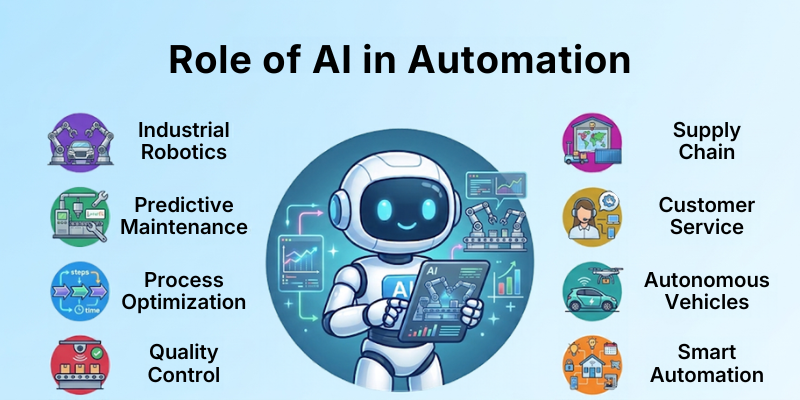
In simple words, automation is the use of technology to perform tasks without continuous human intervention. Artificial intelligence enhances automation by enabling smart decision making, predictive maintenance, robotics, and workflow optimization. It does not replace humans entirely but augments productivity and precision.
In this guide, I’ll explain the top 10 roles of AI in automation, how it improves industries, and why it is becoming a critical component of modern operations worldwide.
Mostly, our focus will be on understanding the practical applications and benefits of AI driven automation.
Function of AI in Automation
To properly understand the role of AI in automation, you need to see where it creates the most impact in industries, offices, and manufacturing. Below are the top 10 applications of artificial intelligence in automation.
After listing them, I’ll explain each role in detail so you can clearly understand how AI is shaping modern automated systems.
- Industrial Robotics Automation
- Predictive Maintenance
- Process Optimization
- Quality Control and Inspection
- Supply Chain and Inventory Automation
- Customer Service Automation
- Autonomous Vehicles and Drones
- Smart Home and Office Automation
- Data Analysis and Reporting Automation
- Workflow and Task Management
Let us cover all in detail.
1. Industrial Robotics Automation
AI powered robots are revolutionizing factories and production lines. These robots can perform repetitive tasks such as assembly, welding, painting, and packaging with high precision.
Unlike traditional robots, AI enabled robots can adapt to changing conditions, learn from experience, and handle complex tasks autonomously. This improves efficiency and reduces human error in industrial operations.
How It Works: AI algorithms guide robotic arms and machines to perform tasks accurately while learning from real time feedback.
Benefits:
- Increased production efficiency
- Reduced human error
- Cost effective manufacturing
- Safer working environments
As a result, intelligent robots make manufacturing faster, more precise, and safer while helping factories achieve higher production efficiency.
2. Predictive Maintenance
AI automates maintenance by predicting when machinery or equipment might fail. Sensors collect real time data from machines, and AI analyzes patterns to forecast potential breakdowns.
This proactive approach prevents unexpected downtime, reduces repair costs, and extends equipment lifespan.
How It Works: Machine learning models process sensor data to detect anomalies and schedule maintenance before failures occur.
Benefits:
- Reduces unplanned downtime
- Lowers maintenance costs
- Extends equipment life
- Improves operational reliability
This allows businesses to prevent costly equipment failures, reduce unexpected downtime, and keep machinery operating reliably for longer.
3. Process Optimization
AI automates and optimizes complex industrial and business processes. By analyzing operational data, AI identifies bottlenecks, suggests improvements, and ensures resources are used efficiently.
This helps companies achieve higher productivity and reduce waste across multiple processes.
How It Works: AI uses real time and historical data to model workflows and suggest optimization strategies.
Benefits:
- Improved efficiency
- Reduced operational costs
- Faster process completion
- Better resource allocation
Ultimately, AI driven process optimization helps organizations eliminate inefficiencies, use resources wisely, and achieve better results with less waste.
4. Quality Control and Inspection
AI enhances automated quality control by detecting defects in products faster than humans can. Computer vision and machine learning analyze images or sensor data to ensure products meet standards.
This is used in manufacturing, electronics, food production, and pharmaceuticals. AI ensures high quality output and reduces waste.
How It Works: AI scans product images or measurements and compares them to pre set quality standards.
Benefits:
- Higher product quality
- Faster inspection processes
- Reduced production errors
- Improved customer satisfaction
This makes product inspection faster and more reliable, helping manufacturers maintain quality standards, minimize defects, and deliver better products.
5. Supply Chain and Inventory Automation
AI automates supply chain management by predicting demand, tracking inventory, and optimizing logistics. It ensures that products are produced and delivered efficiently without delays or stockouts.
Smart inventory systems automatically reorder materials when needed, reducing manual oversight.
How It Works: AI analyzes historical sales, market trends, and logistics data to optimize supply chain operations.
Benefits:
- Reduced stockouts and overstock
- Efficient inventory management
- Improved delivery times
- Enhanced supply chain visibility
As a result, businesses can maintain balanced inventory, streamline deliveries, and build more responsive supply chains with fewer disruptions.
6. Customer Service Automation
AI powers chatbots, virtual assistants, and automated support systems for businesses. These systems respond to customer inquiries, provide solutions, and handle routine requests without human intervention.
This improves customer experience, reduces wait times, and allows human agents to focus on complex issues.
How It Works: Natural language processing (NLP) allows AI systems to understand queries and provide accurate responses.
Benefits:
- 24/7 customer support
- Reduced workload for human agents
- Faster query resolution
- Enhanced customer satisfaction
This enables businesses to deliver faster, round the clock customer support while allowing human agents to focus on more demanding customer needs.
7. Autonomous Vehicles and Drones
AI is essential in automating vehicles and drones. Self driving cars, delivery drones, and industrial robots use AI to navigate, avoid obstacles, and make real time decisions.
This reduces the need for manual operation and improves safety in transportation and logistics.
How It Works: AI processes sensor data and environmental information to guide vehicles or drones autonomously.
Benefits:
- Safer transportation
- Reduced labor costs
- Faster deliveries
- Efficient route management
These capabilities make transportation and delivery operations more efficient by supporting safer navigation, faster journeys, and reduced reliance on manual control.
8. Smart Home and Office Automation
AI enhances automation in homes and workplaces through smart systems. Devices like thermostats, lighting, security systems, and office assistants operate intelligently based on user behavior and preferences.
These systems improve convenience, energy efficiency, and productivity.
How It Works: AI collects user data and applies machine learning to optimize device behavior.
Benefits:
- Increased convenience and comfort
- Energy and cost savings
- Enhanced safety and security
- Smarter work environments
This creates more comfortable, secure, and energy efficient environments by allowing everyday devices to respond intelligently to people’s needs.
9. Data Analysis and Reporting Automation
AI automates the collection, analysis, and reporting of large datasets. Businesses and industries can quickly generate insights, detect trends, and make informed decisions without manual calculations.
This saves time and reduces errors in critical decision making processes.
How It Works: AI uses machine learning and analytics algorithms to process and visualize data.
Benefits:
- Faster data processing
- Accurate insights and predictions
- Reduced manual work
- Improved decision making
This helps organizations turn complex data into useful insights faster, reduce manual reporting work, and make better informed business decisions.
10. Workflow and Task Management
AI automates task scheduling, resource allocation, and workflow management. It ensures tasks are assigned efficiently and deadlines are met.
In offices and factories, AI can manage multiple projects simultaneously, track progress, and optimize productivity.
How It Works: AI monitors operations and dynamically adjusts workflows based on priorities and performance data.
Benefits:
- Efficient project management
- Reduced human oversight
- Increased productivity
- Better resource utilization
This helps teams coordinate tasks more effectively, manage resources efficiently, and complete projects with greater speed and consistency.
Future of AI in Automation
The future of AI in automation looks highly promising. AI systems will become more autonomous, adaptive, and intelligent, handling increasingly complex tasks across industries.
Automation powered by AI will not only improve efficiency but also allow humans to focus on creative and strategic work.
Conclusion
In this guide, we covered the top 10 roles of artificial intelligence in automation in detail. From industrial robotics and predictive maintenance to smart homes, autonomous vehicles, and workflow management, AI is transforming the way work gets done.
As technology continues advancing, AI driven automation will remain a critical driver of productivity, efficiency, and innovation across industries worldwide.
FAQs: Role of AI in Automation
Artificial intelligence is changing automation across industries by improving accuracy, reducing manual work, and speeding up everyday operations. Here are some common questions about how AI powered automation works and what it can achieve.
1. How is AI used in industrial automation?
AI powers industrial robots and machines to perform repetitive and complex tasks with greater precision. It helps automate activities such as assembly, packaging, and inspection, improving production efficiency while reducing manual workload.
2. Can AI reduce human error in operations?
Yes. AI improves accuracy and consistency by helping businesses:
- Detects defects during quality inspections.
- Monitor operations in real time.
- Perform repetitive tasks precisely.
- Identify errors in business processes.
This helps reduce mistakes and improve overall performance.
3. How does AI support predictive maintenance?
AI helps identify possible equipment failures before they happen through a simple process:
- Sensors collect real time machine data.
- AI analyzes performance patterns.
- Machine learning detects unusual changes.
- Maintenance teams receive alerts to inspect equipment.
This reduces unexpected downtime and helps lower repair costs.
4. Is AI useful in supply chain management?
Yes. AI improves supply chain operations by analyzing demand, inventory, and delivery information.
| Application | Main benefit |
| Demand forecasting | Predicts customer needs |
| Inventory management | Reduces stock shortages and excess stock |
| Route optimization | Supports faster deliveries |
| Logistics monitoring | Improves supply chain visibility |
5. Can AI improve customer service automation?
Yes. AI powered chatbots and virtual assistants can provide 24/7 customer support. They answer common questions, handle routine requests, and guide customers toward solutions. This reduces waiting times and allows human agents to focus on more complex problems.
6. How does AI help in autonomous vehicles?
AI helps autonomous cars, drones, and other vehicles operate by following these steps:
- Sense: Collects information through cameras and sensors.
- Analyze: Identifies roads, obstacles, and surrounding conditions.
- Decide: Selects suitable actions and routes.
- Respond: Controls movement based on real time information.
This supports navigation and reduces the need for constant human input.
7. Is AI applicable in smart homes and offices?
Yes. AI makes homes and workplaces more convenient by learning user habits and adjusting connected devices.
Common applications include:
- Smart lighting and temperature control.
- Automated security and surveillance systems.
- Intelligent energy management.
- Personalized workplace and home settings.
These features improve comfort, security, and energy efficiency.
8. Can AI automate data analysis?
Yes. AI can process large datasets, recognize patterns, and identify important trends much faster than manual analysis. It also helps generate reports and useful predictions, allowing businesses to make informed decisions with less effort.
9. How does AI enhance workflow management?
AI improves workflow management through several capabilities:
- Tracks task progress and deadlines.
- Assigns work according to priorities.
- Allocates resources efficiently.
- Identifies delays and adjusts workflows.
This helps teams improve productivity, coordinate tasks, and complete projects more efficiently.
10. What is the future of AI in automation?
The future of AI in automation will involve more intelligent, adaptive, and autonomous systems. These technologies are expected to:
- Handle increasingly complex tasks.
- Require less routine human intervention.
- Improve productivity across industries.
- Support faster and more consistent operations.
As these capabilities advance, AI powered automation will continue changing how businesses and people work.





- Be Respectful
- Stay Relevant
- Stay Positive
- True Feedback
- Encourage Discussion
- Avoid Spamming
- No Fake News
- Don't Copy-Paste
- No Personal Attacks
- Be Respectful
- Stay Relevant
- Stay Positive
- True Feedback
- Encourage Discussion
- Avoid Spamming
- No Fake News
- Don't Copy-Paste
- No Personal Attacks
