Role of AI in the Job Market – Will Artificial Intelligence Replace Your Job?
Published: 4 Nov 2026
When I look at how technology is transforming workplaces today, it’s clear that artificial intelligence is playing a major role in shaping the job market. AI is automating tasks, creating new career opportunities, and changing the skills employers look for.
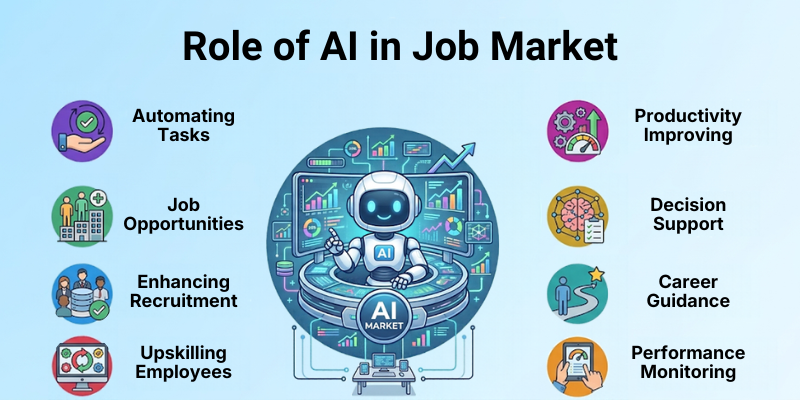
In simple words, the job market refers to the global and local environment where employers hire employees and workers find work. Artificial intelligence impacts how jobs are created, replaced, or transformed, making it an essential factor in today’s employment landscape.
In this guide, I’ll explain the top 10 roles of AI in the job market, how it affects employers and employees, and why understanding AI’s influence is crucial for career planning.
Mostly, our focus will be on understanding the practical effects of AI on employment and the future of work.
Contribution of AI in the Job Market
To properly understand the role of AI in the job market, it’s important to see where it has the most impact in industries, workplaces, and employment trends. Below are the top 10 ways AI is influencing jobs today.
After listing them, I’ll explain each role in detail so you can see how AI is transforming work for employees and employers alike.
- Automating Repetitive Tasks
- Creating New Job Opportunities
- Enhancing Recruitment and Hiring
- Upskilling and Reskilling Employees
- Improving Workplace Productivity
- Data Analysis and Decision Support
- Personalized Career Guidance
- Monitoring Employee Performance
- Supporting Remote Work and Collaboration
- Transforming Industry Specific Roles
Let us cover all in detail.
1. Automating Repetitive Tasks
AI automates routine and repetitive tasks in offices, factories, and service industries. Tasks such as data entry, report generation, scheduling, and assembly line work can be handled more efficiently by AI systems.
This frees employees to focus on more creative, strategic, and decision based work, increasing overall productivity.
How It Works: AI software and robotic systems perform predefined tasks automatically while learning to improve efficiency over time.
Benefits:
- Saves time on repetitive work
- Reduces human error
- Allows focus on strategic tasks
- Increases workplace efficiency
This shift allows employees to spend more time on meaningful work while creating a faster and more productive workplace.
2. Creating New Job Opportunities
While AI automates some roles, it also creates new jobs that never existed before. Careers in AI programming, machine learning, robotics maintenance, and AI ethics are emerging rapidly.
Companies are also hiring professionals to manage AI systems and integrate them into existing workflows.
How It Works: AI innovation drives demand for skilled employees to design, implement, and maintain AI powered systems.
Benefits:
- New career paths in technology
- Demand for AI expertise
- Encourages innovation driven industries
- Expands global employment opportunities
These emerging opportunities are opening new career paths and reshaping the future of employment across industries.
3. Enhancing Recruitment and Hiring
AI improves hiring processes by screening resumes, matching candidates to job requirements, and even conducting initial interviews using chatbots.
This allows recruiters to focus on top candidates and reduces bias in preliminary selection.
How It Works: AI algorithms analyze candidate profiles, assess skills, and predict the best job fit.
Benefits:
- Faster recruitment processes
- Reduces hiring bias
- Matches candidates accurately to roles
- Saves HR time and resources
These improvements help companies find suitable talent faster and make recruitment more efficient and effective.
4. Upskilling and Reskilling Employees
AI helps identify skill gaps in employees and recommends training programs. Companies can use AI to design personalized learning paths and reskilling initiatives.
This is critical as automation transforms job requirements and ensures employees remain relevant in the changing market.
How It Works: AI analyzes performance data and career goals to suggest relevant courses, workshops, or certifications.
Benefits:
- Supports continuous learning
- Prepares workforce for AI driven roles
- Enhances career growth
- Reduces unemployment from automation
Continuous learning helps employees adapt to changing job demands and remain competitive in the evolving job market.
5. Improving Workplace Productivity
AI powered tools improve workflow management, task prioritization, and team collaboration. They help employees stay organized and complete work efficiently.
By providing insights, reminders, and process automation, AI ensures higher productivity without overburdening workers.
How It Works: AI monitors tasks, recommends schedules, and automates repetitive steps to streamline operations.
Benefits:
- Optimizes employee output
- Reduces work related stress
- Enhances time management
- Supports organizational efficiency
These capabilities create smoother workflows and help employees achieve better results with less effort.
6. Data Analysis and Decision Support
AI can analyze large volumes of business and market data to guide decision making. Employees use AI insights to make better strategic and operational choices.
This is especially valuable in finance, marketing, healthcare, and management roles.
How It Works: AI models process structured and unstructured data to detect patterns and generate actionable insights.
Benefits:
- Informed business decisions
- Reduces guesswork in planning
- Improves organizational strategy
- Supports innovation driven work
These insights empower professionals to make informed decisions and drive better business outcomes.
7. Personalized Career Guidance
AI tools help individuals plan their careers by analyzing their skills, experience, and interests. They provide suggestions for career transitions, suitable job roles, and educational opportunities.
This helps employees make smarter career choices in an AI driven job market.
How It Works: AI platforms assess professional profiles, skillsets, and labor market trends to recommend career paths.
Benefits:
- Tailored career advice
- Encourages skill development
- Guides successful job transitions
- Enhances employability
This guidance helps individuals choose suitable career paths and prepare for emerging employment opportunities.
8. Monitoring Employee Performance
AI tracks employee performance using productivity metrics, task completion rates, and efficiency scores.
This data helps managers identify high performers, areas for improvement, and training needs without constant manual monitoring.
How It Works: AI software collects and analyzes workflow data to generate performance insights.
Benefits:
- Objective performance evaluation
- Supports constructive feedback
- Identifies training needs
- Encourages productivity improvement
These insights help organizations improve workforce performance and build a more effective working environment.
9. Supporting Remote Work and Collaboration
AI facilitates remote work by automating communication, scheduling, and project management. Tools like AI assistants help teams coordinate effectively from different locations.
This became especially important during the COVID-19 pandemic and continues to support flexible working models.
How It Works: AI powered collaboration platforms automate tasks, track projects, and provide productivity insights.
Benefits:
- Enables efficient remote work
- Improves team coordination
- Reduces administrative overhead
- Enhances flexible working arrangements
These capabilities make remote teamwork more connected, organized, and productive across different locations.
10. Transforming Industry Specific Roles
AI is changing jobs across sectors such as healthcare, finance, education, and logistics. For example, AI assists doctors in diagnosis, bankers in fraud detection, and educators in personalized learning.
This transformation requires workers to adopt new skills and collaborate with AI systems effectively.
How It Works: AI integrates into industry workflows to support specialized tasks and optimize decision making.
Benefits:
- Industry specific efficiency
- Enhances professional capabilities
- Drives innovation in work practices
- Prepares workforce for AI adoption
This transformation is reshaping professional responsibilities and preparing workers for the changing demands of modern industries.
Future of AI in the Job Market
The future of AI in the job market is a mix of automation, augmentation, and new opportunities. AI will continue to replace repetitive tasks while creating high skill roles.
Employees who adapt, upskill, and collaborate with AI will thrive, and businesses that leverage AI efficiently will become more competitive.
Conclusion
In this guide, we covered the top 10 roles of artificial intelligence in the job market. From automating tasks and enhancing recruitment to career guidance, productivity, and industry specific transformations, AI is reshaping the way we work.
Understanding AI’s impact is crucial for both employers and employees to succeed in the modern job market.
FAQs: Role of AI in the Job Market
Want to understand how artificial intelligence is reshaping employment and career opportunities? Here are answers to common questions about job security, recruitment, workplace productivity, and the future of work.
1. How is AI changing the job market?
AI is transforming the job market by automating routine tasks, improving workplace productivity, and introducing new career opportunities.
Its impact includes:
- Changing traditional job responsibilities.
- Increasing demand for technical skills.
- Creating new employment opportunities.
- Reshaping how businesses hire and manage workers.
These changes are influencing the skills employers need and the way people build their careers.
2. Can AI lead to job loss?
Yes, AI may replace some repetitive and routine jobs through automation. However, it also creates new opportunities in technology, data science, robotics, and AI management.
Workers can prepare for these changes by:
- Learning new digital skills.
- Developing problem solving abilities.
- Exploring emerging career paths.
- Adapting to AI powered workplaces.
3. How does AI support recruitment?
AI makes recruitment faster by helping HR teams screen applications, evaluate candidate profiles, and identify suitable applicants.
| Recruitment task | How AI helps |
| Resume screening | Filters applications based on job requirements. |
| Candidate matching | Identifies relevant skills and experience. |
| Initial interviews | Supports preliminary candidate assessments. |
| Applicant ranking | Organizes candidates for recruiter review. |
These tools save time and help recruiters manage hiring processes more efficiently, although human oversight remains important.
4. Can AI help employees improve skills?
Yes! AI powered learning platforms recommend personalised training based on employees’ abilities, performance, and career goals.
How it works:
- Identifies existing employee skills.
- Detects knowledge and performance gaps.
- Recommends relevant courses and training.
- Tracks learning progress and improvement.
This approach helps workers develop valuable skills and adapt to changing employment demands.
5. How does AI increase workplace productivity?
AI improves workplace productivity by automating repetitive activities, organising schedules, and streamlining daily operations. Key benefits include:
- Better time management.
- Faster task completion.
- Improved workflow organisation.
- More time for creative and strategic work.
As a result, employees can accomplish more while focusing on higher value responsibilities.
6. Are new careers emerging because of AI?
Absolutely! Artificial intelligence is creating demand for professionals in several growing fields. Some emerging career opportunities include:
- AI developers: Build intelligent software and applications.
- Data scientists: Analyse information and identify useful patterns.
- Robotics engineers: Design and maintain robotic systems.
- AI ethics specialists: Address fairness and responsible AI use.
- Machine learning engineers: Develop systems that learn from data.
These careers are expanding employment opportunities for people with relevant technical and professional skills.
7. Can AI guide career decisions?
Yes, AI powered career platforms examine professional profiles and labour market trends to suggest suitable career paths. They can help individuals:
- Identify their strengths and existing skills.
- Discover suitable job opportunities.
- Find relevant learning programmes.
- Explore career changes and advancement options.
This guidance makes career planning more informed and helps individuals prepare for future employment opportunities.
8. Does AI support remote work?
Yes, AI makes remote working easier by improving communication, project management, and team coordination.
| AI application | Remote work benefit |
| Virtual assistants | Manage schedules and reminders. |
| AI meeting tools | Summarise discussions and action points. |
| Project management | Track tasks and deadlines. |
| Communication tools | Support faster team coordination. |
These capabilities help remote teams stay organised and work effectively from different locations.
9. How does AI transform industry specific jobs?
AI is changing professional responsibilities across multiple industries.
For example:
- Healthcare: Supports medical diagnosis and patient care.
- Finance: Helps detect suspicious transactions and fraud.
- Education: Enables personalised learning experiences.
- Logistics: Improves delivery planning and route optimisation.
These applications enhance professional capabilities and encourage workers to develop skills that complement intelligent technologies.
10. What is the future of AI in employment?
The future of employment will likely involve greater collaboration between humans and AI systems. Rather than replacing every worker, AI is expected to automate certain tasks while changing many existing roles and creating new ones.
Important developments to expect:
- More AI assisted workplaces.
- Growing demand for digital and technical skills.
- New career opportunities across industries.
- Greater focus on continuous learning.
- Increased collaboration between humans and intelligent systems.
Ultimately, employees who adapt, develop new skills, and learn to work alongside AI will be better prepared for the changing job market.
Role of AI in Microbiology - How Machine Intelligence Is Redefining the Future of Microbial Science




- Be Respectful
- Stay Relevant
- Stay Positive
- True Feedback
- Encourage Discussion
- Avoid Spamming
- No Fake News
- Don't Copy-Paste
- No Personal Attacks
- Be Respectful
- Stay Relevant
- Stay Positive
- True Feedback
- Encourage Discussion
- Avoid Spamming
- No Fake News
- Don't Copy-Paste
- No Personal Attacks
