AI in Ethics and Governance in 2026 – Making Decisions Fairer, Smarter, and Safer
Published: 8 Nov 2026
Artificial Intelligence (AI) is now an important part of how governments and companies make decisions. It helps leaders, workers, and citizens by making systems faster, fairer, and smarter.
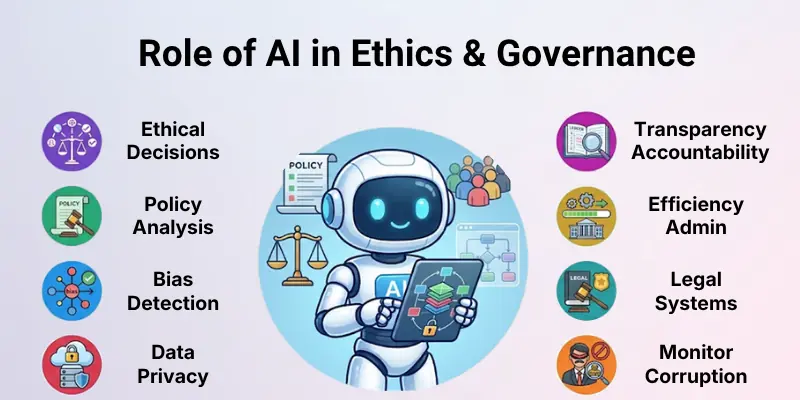
AI studies data, finds patterns, and helps create rules that guide how things should work. But at the same time, it needs strong ethics, meaning clear rules about what is right or wrong.
When used with care, AI can improve fairness, stop corruption, and protect people’s rights. So, guys, let’s now explore the role of AI in ethics and governance in different ways.
Role of AI in Ethics and Governance
Here is a list of the main roles that AI plays in this field:
- Ethical Decision Making
- Policy Development and Analysis
- Bias Detection and Fairness
- Data Privacy and Protection
- Transparency and Accountability
- Public Administration Efficiency
- Law Enforcement and Legal Systems
- Monitoring Corruption and Fraud
- Supporting Human Rights and Inclusion
- Building Trust in Technology
Let’s now explain each one clearly in simple words.
1. Ethical Decision Making
AI helps people make fair and honest choices. It studies large amounts of data and checks all sides before giving suggestions. This helps reduce human mistakes and personal bias in decisions. Governments and businesses use AI to see if their choices are fair to everyone. It brings balance and clarity to complex problems. With AI, people can make decisions that follow ethics and laws.
Examples:
- AI tools helping in fair hiring or promotions.
- Systems checking if loan approvals are fair for all users.
These examples show how AI can support more ethical decisions by reducing bias and helping people make fairer choices.
2. Policy Development and Analysis
AI helps leaders create better public rules and policies. It studies how people live, work, and react to changes. By doing this, it shows what kind of policy will help the most people. It also predicts how new laws might affect society. This saves time and reduces guesswork in government planning. Good policies made with AI are based on facts, not opinions.
Examples:
- AI helps to shape education or health policies.
- Predicting how a new tax rule will affect small businesses.
By using data to understand people’s needs, AI helps leaders create smarter policies that benefit society.
3. Bias Detection and Fairness
AI helps in finding unfair or unequal patterns in data. Sometimes people or systems can be unfair without noticing it. AI studies data and points out where bias exists. This ensures that decisions are fair for all, not just a few. It supports equality in jobs, justice, and daily services. This role of AI makes society more just and balanced.
Examples:
- Checking job applications for gender or race bias.
- Making sure loan systems treat everyone equally.
These uses of AI help identify unfair treatment and encourage equal opportunities for everyone.
4. Data Privacy and Protection
AI helps keep personal and private data safe. It monitors systems and spots any strange or risky activity. AI can stop hackers before they steal or misuse data. It also helps companies follow privacy laws. This builds trust between people and organizations. Strong privacy rules protect everyone’s personal rights.
Examples:
- Detecting cyber threats in government data systems.
- AI tools masking private information in public reports.
With stronger threat detection and data protection, AI helps organizations protect privacy and build public trust.
5. Transparency and Accountability
AI helps make processes open and easy to check. It records each step in a decision making process. This lets people see how and why a choice was made. It builds public trust by showing that nothing is hidden. When people can check decisions, they feel more confident. Transparency makes both AI and humans more responsible.
Examples:
- AI showing how it scored job candidates.
- Tracking how public funds are used in real time.
These tools make decisions easier to understand and review, helping organizations stay transparent and accountable.
6. Public Administration Efficiency
AI makes government offices work faster and smarter. It handles routine tasks like sorting forms or replying to basic questions. This saves time and allows staff to focus on important issues. Citizens get faster help and better service. AI can also reduce paperwork and delays. This makes the system smoother and easier for everyone.
Examples:
- Chatbots answering citizen queries on government websites.
- AI helping manage public service requests or tax filings.
By reducing paperwork and delays, AI helps government offices deliver faster and more convenient services to citizens.
7. Law Enforcement and Legal Systems
AI supports police and law departments in keeping peace. It studies data from cases and helps officers predict crimes. AI systems can also help courts review old cases quickly. This improves justice and reduces waiting time for decisions. Still, humans must always stay in control of final judgments. AI only helps make the process faster and fairer.
Examples:
- AI predicting risky areas for theft or violence.
- Systems helping judges review similar past rulings.
When used responsibly under human supervision, AI can support quicker legal processes while helping protect fairness and justice.
8. Monitoring Corruption and Fraud
AI finds patterns that may show corruption or fraud. It checks financial records and reports to catch unusual activity. Governments and companies use it to stop misuse of money. It helps build honesty in public offices and big organizations. AI can also alert leaders about risks early. This creates cleaner, more trusted systems.
Examples:
- Detecting fake invoices in public projects.
- Finding false expense claims in company systems.
By spotting suspicious activities early, AI helps organizations reduce fraud, protect public funds, and promote honesty.
9. Supporting Human Rights and Inclusion
AI promotes fairness and inclusion for all people. It studies social data to find where people are treated unfairly. AI tools can make sure that everyone has equal access to services. It supports rights related to gender, race, or disability. AI also helps make online spaces safer for everyone. This builds a kind and fair digital society.
Examples:
- AI tools blocking hate speech or online abuse.
- Translating public information into many languages.
These applications show how AI can improve accessibility, reduce exclusion, and help more people enjoy equal rights and opportunities.
10. Building Trust in Technology
For people to use AI safely, they must trust it. AI helps build that trust when it works clearly and fairly. Rules and ethical systems show people that AI is under control. When used right, AI improves life instead of replacing humans. Trust grows when companies and governments stay honest about AI use. With trust, AI becomes a positive part of daily life.
Examples:
- Sharing public reports about AI system decisions.
- Creating strong laws for fair and safe AI use.
When AI is used transparently and responsibly, it can strengthen public confidence and support a safer digital future.
Benefits of AI in Ethics and Governance
AI supports ethical and effective governance by promoting transparency, improving decision making, reducing bias, and helping organizations build public trust. AI brings many useful benefits, such as:
- AI helps people make fair and quick decisions.
- It reduces human mistakes and personal bias in work.
- It builds public trust by keeping things open and clear.
- AI finds corruption and unfair behavior early.
- It keeps private and personal data safe from misuse.
- It helps governments make smart and fair public policies.
- AI supports equality and inclusion for all people.
Overall, AI can encourage fairer decisions, strengthen accountability, protect citizens’ rights, and support more transparent and inclusive governance.
Challenges of AI in Ethics and Governance
Despite its potential, using AI in ethics and governance raises important concerns about fairness, privacy, transparency, regulations, and responsible decision making. AI is powerful, but it faces challenges too:
- It is hard to make clear laws for AI use.
- AI can still give unfair results because of bad data.
- Setting up and maintaining AI systems is very costly.
- AI can create privacy problems by collecting too much data.
- Some people fear or refuse to use AI systems.
- AI decisions can be hard to understand or explain.
- There are not enough skilled people to manage AI ethics.
Addressing these challenges is essential to ensuring that AI systems remain fair, explainable, secure, and accountable while respecting human rights and public trust.
Future of AI in Ethics and Governance
The future of AI in ethics and governance looks very promising. Experts believe that AI will soon help governments make better, faster, and more ethical choices. By 2030, many countries will use AI systems for transparent public service and fair law enforcement.
There will be stronger rules to stop misuse and protect human rights. AI will also support global efforts for peace, equality, and environmental safety. With human guidance, AI will lead to fairer systems that benefit everyone.
Final Note
In this guide, we learned how AI helps in ethics and governance by supporting fairness, transparency, and trust. It helps detect corruption, protect privacy, and make public systems more efficient. The future of governance will depend on using AI responsibly and keeping humans in control. With the right balance between technology and values, AI can make the world more fair, safe, and honest for everyone.
FAQs About AI in Ethics and Governance
AI in ethics and governance helps businesses and governments use artificial intelligence fairly, safely, and responsibly. These frequently asked questions explain AI governance policies, ethical principles, transparency, and the importance of protecting people’s rights.
1. What is AI governance and why is it important?
AI governance refers to the rules and systems that guide how AI is developed and used. It is important because it helps organizations:
- Keep AI systems safe and fair.
- Follow laws and ethical standards.
- Protect personal data and human rights.
- Make AI decisions more transparent.
2. How does ai governance policy help in building trust?
An AI governance policy builds trust by setting clear standards for how AI systems handle data and make decisions. It focuses on three key areas:
| Key area | How it builds trust |
| Data protection | Keeps personal information safer. |
| Fairness | Helps reduce biased decisions. |
| Safety | Reduces the risk of harm or misuse. |
3. What is meant by ai governance in companies?
AI governance in companies means creating policies and standards to manage AI projects responsibly. It helps businesses make fair decisions, reduce risks, protect customer information, and ensure that AI follows company values and legal requirements.
4. How are ethics of artificial intelligence managed in real life?
The ethics of artificial intelligence are managed through practical steps:
- Set ethical guidelines: Define what responsible AI use means.
- Follow laws: Ensure AI systems meet legal requirements.
- Review decisions: Let humans check important AI outcomes.
- Monitor performance: Identify harmful or unfair results and correct them.
These steps help organizations reduce risks and protect people.
5. What are the main goals of ai and ethics?
The main goals of AI and ethics are to make artificial intelligence fair, safe, and responsible.
- Fairness: Reduce bias and discrimination.
- Safety: Prevent harm to people.
- Privacy: Protect personal information.
- Accountability: Make organizations responsible for AI outcomes.
Together, these principles help ensure AI benefits people without violating their rights.
6. Why is AI code of ethics important for developers?
An AI code of ethics gives developers a clear checklist for building responsible AI systems.
- Check AI systems for bias and unfair results.
- Protect users’ personal information.
- Make AI decisions understandable where possible.
- Test systems for safety and reliability.
- Respect equality and human rights.
Following these principles helps developers create more trustworthy AI tools.
7. What are the risks of poor ai governance?
Poor AI governance can expose people and organizations to several risks.
| Risk | Possible impact |
| Biased decisions | Unfair treatment of certain groups. |
| Data leaks | Exposure of private information. |
| Misuse of AI | Harmful or irresponsible applications. |
| Weak accountability | Difficulty identifying who is responsible. |
| Loss of trust | Reduced confidence in AI services. |
Strong governance helps organizations identify and manage these risks before they cause serious harm.
8. How can governments improve AI governance and ethics?
Governments can improve AI governance by taking these practical steps:
- Create clear AI laws and ethical guidelines.
- Train public officials to understand AI risks.
- Establish systems to review AI decisions.
- Protect citizens’ privacy and human rights.
- Monitor AI applications and address misuse.
These measures encourage safer AI adoption and more responsible public services.
9. What role does transparency play in ai governance?
Transparency helps people understand how AI systems operate and why they produce particular decisions. It supports responsible governance in three important ways:
- Clear explanations: Help people understand AI driven outcomes.
- Better accountability: Make it easier to review decisions and identify responsibility.
- Greater trust: Give users more confidence in how AI is used.
10. How does AI governance support responsible innovation?
AI governance supports responsible innovation by balancing technological progress with safety, fairness, and accountability.
When businesses follow a clear governance process, they can:
- Develop new AI products responsibly.
- Identify risks before launching systems.
- Protect users and their information.
- Meet legal and ethical requirements.
This approach helps businesses innovate while building trust and reducing the risk of harm.






- Be Respectful
- Stay Relevant
- Stay Positive
- True Feedback
- Encourage Discussion
- Avoid Spamming
- No Fake News
- Don't Copy-Paste
- No Personal Attacks
- Be Respectful
- Stay Relevant
- Stay Positive
- True Feedback
- Encourage Discussion
- Avoid Spamming
- No Fake News
- Don't Copy-Paste
- No Personal Attacks
