Role of AI in Gaming in 2026 – How AI Is Changing the Future of Play
Published: 9 Nov 2026
Gaming today is not just about pressing buttons or finishing levels. It has become a world full of life, motion, and stories that change with every player. Smart systems help games think, react, and grow over time. They make characters act real and environments feel alive.
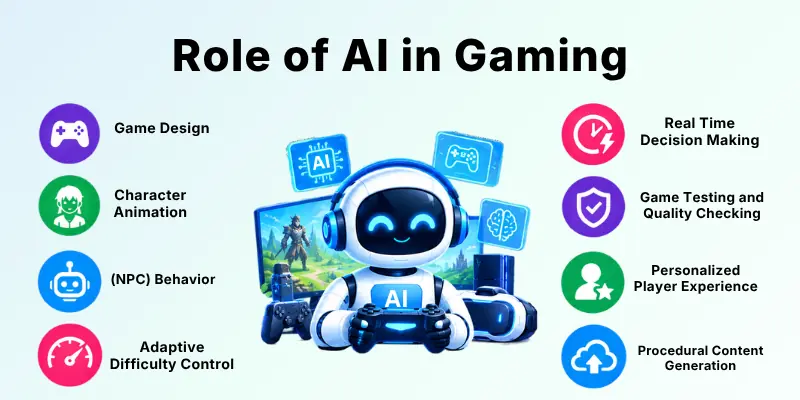
In this section, we will explore the role of AI in gaming, how these systems are used in gaming, their roles, benefits, challenges, and what the future holds.
Let’s begin our journey into how technology has changed the way we play.
Power of AI in Gaming
Guys, in this section we will explore the main discussion of our article. Here we will learn how different systems work behind every game, making it smarter, faster, and more enjoyable for everyone. Roles of AI in Gaming:
- Game Design and Story Creation
- Character Animation
- Non Player Character (NPC) Behavior
- Adaptive Difficulty Control
- Real Time Decision Making
- Game Testing and Quality Checking
- Personalized Player Experience
- Procedural Content Generation
- Predictive Game Strategy
- Emotion and Mood Detection
- Voice and Chat Interaction
- Anti Cheat and Fair Play Systems
- Virtual Reality Enhancement
- Game Physics Control
- Smart Environment Simulation
- Sound and Music Adaptation
- Real Time Analytics and Player Data
- Game Monetization and Recommendation
- Player Retention Analysis
- Cloud and Multiplayer Optimization
Let us learn about each in detail.
1. Game Design and Story Creation
Game design tools now use smart systems to plan stories, characters, and game levels faster. Developers can test new ideas easily and create better experiences for players. These systems help balance storylines and improve creativity. I find this makes worlds feel alive and more real. It saves both time and effort during game creation.
Benefits:
- Speeds up story and level design
- Improves creativity and balance
- Reduces planning time
Example: Used in open world titles like Assassin’s Creed and Cyberpunk 2077
2. Character Animation
Smart tools help animate characters more smoothly by learning from real movements. They create natural gestures and lifelike actions. This helps small studios make realistic games without huge budgets. It also saves hours of manual animation work. Players get more emotion and detail on screen.
Benefits:
- Improves animation quality
- Saves production time
- Adds human like motion
Example: Seen in sports games like FIFA and NBA 2K
3. Non-Player Character (NPC) Behavior
NPCs are the heart of many games. Smart systems help them make choices, talk naturally, and react differently each time. They can change plans based on what you do in the game. This makes every play feel fresh and unpredictable. NPCs now act more like real people instead of simple bots.
Benefits:
- Builds realistic characters
- Increases engagement
- Adds replay value
Example: NPCs in The Last of Us adapt to player actions
4. Adaptive Difficulty Control
This feature studies how well a player performs and adjusts the game’s difficulty. It helps beginners and experts enjoy the same game differently. It prevents frustration and boredom at the same time. The system keeps track of your success and failure rate. This makes gameplay smooth and fair for all.
Benefits:
- Keeps challenge balanced
- Retains player interest
- Prevents frustration
Example: Used in racing and action games to adjust rival levels
5. Real Time Decision Making
Games can now make instant changes while you play. These decisions can affect storylines, NPC behavior, or gameplay speed. It makes every session new and exciting. I enjoy how the world reacts to every move I make. This builds deeper connection and realism in gaming.
Benefits:
- Creates dynamic outcomes
- Adds surprise and tension
- Makes gameplay unique
Example: Detroit: Become Human changes stories based on player decisions
6. Game Testing and Quality Checking
Testing used to take months, but smart systems check games faster. They run thousands of plays to find bugs or glitches. Developers can focus on improving design instead of hunting for errors. This saves time and reduces release problems. Players get smoother gameplay from day one.
Benefits:
- Detects bugs quickly
- Saves testing time
- Improves quality and stability
Example: Used for pre release testing of large online games
7. Personalized Player Experience
Games now study how each player behaves and adjust stories or rewards. The system can change missions or music to match your mood. It feels like the game knows you personally. This helps players stay more connected and interested. I find it makes every session different and more fun.
Benefits:
- Customizes gameplay
- Improves enjoyment
- Builds loyalty
Example: Mobile puzzle games adapt levels to player skill
8. Procedural Content Generation
Games can now create maps, missions, and stories automatically. Each time you play, new content appears without human design. This keeps games fresh and endless. Developers save hours of work while players enjoy surprises. Every playthrough feels like a new adventure.
Benefits:
- Expands game worlds
- Reduces manual design
- Adds replay power
Example: No Man’s Sky creates billions of planets automatically
9. Predictive Game Strategy
Games collect data from players to predict what they might do next. This helps make smarter enemies or tougher puzzles. It also helps developers improve future updates. I think it keeps games more balanced and fair. It also makes challenges smarter and sharper.
Benefits:
- Builds better strategy
- Improves balance
- Enhances long term design
Example: Used in eSports planning and game balancing
10. Emotion and Mood Detection
Some games use face or sound sensors to study how players feel. If you look stressed, the game can reduce pressure. If you look calm, it may increase action. This makes games more emotional and interactive. It feels like the game understands your mood.
Benefits:
- Adds emotional touch
- Improves comfort
- Enhances realism
Example: Seen in VR based emotion sensitive horror games
11. Voice and Chat Interaction
Games now respond to voice and chat commands naturally. Players can speak to control actions or talk to characters. It makes gaming easier for everyone, even beginners. It also feels more personal and connected. This feature adds fun and freedom to every play.
Benefits:
- Makes gaming hands free
- Improves accessibility
- Builds stronger connection
Example: Used in RPG games with voice command support
12. Anti-Cheat and Fair Play Systems
Fair play keeps online games safe and honest. These systems detect cheating and hacking patterns fast. They block unfair players before they harm others. This keeps the game experience healthy and equal. It builds trust between players and developers.
Benefits:
- Keeps competition fair
- Protects players
- Stops hacking and fraud
Example: Used in Call of Duty and PUBG anti-cheat systems
13. Virtual Reality Enhancement
Smart tools make virtual worlds feel closer to real life. They improve motion, vision, and control. Players feel like they are inside the game. It increases excitement and deepens the sense of presence. I think VR games now feel more natural than ever before.
Benefits:
- Boosts immersion
- Enhances realism
- Reduces motion sickness
Example: HalfLife: Alyx offers advanced VR world experience
14. Game Physics Control
Physics systems control how objects move, fall, or crash. They make cars slide, balls bounce, and water flow naturally. This adds life to every move in the game. It makes play realistic and fun. The more accurate the physics, the more engaging the experience.
Benefits:
- Adds realism
- Improves gameplay detail
- Makes movements natural
Example: Used in car crash and sports simulations
15. Smart Environment Simulation
Games can now change weather, lighting, or events while you play. This creates living environments that feel real. It also adds variety to every mission. Players enjoy new scenes each time. It keeps games visually rich and interesting.
Benefits:
- Adds life to worlds
- Improves visual detail
- Keeps play dynamic
Example: Weather simulation in Forza Horizon series
16. Sound and Music Adaptation
Music and sound adjust automatically to player actions. When tension rises, the music changes tone. Calm moments have soft tunes. It helps players stay in the right mood. This makes every sound feel part of the story.
Benefits:
- Adds emotional depth
- Improves focus
- Boosts excitement
Example: Adaptive sound system in Resident Evil series
17. Real Time Analytics and Player Data
Game systems study player habits and feedback in real time. This data helps developers improve gameplay and fix bugs. It also guides updates and design choices. Players benefit from smoother and more balanced games. It helps companies understand what works best.
Benefits:
- Improves updates
- Enhances stability
- Supports better design
Example: Used in live games like Fortnite and Apex Legends
18. Game Monetization and Recommendation
Games study what players like and offer matching items. It helps players find better upgrades or bundles. This keeps buying simple and useful. Developers can earn while keeping users happy. It creates a win-win for both sides.
Benefits:
- Improves user satisfaction
- Supports business growth
- Builds trust and fairness
Example: Personalized store offers in mobile gaming apps
19. Player Retention Analysis
Smart systems track why players stop or continue playing. Developers use this to fix issues and make games more engaging. It helps maintain loyal communities. This ensures games stay popular for longer. It also improves long term performance.
Benefits:
- Increases player loyalty
- Reduces quitting rate
- Builds long term success
Example: Used by studios like Epic Games for live updates
20. Cloud and Multiplayer Optimization
Games hosted on cloud systems can run smoothly even on weak devices. These tools manage servers, reduce lag, and improve loading speed. Players from anywhere can join instantly. It makes online play fast and fair for everyone. Developers save cost on heavy hardware.
Benefits:
- Reduces lag and delays
- Improves server performance
- Boosts online gaming quality
Example: Seen in NVIDIA GeForce Now and Xbox Cloud Gaming
Benefits of AI Technology in Gaming
Guys, in this section we will learn how these systems make gaming better for players, developers, and the whole industry. These benefits show how gaming has changed from just entertainment to a complete smart experience.
Main Benefits:
- It improves the player’s overall experience and fun.
- It makes characters and game worlds more real.
- It helps developers create games in less time.
- It finds bugs and errors quickly before launch.
- It builds new and endless gaming content easily.
- It adjusts game levels based on player skills.
- It personalizes stories and rewards for each player.
- It saves time and money on testing and animation.
- It increases creativity in design and story creation.
- It makes every game run faster and smoother.
Examples: Games like Fortnite, FIFA, and No Man’s Sky use these systems to adjust gameplay, create new maps, and make each experience more natural and engaging.
Challenges of Implementing AI in Gaming
Guys, in this section we will learn the main challenges that the gaming industry faces while using these systems. Even though they bring great results, they also come with a few limitations that need smart solutions.
Main Challenges:
Although AI is transforming gaming, developers still face several challenges when using this technology. The main challenges include.
- It costs a lot to build and run these systems.
- There are not enough trained developers available.
- Bugs and coding mistakes can break the gameplay.
- Keeping player data safe is a big challenge.
- Testing advanced features takes a lot of time.
- These systems need huge data and strong storage.
- Old devices may not support new technology.
- Games depend heavily on the internet and servers.
- Updates take long and need constant work.
- It is hard to balance automation with creativity.
Developers must work hard to balance smart tools, costs, and creativity to give players a smooth and fun gaming experience.
Future of AI in Gaming
The future of gaming will bring more life and emotion into every play. Games will learn from players in real time, changing how stories unfold and how characters react. You may play in worlds that grow, talk, and feel real with every step you take.
Voice and movement will guide the story naturally, creating unique journeys for every gamer. Virtual and augmented reality will become more interactive and personalized. Developers will use data and smart systems to design, test, and release games faster than ever. Overall, the future of gaming will be more human, more creative, and more connected than we have ever seen before.
Final Note
In this guide, we explored how smart gaming systems change the way games are made and played.
We discussed every major role of AI in gaming and the benefits and challenges that shape today’s gaming world. These systems help developers save time, improve quality, and make every game more personal. From character design to full story control, everything now reacts to how we play.
The future of gaming looks bright, creative, and full of endless fun for everyone. So, let’s keep exploring and enjoying the new world of gaming together.
FAQs About AI in Gaming World
Here are some of the most commonly asked questions related to the role of AI in the gaming industry.
1. What is artificial intelligence gaming?
Artificial intelligence gaming uses smart systems to make games more realistic and interactive. It creates lifelike stories, intelligent characters, and exciting challenges that keep players engaged.
2. How do AI video games improve player experience?
AI video games personalize gameplay by adapting to players’ actions and skills. They improve the experience through:
- Adaptive difficulty: Adjusts challenges to match player skills.
- Smart characters: Responds naturally to player decisions.
- Dynamic gameplay: Creates more engaging experiences.
3. How is AI in computer games used by developers?
Developers use AI in computer games through these steps:
- Design characters: Create smarter NPCs and realistic actions.
- Test gameplay: Detect bugs and performance issues.
- Balance challenges: Adjust game difficulty and mechanics.
This saves development time and improves game quality.
4. What is the connection between AI and games today?
AI and games work together to create more immersive experiences. Their main connections include:
| AI Technology | Gaming Benefit |
| Machine learning | Adaptive challenges |
| Smart algorithms | Realistic character behaviour |
| AI driven graphics tools | More detailed game worlds |
5. How is artificial intelligence in gaming changing the industry?
Artificial intelligence in gaming is transforming the industry by helping studios:
- Develop creative missions and interactive worlds.
- Automate testing and reduce development time.
- Personalize gameplay for different players.
These improvements make games more engaging and efficient to produce.
6. How does artificial intelligence in game development help designers?
Artificial intelligence in game development helps designers work faster and focus on creativity. It can generate maps, support story creation, add visual effects, and identify bugs automatically.
7. What are AI powered games?
AI powered games use intelligent systems to respond to player choices. Their key features include:
- Changing storylines and game paths.
- Adapting enemy behaviour in real time.
- Creating different experiences across levels.
8. What can future game systems do for players?
Future game systems may offer more natural and immersive experiences through:
- Voice control: Responding to spoken commands.
- Smart sensors: Supporting more interactive gameplay.
- Adaptive stories: Changing narratives based on player emotions and decisions.
These features could make gaming feel more realistic.
9. What are some games that use artificial intelligence?
Popular examples of games that use AI include Fortnite, FIFA, and The Last of Us. Each uses AI in different ways to support gameplay.
| Game | Example of AI Use |
| Fortnite | NPC behaviour and interactive encounters |
| FIFA | Player movement and team tactics |
| The Last of Us | Enemy reactions and companion behaviour |
10. Can AI play video games without human help?
Yes, AI can play video games autonomously by learning rules, practising strategies, and adapting its actions. Developers also use game playing AI to test features, identify problems, and improve gameplay balance.





- Be Respectful
- Stay Relevant
- Stay Positive
- True Feedback
- Encourage Discussion
- Avoid Spamming
- No Fake News
- Don't Copy-Paste
- No Personal Attacks
- Be Respectful
- Stay Relevant
- Stay Positive
- True Feedback
- Encourage Discussion
- Avoid Spamming
- No Fake News
- Don't Copy-Paste
- No Personal Attacks
