Role of AI in Civil Engineering – Building Stronger, Safer, and More Sustainable Structures
Published: 16 Nov 2026
I’ve seen civil engineering projects become more complex every year, with huge amounts of data to manage.
In my experience, AI can help engineers make smarter decisions, reduce errors, and save time. I believe AI is not here to replace engineers but to assist them in planning, designing, and building better structures.
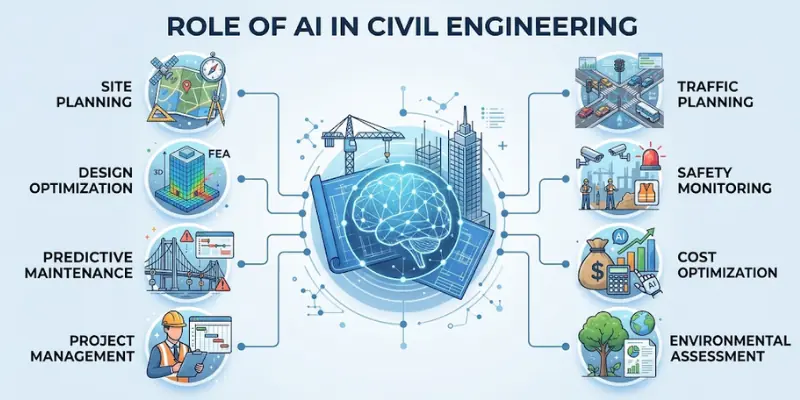
This guide will explore the role of AI in civil engineering and show how it is transforming construction, infrastructure, and project management.
Impact of AI in Civil Engineering
Here are the key roles AI plays in civil engineering:
- Planning and Site Analysis
- Structural Design Optimization
- Predictive Maintenance of Infrastructure
- Construction Project Management
- Traffic and Transportation Planning
- Safety Monitoring on Construction Sites
- Resource and Cost Optimization
- Environmental Impact Assessment
- Smart Building and Infrastructure Design
- Monitoring and Analyzing Building Materials
Let us learn about each in detail.
1. Planning and Site Analysis
AI helps engineers analyze construction sites before starting a project. I’ve seen it process satellite images, soil data, and terrain information quickly. This helps in selecting the best site, estimating risks, and planning layouts. AI reduces the chances of costly mistakes.
How to use: Input site data into AI mapping and analysis tools.
Popular Tools: ArcGIS AI, Trimble SiteVision, Autodesk Civil 3D AI
Benefits:
- Speeds up site selection and analysis
- Improves risk estimation
- Reduces human errors
- Saves time and cost in planning
Challenges:
- Requires accurate site data
- Some tools need training
Accurate site analysis helps engineers reduce risks and plan construction projects effectively. Smart mapping tools support better decisions, lower costs, and reliable project outcomes.
2. Structural Design Optimization
AI can suggest the best design for buildings, bridges, and other structures. I’ve seen it calculate loads, stress points, and materials faster than traditional methods. Engineers can explore more design options and find the most efficient solution. This reduces material waste and improves safety.
How to use: Input design requirements into AI structural modeling software.
Popular Tools: SAP2000 AI, ETABS AI, Autodesk Robot Structural Analysis
Benefits:
- Improves structural efficiency
- Reduces material costs
- Ensures safety and compliance
- Speeds up the design process
Challenges:
- Requires accurate input data
- Engineers must validate AI suggestions
Optimized designs improve structural safety and reduce material waste. Intelligent modeling helps engineers create stronger, more cost effective structures.
3. Predictive Maintenance of Infrastructure
AI predicts when roads, bridges, or buildings may need repairs. I’ve seen AI use sensors and historical data to alert engineers before failures happen. This prevents accidents and costly repairs. AI helps plan maintenance schedules efficiently.
How to use: Collect sensor data and feed it to AI predictive tools.
Popular Tools: IBM Maximo, Hitachi AI Maintenance, Smart Infrastructure AI
Benefits:
- Reduces downtime and repair costs
- Improves safety
- Predicts issues before they occur
- Supports efficient maintenance planning
Challenges:
- Sensor installation costs
- Needs regular data updates
Predictive maintenance identifies infrastructure problems before they become serious. Early alerts reduce repair costs, improve safety, and extend asset life.
4. Construction Project Management
AI helps manage schedules, resources, and timelines in construction projects. I’ve seen teams avoid delays by using AI to optimize workflows. It tracks progress, predicts risks, and suggests adjustments. Projects finish faster and stay on budget.
How to use: Use AI project management platforms with real time updates.
Popular Tools: Procore AI, Autodesk Construction Cloud AI, PlanGrid AI
Benefits:
- Improves schedule accuracy
- Reduces project delays
- Optimizes resource allocation
- Enhances decision making
Challenges:
- Integration with existing software
- Requires training for staff
Effective project management improves scheduling, budgeting, and resource allocation. Intelligent tools help teams reduce delays and deliver projects efficiently.
5. Traffic and Transportation Planning
AI helps design roads, traffic lights, and transport systems. I’ve seen cities reduce congestion by analyzing vehicle data with AI. It predicts traffic patterns and suggests improvements. This improves road safety and efficiency.
How to use: Input traffic and urban data into AI simulation tools.
Popular Tools: PTV Vissim AI, TransModeler AI, Aimsun AI
Benefits:
- Optimizes traffic flow
- Improves public transport planning
- Reduces congestion
- Enhances road safety
Challenges:
- Needs continuous traffic data
- Predictions may vary with unexpected events
Smart transportation planning improves traffic flow and road safety. Data driven insights help reduce congestion and make travel more efficient.
6. Safety Monitoring on Construction Sites
AI monitors workers, equipment, and hazards in real time. I’ve seen it detect unsafe conditions and alert managers immediately. This reduces accidents and improves compliance with safety regulations. AI can also analyze past incidents to prevent repeats.
How to use: Deploy AI cameras and sensors to monitor the site.
Popular Tools: Smartvid.io, Triax AI, HoloBuilder AI
Benefits:
- Improves worker safety
- Alerts managers to risks instantly
- Reduces accident costs
- Enhances regulatory compliance
Challenges:
- High initial setup costs
- Privacy concerns for workers
Real time monitoring helps detect hazards and prevent workplace accidents. Intelligent safety systems protect workers and support safer construction practices.
7. Resource and Cost Optimization
AI helps calculate the most efficient use of materials, labor, and equipment. I’ve seen it reduce waste and keep projects within budget. It suggests alternatives and optimizes schedules for maximum efficiency. This helps companies save money and time.
How to use: Input project details into AI resource planning software.
Popular Tools: PlanSwift AI, Autodesk Quantity Takeoff AI, Oracle Aconex AI
Benefits:
- Reduces material and labor waste
- Optimizes project costs
- Improves resource allocation
- Supports better budgeting
Challenges:
- Accuracy depends on data quality
- Requires staff to adapt to AI recommendations
Efficient resource planning reduces waste and controls construction costs. Intelligent analysis helps teams manage budgets, materials, and labor more effectively.
8. Environmental Impact Assessment
AI predicts the environmental effects of construction projects. I’ve seen it assess emissions, noise, and water impact faster than manual methods. This helps engineers make eco-friendly decisions and comply with regulations. AI improves sustainability in civil engineering projects.
How to use: Feed project data into AI environmental modeling tools.
Popular Tools: Envirosuite AI, SimaPro AI, ArcGIS AI Environmental Analysis
Benefits:
- Supports sustainable planning
- Reduces environmental risks
- Ensures regulatory compliance
- Speeds up assessment processes
Challenges:
- Requires detailed environmental data
- May need expert validation
Environmental assessments identify potential risks before construction begins. Advanced analysis supports sustainable development and better regulatory compliance.
9. Smart Building and Infrastructure Design
AI designs smart buildings with optimized energy use, security, and automation. I’ve seen engineers integrate sensors, AI controls, and analytics to improve efficiency. This reduces operating costs and enhances user comfort. AI also predicts maintenance needs in smart infrastructures.
How to use: Combine design software with AI optimization tools.
Popular Tools: Autodesk BIM AI, Honeywell Building AI, Siemens Smart Infrastructure AI
Benefits:
- Reduces energy consumption
- Enhances comfort and safety
- Predicts maintenance needs
- Optimizes building performance
Challenges:
- High initial investment
- Complex integration of AI systems
Smart building systems improve energy efficiency, comfort, and safety. Intelligent controls can lower operating costs and support sustainable infrastructure.
10. Monitoring and Analyzing Building Materials
AI tracks the quality, durability, and performance of materials like concrete and steel. I’ve seen it detect defects before they cause failures. This improves safety and reduces repair costs. AI also predicts material lifespan under different conditions.
How to use: Use AI sensors and imaging tools for material inspection.
Popular Tools: Concrete AI Sensors, Smart Material Testing AI, DynaCore AI
Benefits:
- Detects defects early
- Predicts material lifespan
- Improves safety and reliability
- Reduces maintenance costs
Challenges:
- Sensors and equipment cost money
- Requires accurate calibration
Advanced material monitoring detects defects and evaluates durability early. Reliable inspections improve structural safety and reduce maintenance expenses.
Future of AI in Civil Engineering
AI in civil engineering is expected to grow rapidly by 2030. McKinsey predicts that over 70% of construction projects will use AI driven planning and monitoring tools. AI will move the industry toward fully smart infrastructure, predictive maintenance, and automated construction.
I believe AI will help engineers work faster, reduce errors, and create safer, more sustainable structures. The future promises efficient projects, smarter designs, and eco friendly construction practices.
Final Note
In this guide, we explored the role of AI in civil engineering through ten key areas, from site planning to smart infrastructure design. I’ve seen how AI assists engineers, reduces errors, and improves efficiency.
The future isn’t about replacing humans; it’s about working together with AI to build smarter, safer, and more sustainable projects.
FAQs: AI in Civil Engineering
Artificial intelligence is transforming civil engineering through smarter design, safer construction, and efficient project management. Here are answers to common questions about its applications, benefits, and tools.
1. How does AI help in civil engineering projects?
AI analyzes construction and site data to improve planning, design, and monitoring. It helps engineers reduce errors, save time, control costs, and make better project decisions.
2. Can AI improve structural design?
Yes, AI helps engineers optimize building and bridge designs by analyzing loads, stress, and materials. Key benefits include:
- Exploring multiple design options
- Reducing material waste
- Improving structural safety
- Increasing design efficiency
3. How does AI help in construction project management?
AI supports construction management through these steps:
- Track progress: Monitor schedules, resources, and completed work.
- Predict delays: Identify potential problems early.
- Optimize plans: Adjust resources and timelines.
- Control costs: Help projects stay within budget.
Tools such as Procore and Autodesk Construction Cloud support digital project management.
4. Can AI optimize inventory and materials in construction?
Yes, AI predicts material requirements and tracks usage to prevent shortages and reduce waste.
| Application | Main benefit |
| Demand forecasting | Prevents material shortages |
| Inventory tracking | Improves stock control |
| Resource planning | Reduces unnecessary costs |
| Usage analysis | Minimizes material waste |
5. How does AI improve safety on construction sites?
AI powered cameras and sensors monitor workers, equipment, and hazards in real time. They can alert managers to unsafe conditions, helping teams prevent accidents and strengthen workplace safety.
6. Can AI predict maintenance needs for infrastructure?
Yes, predictive maintenance uses sensor readings and historical data to identify potential problems before failures occur.
How it works:
- Collect data from roads, bridges, and buildings.
- Analyze wear patterns and structural changes.
- Identify possible maintenance needs.
- Schedule inspections and repairs early.
Tools such as IBM Maximo support asset management and predictive maintenance.
7. How does AI assist in traffic and transportation planning?
AI analyzes traffic patterns to help engineers improve roads, traffic signals, and transport systems. It can support better traffic flow, reduce congestion, and improve road safety. Tools such as PTV Vissim and Aimsun help simulate and evaluate transportation scenarios.
8. Can AI help in environmental impact assessment?
Yes, AI helps engineers assess the potential environmental effects of construction projects.
Key applications include:
- Monitoring air and water quality
- Assessing soil and environmental risks
- Estimating emissions and pollution
- Supporting sustainable project planning
Environmental analysis tools can help, but expert review is still important for reliable assessments.
9. How does AI support smart building design?
AI helps create smart buildings by optimizing energy use, automation, and safety systems. A typical process involves:
- Collecting data from building sensors.
- Analyzing energy use and occupancy.
- Adjusting heating, lighting, and other systems.
- Monitoring performance to improve efficiency and comfort.
10. Can AI detect problems in building materials?
Yes, AI powered inspection systems can analyze images, sensor readings, and test results to identify possible defects in concrete, steel, and other materials.
Benefits include:
- Detecting defects earlier
- Assessing material condition
- Supporting quality control
- Reducing maintenance costs
Engineers must validate findings through appropriate inspections and material testing to ensure structural safety.





- Be Respectful
- Stay Relevant
- Stay Positive
- True Feedback
- Encourage Discussion
- Avoid Spamming
- No Fake News
- Don't Copy-Paste
- No Personal Attacks
- Be Respectful
- Stay Relevant
- Stay Positive
- True Feedback
- Encourage Discussion
- Avoid Spamming
- No Fake News
- Don't Copy-Paste
- No Personal Attacks
