Role of AI in Data Security – How Smart Technology Keeps Your Data Safe
Published: 16 Nov 2026
I’ve seen how data breaches and cyberattacks are becoming more frequent and sophisticated every year. In my experience, AI helps organizations protect sensitive information faster and more accurately than traditional methods.
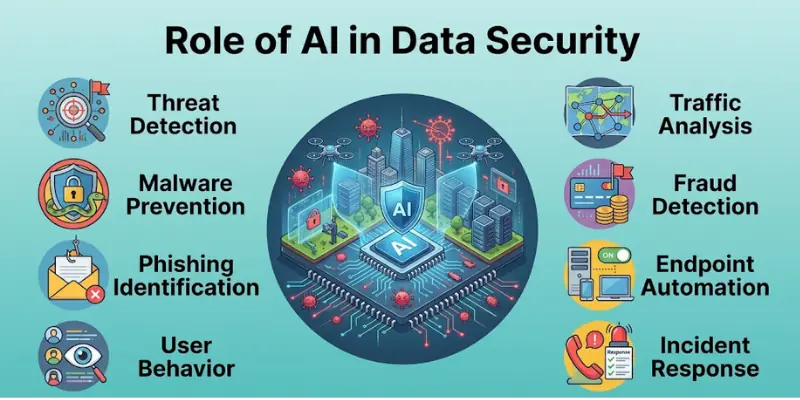
I believe AI is not here to replace security teams but to empower them to detect threats, prevent attacks, and manage risks effectively. This guide explores the role of AI in data security and how it strengthens protection for businesses and individuals.
Role of AI in Data Security
Here are the key roles AI plays in data security:
- Threat Detection and Anomaly Detection
- Malware and Ransomware Prevention
- Phishing Attack Identification
- User Behavior Monitoring
- Network Traffic Analysis
- Fraud Detection in Financial Systems
- Endpoint Security Automation
- Security Incident Response
- Data Privacy and Compliance Monitoring
- Predictive Cybersecurity Risk Management
Let us learn about each in detail.
1. Threat Detection and Anomaly Detection
AI can analyze network traffic and system activity to detect unusual behavior. I’ve seen it identify suspicious activity in seconds that humans might miss. This helps security teams respond quickly to potential threats. AI improves accuracy and reduces false positives.
How to use: Implement AI monitoring tools on networks and systems.
Popular Tools: Darktrace, Vectra AI, Cynet AI
Benefits:
- Detects threats in real time
- Reduces human error
- Enhances overall security posture
- Supports proactive response
Challenges:
- Needs large datasets for accurate detection
- Can produce false alerts if not tuned properly
Intelligent monitoring helps security teams identify suspicious activity and respond quickly. This strengthens data security and reduces potential cyber risks.
2. Malware and Ransomware Prevention
AI identifies malicious software before it can harm systems. I’ve seen it analyze files and processes faster than traditional antivirus software. This protects sensitive data from theft or corruption. AI also predicts new malware patterns.
How to use: Deploy AI powered antivirus and threat detection platforms.
Popular Tools: Cylance AI, Sophos AI, CrowdStrike AI
Benefits:
- Detects known and unknown malware
- Prevents ransomware attacks
- Reduces manual scanning efforts
- Protects critical data
Challenges:
- Requires constant updates for new threats
- Needs integration with existing security systems
Advanced security tools help detect malware and prevent ransomware attacks. This protects sensitive information and reduces the risk of data loss.
3. Phishing Attack Identification
AI can detect phishing emails and fake websites automatically. I’ve seen it block malicious messages before employees even open them. This reduces the risk of credential theft and fraud. AI improves email security and awareness.
How to use: Integrate AI email security solutions with corporate inboxes.
Popular Tools: Proofpoint AI, Barracuda AI, Mimecast AI
Benefits:
- Blocks phishing emails in real time
- Protects sensitive credentials
- Reduces human error
- Enhances employee security awareness
Challenges:
- Requires continuous learning for new phishing techniques
- May occasionally flag legitimate emails
Smart email security systems help identify phishing attempts before they cause harm. These tools protect user credentials and reduce the risk of online fraud.
4. User Behavior Monitoring
AI tracks user actions to detect unusual or suspicious behavior. I’ve seen it identify insider threats and potential data leaks quickly. This helps organizations prevent unauthorized access. AI enhances accountability and security oversight.
How to use: Apply AI monitoring software on user accounts and systems.
Popular Tools: Securonix, Exabeam, ObserveIT AI
Benefits:
- Detects insider threats
- Improves monitoring efficiency
- Alerts teams to unusual activity
- Supports compliance reporting
Challenges:
- Privacy concerns must be managed
- Needs clear rules for alerts
Intelligent monitoring helps organizations identify unusual user activity and potential data leaks. Proper oversight improves access control while respecting employee privacy.
5. Network Traffic Analysis
AI analyzes network traffic to identify attacks or vulnerabilities. I’ve seen it spot suspicious patterns in real time. This helps prevent breaches and maintain network integrity. AI ensures continuous monitoring without fatigue.
How to use: Deploy AI network monitoring tools to track traffic.
Popular Tools: Darktrace, Cisco AI Security, Fortinet AI
Benefits:
- Detects anomalies quickly
- Prevents network intrusions
- Reduces downtime
- Supports threat investigation
Challenges:
- High traffic volumes can require robust computing
- Must tune AI models for accuracy
Advanced network analytics help detect suspicious traffic and potential intrusions. Continuous monitoring strengthens network security and reduces the risk of breaches.
6. Fraud Detection in Financial Systems
AI detects fraudulent transactions in banking and finance. I’ve seen it flag unusual payments and patterns instantly. This protects both businesses and customers. AI reduces financial losses and improves trust.
How to use: Integrate AI into transaction monitoring and fraud detection systems.
Popular Tools: SAS Fraud AI, FICO AI, Feedzai AI
Benefits:
- Detects fraud in real time
- Reduces false positives
- Protects financial assets
- Enhances customer confidence
Challenges:
- Needs historical transaction data
- Complex fraud patterns may require model tuning
Smart fraud detection tools identify unusual transactions and suspicious payment patterns. This helps protect financial assets and build customer trust.
7. Endpoint Security Automation
AI protects devices like laptops, mobile phones, and IoT systems. I’ve seen it automatically block threats and apply patches. This reduces the workload for IT teams. AI ensures consistent protection across all endpoints.
How to use: Deploy AI endpoint protection platforms across devices.
Popular Tools: CrowdStrike Falcon, SentinelOne AI, Kaspersky AI
Benefits:
- Prevents device level attacks
- Automates threat response
- Reduces IT workload
- Enhances overall security coverage
Challenges:
- Requires device compliance
- Needs regular AI model updates
Intelligent endpoint protection helps secure computers, mobile devices, and connected systems. Automated threat responses reduce IT workloads and improve data protection.
8. Security Incident Response
AI helps teams respond faster to breaches and attacks. I’ve seen it prioritize threats, suggest actions, and automate mitigation steps. This reduces damage and recovery time. AI improves overall incident management efficiency.
How to use: Use AI incident response platforms integrated with security operations.
Popular Tools: Palo Alto Cortex XDR, IBM QRadar AI, Siemplify AI
Benefits:
- Speeds up incident response
- Reduces impact of breaches
- Automates repetitive tasks
- Supports decision making under pressure
Challenges:
- Requires integration with multiple systems
- Must be monitored by security experts
Automated security tools help teams identify incidents and prioritize urgent threats. Faster responses can limit damage and improve recovery.
9. Data Privacy and Compliance Monitoring
AI ensures organizations comply with privacy regulations like GDPR or HIPAA. I’ve seen it detect unauthorized data access or policy violations quickly. This helps avoid penalties and data misuse. AI strengthens regulatory compliance.
How to use: Implement AI compliance monitoring tools on databases and applications.
Popular Tools: OneTrust AI, BigID AI, TrustArc AI
Benefits:
- Monitors compliance continuously
- Detects violations in real time
- Supports reporting and auditing
- Protects sensitive information
Challenges:
- Needs up to date regulatory knowledge
- False positives may occur
Intelligent compliance tools help detect policy violations and unauthorized data access. Continuous monitoring supports regulatory compliance and protects sensitive information.
10. Predictive Cybersecurity Risk Management
AI predicts potential cyber risks before they happen. I’ve seen it analyze trends, vulnerabilities, and historical incidents to anticipate attacks. This helps teams plan preventive measures. AI enables proactive security rather than reactive responses.
How to use: Input historical and system data into AI risk prediction platforms.
Popular Tools: RiskIQ AI, Bitdefender AI, CrowdStrike Falcon AI
Benefits:
- Identifies potential threats early
- Improves planning and defense strategies
- Reduces chances of breach
- Supports proactive cybersecurity
Challenges:
- Requires continuous data updates
- Predictions need expert review
Predictive analytics help security teams identify vulnerabilities and anticipate potential attacks. Proactive risk management strengthens cyber defences and reduces the likelihood of data breaches.
Future of AI in Data Security
AI is expected to dominate cybersecurity by 2030. According to Gartner, over 75% of organizations will use AI driven security tools to detect threats, manage risks, and respond to incidents.
AI will move the industry toward real time threat prevention, automated response, and predictive risk management. I believe AI will enhance human teams rather than replace them, making data protection faster, smarter, and more reliable. The future promises safer digital environments and stronger cybersecurity frameworks.
Final Note
In this guide, we explored the role of AI in data security through ten major areas, from threat detection to predictive risk management.
I’ve seen how AI helps security teams prevent breaches, reduce errors, and make faster decisions. The future isn’t about replacing humans; it’s about collaborating with AI to protect sensitive information and secure digital systems effectively.
FAQs: AI in Data Security
Artificial intelligence is transforming data security by detecting cyber threats, preventing data breaches, and protecting sensitive information. Here are answers to common questions about how AI helps organizations improve cybersecurity and data protection.
1. How does AI help in data security?
AI monitors networks, systems, and applications to identify suspicious activity in real time. It helps security teams respond proactively, reduce potential breaches, and strengthen data protection.
2. Can AI detect malware and ransomware?
Yes, AI identifies malicious software by analyzing files and suspicious behavior. Key benefits include:
- Detecting known and emerging malware
- Identifying ransomware activity
- Reducing the risk of data loss
- Supporting faster threat responses
Tools such as Cylance and CrowdStrike Falcon offer malware and endpoint protection capabilities.
3. How does AI prevent phishing attacks?
Intelligent email security systems scan messages, links, and websites for signs of phishing. The process typically involves:
- Examining email content and sender information.
- Identifying suspicious links or attachments.
- Flagging or blocking potentially harmful messages.
- Alerting security teams when necessary.
Tools such as Proofpoint and Mimecast provide email security solutions that help protect sensitive credentials.
4. Can AI monitor user behavior for security?
Yes, AI analyzes user activity to identify unusual access patterns and potential insider threats.
| Monitoring function | Security benefit |
| Login analysis | Flags unusual sign in activity |
| Access monitoring | Identifies suspicious data access |
| Behavior analysis | Detects deviations from normal activity |
| Security alerts | Helps teams investigate potential threats |
Solutions such as Securonix and Exabeam support user and entity behavior analytics.
5. How does AI help in network traffic analysis?
AI examines network traffic to identify unusual patterns, suspicious connections, and possible intrusions. Tools such as Darktrace and Cisco security solutions help security teams monitor network activity and investigate potential threats.
6. Can AI detect financial fraud?
Yes, AI analyzes financial transactions to identify suspicious payments and unusual spending patterns. It can help organizations:
- Flag potentially fraudulent transactions
- Detect abnormal payment activity
- Reduce financial losses
- Protect customers and businesses
Platforms such as SAS and Feedzai offer AI powered fraud detection capabilities.
7. How does AI automate endpoint security?
AI helps protect laptops, mobile phones, servers, and IoT devices by detecting threats and supporting automated responses.
Endpoint security checklist:
- Monitor connected devices for suspicious activity.
- Identify malware and potential vulnerabilities.
- Isolate compromised devices when appropriate.
- Support security updates and remediation.
Tools such as CrowdStrike Falcon and SentinelOne help organizations manage endpoint threats and improve security operations.
8. Can AI assist in security incident response?
Yes, AI helps security teams prioritize alerts, investigate suspicious activity, and respond to cyber incidents more efficiently. The response process generally includes:
- Detecting a potential security incident.
- Assessing its severity and possible impact.
- Recommending or automating approved response actions.
- Supporting recovery and incident reporting.
Platforms such as Palo Alto Cortex XDR and IBM QRadar support security monitoring and incident investigation.
9. How does AI ensure data privacy and compliance?
AI helps organizations monitor access to sensitive information and identify possible policy violations. It can support compliance efforts involving regulations such as GDPR and HIPAA, but organizations must still verify requirements and maintain appropriate human oversight.
Tools such as OneTrust and BigID provide data privacy, governance, and compliance capabilities.
10. Can AI predict cybersecurity risks?
Yes, AI analyzes historical incidents, system activity, and vulnerability information to identify potential security risks.
| Step | How it helps |
| Analyze past incidents | Identifies recurring threat patterns |
| Assess vulnerabilities | Highlights potential weaknesses |
| Predict risks | Estimates where problems may arise |
| Plan preventive action | Helps teams prioritize security measures |
Solutions from providers such as Bitdefender and CrowdStrike support different aspects of threat detection and risk management. Human review remains essential because predictions are not guarantees.




- Be Respectful
- Stay Relevant
- Stay Positive
- True Feedback
- Encourage Discussion
- Avoid Spamming
- No Fake News
- Don't Copy-Paste
- No Personal Attacks
- Be Respectful
- Stay Relevant
- Stay Positive
- True Feedback
- Encourage Discussion
- Avoid Spamming
- No Fake News
- Don't Copy-Paste
- No Personal Attacks
