Role of AI in Customer Experience in 2026 – How AI Solves Problems Faster
Published: 19 Nov 2026
AI in customer experience means using smart tools to make customers feel heard, valued, and happy.
I have seen that it helps businesses talk to customers faster, understand them better, and solve their problems quickly. From chatbots to product suggestions, it changes how companies connect with people.
In this article, we will explore what the role of AI in customer experience really means, its benefits, challenges, and what the future holds.
Duty of AI in Customer Experience
So, to understand the role of AI in customer experience, we need to look at how AI is used in real situations. It studies customer data, gives quick replies, and learns what people like. I have noticed that this makes customer service smoother and more personal.
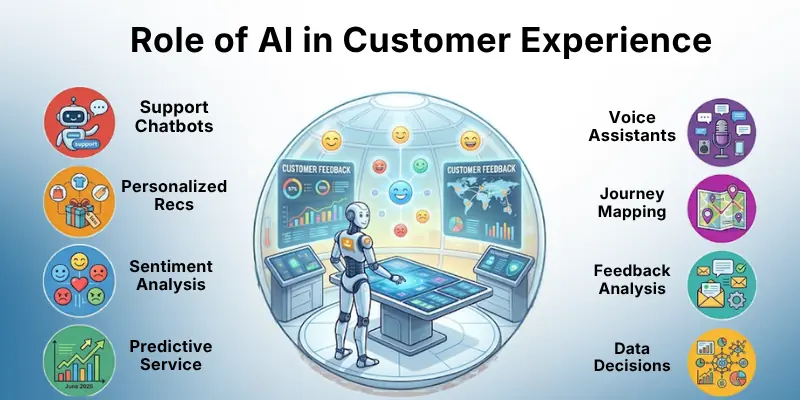
Let’s see the main roles where AI improves the customer journey from start to end.
Main Roles of AI in Customer Experience:
- Customer Support Chatbots
- Personalized Recommendations
- Sentiment Analysis
- Predictive Customer Service
- Voice and Virtual Assistants
- Customer Journey Mapping
- Feedback Analysis
- Automated Email and Message Response
- Data Driven Decision Making
- Complaint Management
- Omnichannel Support
- Customer Retention Prediction
- Product and Service Personalization
- Real Time Assistance
- Emotion Recognition
Let’s now cover each role in detail.
1. Customer Support Chatbots
AI chatbots talk to customers 24/7. They can answer questions, solve basic problems, and send updates. I have seen them handle thousands of chats at once. They make customer service faster and reduce waiting time. This improves satisfaction and saves staff time.
Benefits:
- Replies quickly to customer questions.
- Works all day and night without breaks.
- Reduces workload for support teams.
- Keeps response quality consistent.
Example: E-commerce sites use chatbots to help with orders or refunds.
2. Personalized Recommendations
AI studies what customers buy, like, or search for. It then shows them products or services they might want next. I have seen this make shopping or browsing more enjoyable. It feels like a personal helper suggesting useful things. This helps companies sell more and improve user happiness.
Benefits:
- Gives customers a personal shopping experience.
- Increases product sales and engagement.
- Builds trust by showing relevant offers.
Example: Streaming apps recommend shows or songs using viewing data.
3. Sentiment Analysis
AI reads customer reviews, posts, and messages. It checks if people are happy, sad, or angry. I have seen it help companies understand real emotions. This lets teams fix issues before they grow bigger. It improves customer trust and relationships.
Benefits:
- Helps detect unhappy customers quickly.
- Improves brand image through timely response.
- Gives clear insight into public opinion.
Example: Social media tools use sentiment AI to study user comments.
4. Predictive Customer Service
AI predicts what customers might need or ask next. It studies behavior patterns and past interactions. I have seen it warn companies before a customer complains. This helps them solve issues early. It makes the experience smoother and more caring.
Benefits:
- Fixes problems before customers notice.
- Improves loyalty and trust.
- Reduces complaint volume.
Example: Telecom companies use AI to predict when users face network issues.
5. Voice and Virtual Assistants
AI voice tools talk to customers using natural speech. They help people find information or complete actions hands free. I find them useful in banks, airlines, and online stores. They make service simple for everyone, even without screens. This builds stronger engagement with users.
Benefits:
- Easy to use and quick.
- Improves accessibility for all users.
- Saves customer time with instant answers.
Example: Virtual assistants like Alexa or Siri handle user queries daily.
6. Customer Journey Mapping
AI studies how people move through a website or store. It tracks every click or step of the journey. I have seen it show where customers get stuck. This helps teams improve the buying process. It ensures customers have a smooth and happy path.
Benefits:
- Finds weak spots in the customer journey.
- Improves website flow and navigation.
- Helps increase conversions.
Example: Online stores use AI to track which pages users leave quickly.
7. Feedback Analysis
AI studies feedback forms and surveys quickly. It groups answers by topic or mood. I have seen it find patterns that humans might miss. This helps businesses know what customers really think. It supports better planning and service updates.
Benefits:
- Saves time by reading many reviews fast.
- Highlights key areas to improve.
- Guides decisions with real customer input.
Example: Airlines use AI to review passenger surveys and improve services.
8. Automated Email and Message Response
AI answers emails and messages with quick replies. It can handle simple queries without human help. I have seen it save hours for support teams. This keeps response times short and customers happy. It also ensures no message is missed.
Benefits:
- Speeds up message replies.
- Improves communication quality.
- Reduces staff workload.
Example: Banks use AI to answer simple account or payment questions.
9. Data Driven Decision Making
AI studies customer data to find insights. It helps managers understand what works best. I have seen it guide product updates and marketing. It makes choices based on facts, not guesses. This leads to smarter and faster results.
Benefits:
- Improves accuracy in planning.
- Reduces the chance of poor decisions.
- Saves time and effort in data study.
Example: Retailers use AI dashboards to track and adjust sales trends.
10. Complaint Management
AI helps organize and track customer complaints. It prioritizes urgent ones automatically. I have seen it help companies fix issues faster. It also gives insights into common problems. This makes customer care more efficient.
Benefits:
- Sorts and tracks complaints easily.
- Speeds up issue resolution.
- Reduces customer frustration.
Example: Telecom services use AI to classify and handle user complaints.
11. Omnichannel Support
AI helps connect all customer service channels in one place. It links chats, calls, emails, and social media messages. I have seen it keep track of each customer across platforms. This means the same support continues even if a customer switches channels. It saves time and reduces confusion for both sides. AI makes every conversation connected and smooth.
Benefits:
- Keeps support consistent across all channels.
- Saves customer time by remembering past talks.
- Reduces errors caused by switching platforms.
- Improves teamwork between different departments.
Example: A bank uses AI to link its app chat, call center, and email so every agent sees the full conversation history.
12. Customer Retention Prediction
AI studies customer actions and purchase history. It finds signs that show if someone might stop buying or leave. I have seen it warn companies early about unhappy users. This gives time to offer help, discounts, or personal attention. It turns at-risk customers into loyal ones. This is how AI helps companies keep their audience.
Benefits:
- Predicts when customers might stop using a service.
- Helps prevent churn with early action.
- Build stronger, longer relationships.
- Improves customer lifetime value.
Example: Subscription apps use AI to detect when users lose interest and send offers to keep them active.
13. Product and Service Personalization
AI studies what customers like, buy, and search for. It helps create offers, designs, or content suited to each person. I have seen it make customers feel special and understood. It’s like having a personal assistant suggesting the right things. This builds stronger trust and improves sales. AI makes every interaction unique to each user.
Benefits:
- Gives customers what they want faster.
- Increases user happiness and loyalty.
- Boosts product sales and brand image.
- Makes marketing more effective.
Example: Online stores show personalized product lists based on browsing history.
14. Real Time Assistance
AI gives instant help while the customer is using a product or service. It can detect confusion and offer support right away. I have seen it make customer help faster than calling or emailing. This stops frustration and builds confidence in the brand. It feels like someone is always ready to help. AI keeps the support system active every second.
Benefits:
- Gives help right when needed.
- Reduces waiting time and frustration.
- Improves trust and satisfaction.
- Helps users finish their goals easily.
Example: Travel sites use AI pop ups to guide users while booking flights or hotels.
15. Emotion Recognition
AI tools can study voice, text, or facial cues. They detect how a customer feels: happy, sad, or upset. I have seen this help support teams respond better. It lets the system choose the right tone and message. This improves emotional connection with customers. AI makes support feel more human and caring.
Benefits:
- Understands real emotions during conversations.
- Helps agents reply with empathy.
- Improves relationships with customers.
- Reduces negative experiences and complaints.
Example: Call centers use AI to study voice tone and suggest calmer replies to upset customers.
Benefits of AI in Customer Experience
I have seen how AI makes customer experience smoother and better. It helps both the company and the customer at the same time.
Benefits (Overall):
- Speeds up customer service.
- Makes communication more personal.
- Improves product suggestions and offers.
- Helps find and fix problems early.
- Increases customer loyalty and trust.
- Reduces work for human agents.
- Gives clear insight into customer needs.
Overall, AI helps businesses improve customer service, understand customer needs, provide personalized support, and build stronger customer relationships.
Challenges of AI in Customer Experience
I have also noticed that AI brings some challenges that must be managed carefully.
Challenges (Overall):
- Some customers still prefer talking to real people.
- AI tools can misunderstand emotions or tone.
- Data privacy and security are big concerns.
- Setting up AI systems can be costly.
- Requires regular updates and training.
- May give wrong suggestions if data is poor.
Overall, businesses must address these challenges carefully to use AI effectively while protecting customer data, improving accuracy, and maintaining the human touch in customer service.
Future of AI in Customer Experience
The future of AI in customer experience looks bright. According to studies, over 80% of companies plan to use AI for better customer service by 2026. The market for AI in customer experience is expected to reach $30 billion by 2030. More brands are adding chatbots, personalization tools, and analytics to connect with customers faster. I believe the future will be about more personal, emotional, and helpful customer experiences powered by AI.
Final Note
In this guide, we explored the role of AI in customer experience in simple and clear terms. We saw how it helps in support, personalization, analysis, and customer journeys. I also shared benefits, challenges, and what to expect in the future. AI is not here to replace people but to make every customer interaction smoother and more personal. Let’s now check out some FAQs!
FAQs: Customer Experience and AI
Artificial intelligence is transforming customer experience by helping businesses solve problems faster, personalize interactions, and improve customer satisfaction. Here are answers to common questions about AI in customer experience and its benefits for modern businesses.
Here are some of the most commonly asked questions related to AI in customer experience.
1. How does artificial intelligence for customer experience work?
Artificial intelligence for customer experience analyzes customer data from chats, emails, and social media to understand customer needs. It helps businesses provide faster responses, personalized recommendations, and more helpful support.
2. What is customer experience automation?
Customer experience automation uses AI to handle routine customer service tasks automatically, such as:
- Answering frequently asked questions
- Tracking orders and providing updates
- Collecting customer feedback
- Directing complex issues to the right support agent
This saves time, reduces waiting, and improves customer satisfaction.
3. What are some client experience solutions powered by AI?
AI powered client experience solutions help businesses improve communication and build stronger client relationships. Common examples include:
| AI solution | How it helps |
| AI chatbots | Answer client questions quickly |
| Recommendation systems | Suggest relevant products or services |
| Sentiment analysis | Identify client feelings and concerns |
| Predictive analytics | Anticipate client needs |
These tools make client interactions smoother and easier to manage.
4. How does technology for customer experience make service better?
Customer experience technology improves service by helping businesses understand customer needs and resolve issues efficiently. Tools such as chatbots, customer relationship management (CRM) systems, and AI analytics can provide faster support, useful insights, and more personalized interactions.
5. What is customer engagement AI used for?
Customer engagement AI helps businesses connect with customers through timely, relevant, and personalized communication. Its common uses include:
- Sending personalized offers and messages
- Recommending relevant products
- Answering customer questions
- Identifying opportunities to improve engagement
These features help keep customers interested and connected with a brand.
6. What does CX AI mean in business?
CX AI means using artificial intelligence to improve customer experience (CX). Businesses can use it to predict customer needs, personalize interactions, and improve service quality.
Key benefits of CX AI include:
- Better customer satisfaction
- Faster problem resolution
- More personalized service
- Improved business decisions
7. Can you give examples of artificial intelligence in customer service?
Yes. Common examples of artificial intelligence in customer service include:
- AI chatbots: Answer common questions around the clock.
- Voice assistants: Respond to spoken questions and requests.
- AI help centers: Find relevant answers from support resources.
- Agent assist tools: Help customer service agents resolve complex issues.
These technologies make customer support faster while allowing human agents to focus on more challenging problems.
8. What is AI customer journey mapping?
AI customer journey mapping uses customer data to understand how people interact with a business across its website, app, and other channels.
How it works:
- Collect data about customer interactions.
- Identify patterns and points where customers lose interest.
- Discover problems in the customer journey.
- Improve the experience using data driven insights.
This helps businesses remove obstacles and create smoother customer journeys.
9. How AI can improve customer experience in companies?
AI can improve customer experience in companies by making service faster, smarter, and more personalized. Businesses can follow this simple checklist:
- Use chatbots to answer common questions quickly.
- Analyze customer behavior to understand needs.
- Personalize recommendations and offers.
- Detect service problems and resolve them sooner.
- Use customer feedback to improve future interactions.
These strategies help companies build trust and strengthen long term customer relationships.
10. How are CX and AI connected in modern businesses?
Customer experience (CX) focuses on how customers interact with and feel about a business, while AI provides tools to make those interactions more effective.
| Customer experience goal | How AI supports it |
| Faster service | Automates routine responses |
| Personalization | Tailors content and recommendations |
| Better decisions | Analyzes customer data |
| Higher satisfaction | Identifies issues and improves support |
Together, CX and AI help modern businesses deliver more convenient, relevant, and consistent customer experiences.






- Be Respectful
- Stay Relevant
- Stay Positive
- True Feedback
- Encourage Discussion
- Avoid Spamming
- No Fake News
- Don't Copy-Paste
- No Personal Attacks
- Be Respectful
- Stay Relevant
- Stay Positive
- True Feedback
- Encourage Discussion
- Avoid Spamming
- No Fake News
- Don't Copy-Paste
- No Personal Attacks
