Role of AI in Customer Service in 2026 – Future Tech in Modern Support
Published: 30 Oct 2026
Guys, to understand the role of AI in customer service, we need to look at how smart tools help businesses talk to customers better.
I have seen how technology is changing support systems fast. It helps answer questions, solve problems, and give fast replies any time of the day. It saves time for both customers and companies.
In this guide, I’ll share how AI is used in customer service, its key roles, benefits, challenges, and future.
Role of AI in Customer Service
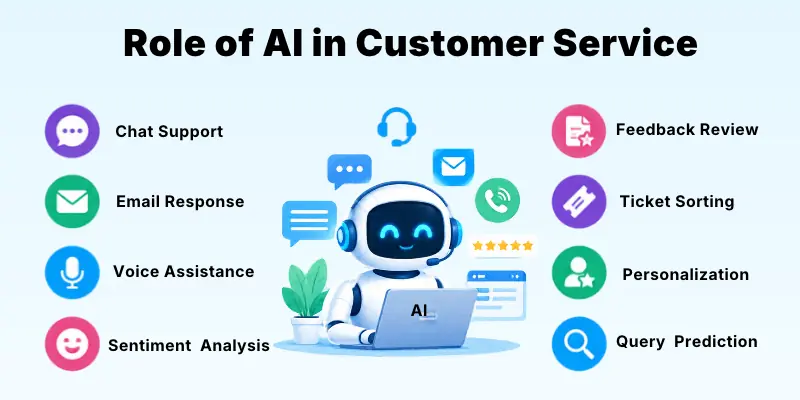
Here are the main roles of AI in customer service:
- Chat Support
- Email Response
- Voice Assistance
- Sentiment Analysis
- Feedback Review
- Ticket Sorting
- Personalization
- Query Prediction
- Knowledge Sharing
- Complaint Tracking
- Response Automation
- Virtual Agent
- Customer Insights
- Multilingual Support
- Service Optimization
Let’s cover all these applications of AI in customer service.
1. Chat Support
I often use chat tools to talk with customers instantly. They reply fast and never get tired. I can help people anytime without waiting. It makes support smoother and more friendly. Customers feel heard right away.
Benefits:
- 24/7 instant reply
- Reduces wait time
- Improves customer trust
Examples:
- Chatbots on websites
- Live chat auto answers
Intelligent chat tools make customer service faster, easier, and more accessible around the clock. They help businesses deliver quick answers while keeping customers engaged.
2. Email Response
I spend a lot of time replying to emails. Smart tools help write and sort emails faster. They understand questions and suggest ready answers. This saves me time and keeps responses clear. It helps me stay organized.
Benefits:
- Faster email replies
- Reduces workload
- Keeps tone consistent
Examples:
- Auto email drafts
- Smart sorting for urgent mails
Smart email solutions help teams manage large numbers of customer messages without losing response quality. Faster and clearer replies can improve both productivity and customer satisfaction.
3. Voice Assistance
Many people prefer to talk instead of type. I use voice systems that understand customer words and reply clearly. They help in phone support and mobile apps. It feels more natural and simple. I like how it makes communication quick.
Benefits:
- Easy voice based help
- Reduces call center load
- Improves user comfort
Examples:
- Phone support bots
- Smart voice assistants in apps
Voice based support makes customer communication more natural and convenient. Automated voice solutions can handle common requests while reducing pressure on human support teams.
4. Sentiment Analysis
I always want to know how customers feel about my service. Smart tools read their tone and words to know if they are happy or upset. This helps me act fast when someone is not satisfied. It makes support more human and caring.
Benefits:
- Tracks customer mood
- Improves response tone
- Builds better relationships
Examples:
- Analyzing feedback tone
- Detecting unhappy customers online
Sentiment analysis gives businesses a clearer view of customer feelings and concerns. Understanding customer emotions helps teams provide more helpful and personalized support.
5. Feedback Review
I get lots of feedback every day. It takes time to read them all, but tools can scan and group them fast. I can see common problems in seconds. It helps me plan better changes.
Benefits:
- Saves review time
- Finds key issues fast
- Improves service quality
Examples:
- Analyzing survey results
- Sorting app reviews
Data driven feedback tools turn large amounts of customer opinions into useful insights. Businesses can use these insights to find service gaps and improve the overall customer experience.
6. Ticket Sorting
I manage many service requests. Smart systems sort tickets by topic or urgency. I can solve serious issues first. This makes my workflow smooth and simple.
Benefits:
- Fast ticket handling
- Better task priority
- Reduces customer wait time
Examples:
- Sorting tickets by keywords
- Grouping similar problems
Automated ticket management helps support teams organize requests and focus on urgent problems first. This improves workflow efficiency and helps customers receive timely assistance.
7. Personalization
I love making support more personal. Smart tools help me remember customer history and preferences. I can give custom replies that feel real and warm. It improves customer trust and loyalty.
Benefits:
- Makes service personal
- Improves user experience
- Builds long term trust
Examples:
- Personalized recommendations
- Custom replies in chat
Personalized support makes customers feel understood rather than treated like just another ticket. Smart customer service tools can use past interactions to create more relevant experiences.
8. Query Prediction
I can now guess what customers might ask next. Smart tools study past chats and predict questions. This helps me prepare quick answers in advance. It makes service faster and smarter.
Benefits:
- Predicts common issues
- Reduces response time
- Improves team efficiency
Examples:
- Auto suggested replies
- Anticipating order related queries
Predictive support tools help businesses understand what customers may need before they ask. This can reduce response times and create a faster, more proactive service experience.
9. Knowledge Sharing
I use smart systems to share helpful articles and guides. They find the best answers for each problem. Customers can solve many issues themselves. It saves my time and helps users learn too.
Benefits:
- Promotes self service
- Reduces support load
- Improves problem solving
Examples:
- Auto FAQ suggestions
- Knowledge base search tools
Intelligent knowledge systems make useful information easier for customers to find on their own. This improves self service while reducing the workload on customer support teams.
10. Complaint Tracking
I always track complaints to ensure nothing is missed. Smart tools record and follow every issue until it’s fixed. I can update customers faster. It builds their trust in the service.
Benefits:
- Tracks every complaint
- Improves response accuracy
- Increases customer trust
Examples:
- Issue tracking dashboards
- Automated status updates
Automated complaint tracking helps businesses follow customer issues from the first report to final resolution. Better tracking can improve response quality and strengthen customer trust.
11. Response Automation
I save time by automating basic responses. Systems send instant answers for common questions. This gives me time for complex issues. Customers like fast replies.
Benefits:
- Reduces manual work
- Speeds up replies
- Keeps service active 24/7
Examples:
- Auto messages for FAQs
- Instant ticket updates
Automated response systems handle repetitive questions quickly while allowing human agents to focus on more complex problems. This creates faster and more efficient customer support.
12. Virtual Agent
Virtual agents act like my online assistants. They can chat, call, or text with users. They handle most simple tasks alone. I step in only when needed. It makes service smooth.
Benefits:
- Handles common tasks
- Frees human agents
- Reduces cost
Examples:
- Smart chat bots
- Automated voice agents
Virtual agents provide quick assistance across chat, voice, and messaging platforms. These digital assistants can handle routine tasks and pass complex issues to human agents when needed.
13. Customer Insights
I always want to know what customers expect. Smart tools study data and show clear insights. I can see what’s working and what’s not. It helps improve my service plans.
Benefits:
- Better decision making
- Improves service quality
- Boosts customer loyalty
Examples:
- Analyzing chat data
- Tracking support satisfaction
Customer data analysis helps businesses understand common needs, preferences, and service problems. These insights support smarter decisions and help improve long term customer satisfaction.
14. Multilingual Support
I serve people from different regions. Smart tools help translate and reply in many languages. Customers feel more comfortable this way. It helps me reach more users easily.
Benefits:
- Supports global users
- Removes language barriers
- Increases service reach
Examples:
- Instant translation in chat
- Multilingual support centers
Language technology helps businesses communicate with customers from different regions more easily. Multilingual service removes communication barriers and creates a more inclusive customer experience.
15. Service Optimization
I keep improving my service based on data. Smart tools study reports and find weak points. I can plan changes fast. It helps make support more efficient.
Benefits:
- Improves workflow
- Increases speed
- Saves company resources
Examples:
- Analyzing service reports
- Optimizing response routes
Data driven service optimization helps businesses identify weak areas and improve support processes. Smarter workflows can save time, reduce costs, and deliver a better customer experience.
Benefits of AI in Customer Service
Smart customer service solutions can improve support for everyone, from frontline agents to company owners. They help make communication faster, smoother, and more personalized. Here’s how it helps every person involved in customer service:
- Customer Support Agent: I solve more queries faster and with less effort.
- Team Leader: I track performance easily and train better.
- Manager: I save money and improve customer satisfaction.
- Customer: I get quick, accurate, and friendly help anytime.
- Company Owner: I build stronger trust and long term loyalty.
These benefits can save time, improve service quality, and create stronger customer relationships. Intelligent support tools also help businesses build lasting trust and loyalty.
Challenges of AI in Customer Service
Although intelligent customer service tools offer many advantages, businesses may also face challenges during their use. These issues can affect cost, privacy, human interaction, and system performance. Even with all its power, there are some challenges too.
- Lack of Human Touch: Automated replies can feel robotic.
- Limited Understanding: Systems may miss complex emotions.
- Training Costs: Setup and updates can be costly.
- Privacy Issues: Customer data must be handled safely.
- Integration Problems: Older systems may not connect well.
Managing these challenges requires careful planning, secure data practices, and human oversight. A balanced approach can help businesses gain the benefits of automation without losing the personal touch.
Future of AI in Customer Service
I believe the future of AI in customer service will be very strong. Support will become faster and more personal. Systems will understand emotions better and give friendlier replies. I see a time when customer service will work smoothly 24/7 without stress for anyone.
Final Note
In this guide, we have covered everything about the role of AI in customer service in detail. I shared how it helps teams, customers, and companies. It’s already making support smarter and more personal. Thank you for reading! Stay connected for my next guides where I’ll cover AI in marketing and AI in e-commerce, and how they are shaping customer experience.
FAQs on AI in Customer Service
Here are some common questions about AI and customer service. These quick answers explain how intelligent tools can improve communication, support, and customer experiences.
1. What is customer care AI?
Customer care AI means using intelligent tools to help customers quickly and efficiently. It can answer common questions, provide instant support, and offer 24/7 assistance while reducing customer wait times.
2. How does artificial intelligence in customer relationship management help businesses?
Artificial intelligence in customer relationship management helps businesses understand and manage customer needs through:
- Customer Data: Tracks preferences and past interactions.
- Behavior Analysis: Shows what customers like or dislike.
- Routine Tasks: Automates repetitive support work.
- Better Insights: Helps teams make smarter service decisions.
3. What is AI chat customer service used for?
AI chat customer service helps users get quick assistance through online conversations. It can:
- Answer frequently asked questions.
- Guide customers through simple problems.
- Provide product or service information.
- Transfer complex issues to human agents.
4. How does artificial intelligence customer support improve response time?
It improves response time through a simple process:
- Receives the request: The system understands the customer’s question.
- Find an answer: Relevant information is quickly identified.
- Provides a response: The customer receives an instant reply.
- Escalates when needed: Complex issues can be sent to a human agent.
5. How can AI customer experience make users happier?
Smart customer experience tools can study feedback, preferences, and previous interactions. They use these insights to provide more relevant support, helping customers feel valued and understood.
6. What are AI-powered services in customer care?
AI-powered services can support different communication channels and make customer care more efficient.
| Service | Main Purpose |
| Chatbots | Answer common questions |
| Email Tools | Draft and organize replies |
| Voice Assistants | Handle basic voice requests |
| Feedback Analysis | Understand customer opinions |
These services help businesses provide faster support while handling large numbers of customer requests.
7. How does AI support work in daily customer service?
AI support assists customer service agents during their daily tasks. It can suggest replies, find useful customer information, and automate repetitive work, helping agents provide faster and more accurate answers.
8. What is an AI agent for customer service?
An AI agent for customer service works like a digital support assistant. It can:
- Chat with customers.
- Answer simple questions.
- Handle routine requests.
- Transfer difficult issues to human staff.
This keeps customer support organized and reduces the workload on service teams.
9. Why do companies use AI software for customer service?
Companies use AI software for customer service to manage large numbers of requests more efficiently. It helps reduce manual work, speed up responses, lower support costs, and maintain consistent customer communication.
10. How is AI in customer engagement improving communication?
AI in customer engagement helps businesses communicate with customers at the right time and through the right channel. A simple customer engagement process can include:
- Sending personalized updates.
- Providing timely reminders.
- Recommending relevant products or services.
- Collecting and analyzing customer feedback.
- Supporting long term customer relationships.
These personalized interactions can improve customer satisfaction, engagement, and brand loyalty.






- Be Respectful
- Stay Relevant
- Stay Positive
- True Feedback
- Encourage Discussion
- Avoid Spamming
- No Fake News
- Don't Copy-Paste
- No Personal Attacks
- Be Respectful
- Stay Relevant
- Stay Positive
- True Feedback
- Encourage Discussion
- Avoid Spamming
- No Fake News
- Don't Copy-Paste
- No Personal Attacks
