Role of AI in Product Development in 2026 – How AI Builds Better Products
Published: 19 Nov 2026
So guys, to understand the role of AI in product development, we need to see how smart tools help make better products faster.
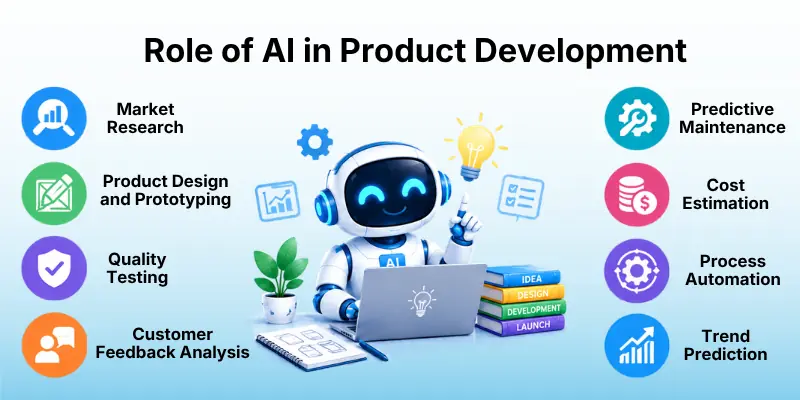
AI in product development means using computer programs to study ideas, design, and test products. I have seen it help companies save time, reduce mistakes, and create products people like. It can study customer feedback, trends, and past designs to suggest improvements.
In this guide, I will explain how AI works in product development, the benefits, challenges, and what the future holds.
Participation of AI in Product Development
Here is a list of the main roles AI plays in product development:
- Idea Generation
- Market Research
- Product Design and Prototyping
- Quality Testing
- Customer Feedback Analysis
- Predictive Maintenance
- Cost Estimation
- Process Automation
- Trend Prediction
- Supply Chain Optimization
- Risk Analysis
- Product Personalization
- Competitor Analysis
- Packaging Design Assistance
- Launch Planning
Let’s now cover each role in detail.
1. Idea Generation
AI helps teams create new product ideas faster. It studies past products, customer needs, and market trends. It compares ideas and shows which ones may work best. I have seen it reduce repeated or low value ideas. This makes brainstorming easier and more productive. AI can even suggest creative ideas humans may miss.
Benefits:
- Saves time by generating multiple ideas fast
- Reduces repeated or unhelpful suggestions
- Focuses team energy on the best ideas
- Improves creativity with smart suggestions
Examples:
- AI tools like IdeaGen suggest new tech product features
- E-commerce sites use AI to create concepts based on trending products
With AI, companies can explore more creative ideas in less time. This helps teams develop innovative products that meet changing customer needs.
2. Market Research
AI studies customer behavior, sales data, and trends. It tells companies what customers want right now. I have seen it find gaps in the market. It checks competitors’ products automatically. This makes research faster and more accurate. AI helps decide which products are most likely to succeed.
Benefits:
- Speeds up research and reduces manual work
- Finds hidden opportunities in customer needs
- Helps plan products with higher chances of success
- Improves understanding of competitors’ strategies
Examples:
- AI tools like Crimson Hexagon analyze social media for insights
- Retail companies use AI to detect trending products
AI helps businesses understand customer needs and identify new market opportunities. This makes it easier to develop products that customers are more likely to want.
3. Product Design and Prototyping
AI suggests design improvements and creates digital prototypes. It tests many variations quickly without building physical models. I have seen it reduce time and cost for design. It predicts which designs may perform best. This improves usability and customer satisfaction. AI helps designers focus on the most promising options.
Benefits:
- Reduces design errors and improves quality
- Saves money by testing virtually first
- Speeds up product development
- Helps create products customers want
Examples:
- Autodesk Dreamcatcher suggests multiple design options
- Car manufacturers test AI generated prototypes digitally
AI helps designers test different ideas before building the final product. This saves time and money while improving product quality.
4. Quality Testing
AI checks products for defects automatically. It can run tests faster than humans. I have seen it find tiny issues that may be missed manually. It ensures products meet quality standards consistently. AI works 24/7 without getting tired. This improves reliability and trust in products.
Benefits:
- Detects defects faster than humans
- Saves time and effort
- Improves customer satisfaction
- Reduces recall and warranty risks
Examples:
- Electronics companies use AI to check devices for faults
- Food companies use AI vision systems to inspect packaging
AI helps detect product defects early and maintain consistent quality. This reduces costly mistakes and gives customers more confidence in the final product.
5. Customer Feedback Analysis
AI reads reviews, surveys, and social media posts. It tells companies what customers like or dislike. I have seen it detect problems early. It shows trends in customer preferences. AI helps teams decide which features to improve next. This guide’s product updates and future development.
Benefits:
- Speeds up analysis of large feedback
- Helps understand customer needs
- Guides product improvement decisions
- Improves satisfaction and loyalty
Examples:
- MonkeyLearn analyzes text feedback for trends
- Apps use AI to study reviews and suggest feature updates
AI turns customer feedback into useful insights for product improvement. This helps businesses fix problems and create better customer experiences.
6. Predictive Maintenance
AI predicts when products may fail or need service. It checks patterns from past performance and data. I have seen it prevent breakdowns and reduce costs. Companies can fix issues before they happen. It works for machines, software, and consumer products. This keeps customers happy and products reliable.
Benefits:
- Reduces downtime and maintenance costs
- Improves product reliability
- Increases customer trust
Examples:
- Manufacturing machines use AI to predict wear and tear
- Vehicle fleets use AI to schedule maintenance
AI helps companies identify possible product failures before they become serious problems. This improves reliability and reduces unexpected maintenance costs.
7. Cost Estimation
AI calculates production costs quickly. It looks at materials, labor, and market prices. I have seen it prevent budget overspending. It helps teams plan affordable products. AI can test different cost scenarios. This makes development more efficient.
Benefits:
- Helps control expenses
- Speeds up budgeting
- Reduces human errors
Examples:
- Software tools use AI to estimate costs for new devices
- Startups use AI to plan production budgets
By comparing materials, labor, and production costs, AI supports smarter financial planning. This helps businesses avoid unnecessary spending during product development.
8. Process Automation
AI automates repetitive tasks like data entry and testing. It saves hours of manual work. I have seen it let teams focus on creative tasks. AI makes workflows smoother and faster. It increases efficiency across departments. Automation reduces human errors in routine tasks.
Benefits:
- Saves time and effort
- Reduces mistakes
- Increases overall productivity
Examples:
- Companies automate testing reports using AI
- Data entry in production systems is automated
By reducing manual work and routine errors, AI makes development processes smoother. This allows teams to focus more on creativity and product improvement.
9. Trend Prediction
AI studies market trends and predicts future demand. It tells which products or features may be popular. I have seen it help companies launch successful products. It reduces the risk of launching unwanted items. AI supports strategic planning and resource allocation. This keeps businesses competitive.
Benefits:
- Helps plan future products
- Reduces launch failures
- Improves understanding of customer needs
Examples:
- Fashion brands predict seasonal trends with AI
- Tech companies forecast feature demand
AI helps businesses predict customer demand and identify emerging market trends. This supports better planning and reduces the risk of launching unwanted products.
10. Supply Chain Optimization
AI manages inventory and predicts stock needs. It helps plan delivery timing and logistics. I have seen it reduce delays and waste. This keeps production smooth. AI improves customer satisfaction and saves costs.
Benefits:
- Reduces inventory waste
- Ensures timely product delivery
- Saves money on logistics
Examples:
- Amazon uses AI to manage warehouse stock
- Manufacturing plants optimize supply chains using AI
With smarter supply chain planning, companies can avoid many delays and stock problems. This supports smoother production and a better customer experience.
11. Risk Analysis
AI identifies risks in development and production. It checks data for possible failures or losses. I have seen it prevent costly mistakes. It helps teams take precautions early. AI reduces uncertainty in planning. This keeps projects on track.
Benefits:
- Helps avoid losses and errors
- Supports safe decision making
- Reduces project failures
Examples:
- Financial risk for new products is assessed by AI
- AI predicts potential production delays
AI helps teams identify potential problems before they become expensive setbacks. This supports safer decisions and keeps product development on track.
12. Product Personalization
AI helps create products suited for individual users. It studies preferences and usage patterns. I have seen companies make custom products easily. This improves satisfaction and loyalty. AI suggests changes based on feedback. It makes products more attractive.
Benefits:
- Increases customer happiness
- Improves sales and loyalty
- Supports targeted improvements
Examples:
- Customized clothing or accessories recommended by AI
- Personalized app features suggested using AI
AI helps companies create products that match individual preferences and needs. This makes products more relevant and can strengthen customer loyalty.
13. Competitor Analysis
AI studies competitor products and strategies. It finds what works and what doesn’t. I have seen it help companies plan better. It keeps businesses ahead in the market. AI monitors pricing, features, and marketing trends. This helps plan competitive products.
Benefits:
- Understand competitors’ strengths and weaknesses
- Improves product planning
- Reduces risk of falling behind
Examples:
- Companies track competitor pricing and features automatically
- Market monitoring tools use AI to detect trends
By tracking competitor features, prices, and market strategies, AI reveals useful insights. This helps teams develop products that stand out in the market.
14. Packaging Design Assistance
AI suggests better packaging designs. It studies materials, costs, and customer preferences. I have seen it improve product appeal. AI checks durability and functionality. It reduces waste and cost. Packaging becomes attractive and practical.
Benefits:
- Creates attractive packaging faster
- Reduces material costs
- Meets customer preferences
Examples:
- Food companies use AI to design eco friendly packaging
- Consumer goods packaging optimized with AI
By comparing packaging designs, materials, and costs, AI helps teams make better choices. This supports appealing, practical, and more cost effective packaging.
15. Launch Planning
AI helps plan the best time and strategy to launch products. It studies market trends and customer interest. I have seen launches succeed more often using AI. AI predicts optimal timing for release. It coordinates production, marketing, and supply. This ensures smoother product launches.
Benefits:
- Increases launch success
- Reduces timing mistakes
- Improves customer reception
Examples:
- Mobile phones launched based on AI predictions
- Seasonal products launched using AI trend data
AI helps businesses choose suitable launch times and coordinate important activities. This improves preparation and gives new products a better chance of reaching the right customers.
Benefits of AI in Product Development
I have noticed that AI brings many advantages to product development. It helps teams work faster, reduce costs, and create better products. With the right tools and planning, companies can improve their product development process.
Key Benefits (Overall):
- AI helps companies develop products faster and save time.
- AI reduces development costs by automating repetitive tasks.
- AI improves product quality by identifying design flaws early.
- AI supports human creativity with new ideas and design suggestions.
- AI helps teams understand customer needs and preferences better.
- AI speeds up testing and improves product performance.
- AI helps smaller companies develop products more efficiently.
Overall, companies can use AI effectively in product development to save time, reduce costs, improve product quality, and create innovative products that meet customer needs.
Challenges of AI in Product Development
I have noticed that using AI in product development isn’t all smooth sailing. There are several hurdles that teams must face and manage. It takes effort, money, and careful planning to make AI work well.
In this part, I will share the key challenges that many companies encounter when they bring AI into product development.
Key Challenges (Overall):
- Many companies find the tools for AI in product development expensive to buy and maintain.
- Data quality often is poor or incomplete, which limits how well AI can work.
- AI can’t replace human creativity and product thinkers entirely, which means people still need to be involved.
- Integrating AI into older systems or workflows can be complex and time‑consuming.
- Some teams worry about ethics, bias, or unfair results when AI makes decisions.
- Keeping up with changes, new data, and new tools means constant work.
- Smaller firms sometimes lack the skills or resources to use AI effectively.
Overall, companies must address these challenges carefully to use AI effectively in product development while controlling costs, improving data quality, and maintaining human creativity and oversight.
Future of AI in Product Development
I believe the future of AI in product development is bright and full of growth. The market for AI in product development is already estimated at $8 billion in 2024 and is expected to grow fast in the coming years.
Many consumer product companies report that they plan to use AI for innovation and product development, about 60% of them. With these stats, it’s clear that AI will play a major role in creating new products, designing faster, cutting costs, and making better decisions. I think companies that adopt AI early will have a big edge in the market.
Final Note
In this guide, we explored the role of AI in product development in simple and easy to understand terms. We covered how AI helps in idea generation, market research, design, testing, supply chain, launch planning, and many more roles.
We also looked at the benefits and challenges and saw some future trends backed by real stats. AI won’t replace humans in product development; rather, it will help us work smarter, faster, and better together. Thanks for reading!
FAQs: AI and Product Development
AI in product development helps businesses turn ideas into better products through smarter design, faster testing, and data driven decisions. Here are answers to common questions about how AI improves product development in 2026.
Here are some of the most commonly asked questions related to the role of AI in product development.
1. What is AI in product development?
AI in product development means using intelligent computer tools to help create and improve products. It supports idea generation, design, testing, and launch, making the process faster and more efficient.
2. How does artificial intelligence in product development improve design?
Artificial intelligence improves product design by analyzing data, learning from past designs, and suggesting useful changes.
Key benefits include:
- Creating virtual prototypes quickly.
- Identifying design problems early.
- Improving products using customer feedback.
- Reducing design time and errors.
3. What is AI‑powered product development tool?
An AI powered product development tool uses artificial intelligence and data to support product creation. Different tools help with different tasks:
| Function | How AI helps |
| Idea generation | Suggests new product concepts |
| Design | Creates and improves designs |
| Testing | Identifies possible defects |
| Cost estimation | Helps estimate development expenses |
4. Can AI driven product development reduce costs?
Yes, AI driven product development can reduce costs by automating repetitive tasks, improving resource use, and identifying problems early.
It helps businesses:
- Reduce material waste.
- Shorten design and testing time.
- Avoid costly development errors.
- Improve budget planning.
5. How do companies create products with AI?
Companies can use AI to develop products through these steps:
- Collect data: Gather customer feedback, market trends, and product information.
- Generate ideas: Use AI to suggest product concepts and features.
- Design and test: Create prototypes and identify potential problems.
- Review results: Let human experts check and improve AI suggestions.
- Launch the product: Prepare the final product for customers.
6. Why do firms need AI for product development now?
Firms use AI for product development to respond to changing customer needs and growing competition. AI helps businesses identify market opportunities, improve designs, and accelerate product launches.
It can provide a competitive advantage when combined with human expertise and reliable data.
7. How to use AI for product development effectively?
Follow this simple checklist to get better results from AI:
- Define clear product goals.
- Choose AI tools that match your needs.
- Use accurate, relevant data.
- Train team members to use the tools.
- Review AI generated results with human expertise.
- Monitor performance and improve the process.
8. What examples show the role of AI in product development?
Several practical applications show how AI supports product creation:
- Automotive: Testing vehicle designs through virtual simulations.
- E-commerce: Analyzing customer feedback to improve products.
- Manufacturing: Detecting defects during quality inspections.
- Consumer technology: Predicting demand for new features.
These examples show how AI can improve product quality, efficiency, and decision making.
9. How does product development with AI change workflows?
Product development with AI changes traditional workflows by automating repetitive tasks and helping teams make faster decisions.
| Traditional workflow | AI supported workflow |
| Manual data analysis | Automated data insights |
| Slower prototype testing | Faster virtual testing |
| Repetitive manual tasks | Automated routine processes |
| Limited trend analysis | Data driven predictions |
As a result, teams can spend more time on creative thinking, product strategy, and customer experience.
10. What is the future of product development with AI?
The future of AI in product development is likely to bring more automation, personalized products, faster prototyping, and smarter design decisions.
Key developments may include:
- More advanced AI design tools.
- Faster product testing and development.
- Greater product personalization.
- Improved predictive analytics.
- Stronger collaboration between humans and AI.
As these technologies develop, AI is likely to become an increasingly important part of modern product development.





- Be Respectful
- Stay Relevant
- Stay Positive
- True Feedback
- Encourage Discussion
- Avoid Spamming
- No Fake News
- Don't Copy-Paste
- No Personal Attacks
- Be Respectful
- Stay Relevant
- Stay Positive
- True Feedback
- Encourage Discussion
- Avoid Spamming
- No Fake News
- Don't Copy-Paste
- No Personal Attacks
