Role of AI in Early Disease Detection – Detect Diseases Before It’s Too Late
Published: 18 Nov 2026
The role of artificial intelligence in early disease detection is becoming essential in modern healthcare. Detecting diseases early improves treatment success and patient outcomes.
AI analyzes patient data, lab reports, imaging, and medical history faster than humans. It identifies subtle signs of disease that doctors may miss. AI also helps prioritize patients for timely care. In this guide, we will cover all major roles of AI in early disease detection and explain each role in detail.
Let us cover all in detail.
Impact of AI in Early Disease Detection
AI strengthens early disease detection by analyzing large amounts of medical data, recognizing patterns, and predicting risks. It supports faster diagnosis, better preventive care, and improved patient monitoring.
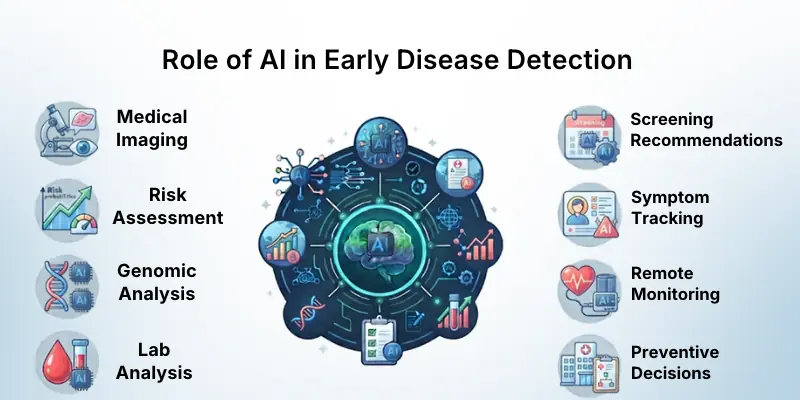
Here are the major roles of AI in early disease detection:
- Medical Imaging Analysis and Pattern Recognition
- Predictive Risk Assessment
- Early Detection of Cancer
- Chronic Disease Monitoring
- Infectious Disease Surveillance
- Genetic and Genomic Analysis
- Personalized Screening Recommendations
- Laboratory Data Analysis
- Symptom Tracking and Alert Systems
- Integration with Electronic Health Records (EHR)
- Remote Monitoring and Telehealth
- Decision Support for Preventive Care
Let us cover all these roles in detail.
1. Medical Imaging Analysis and Pattern Recognition
AI analyzes X-rays, MRIs, CT scans, and other imaging data. It identifies abnormalities early. AI detects subtle signs that humans may overlook. Doctors review AI findings to confirm diagnosis. This reduces missed cases. AI improves imaging interpretation speed. Patients receive faster care.
Additional Points
- Detects early signs in imaging
- Reduces diagnostic errors
- Improves radiology workflow
- Supports timely intervention
- Enhances patient outcomes
Ultimately, AI transforms medical imaging into a faster and more reliable diagnostic process, helping doctors detect hidden health risks before they become serious threats.
2. Predictive Risk Assessment
AI predicts disease risk by analyzing patient history, lifestyle, and lab results. It identifies patients likely to develop conditions. Doctors can plan preventive care early. AI improves screening strategies. It reduces late stage disease diagnosis. Patients receive proactive treatment. This improves overall health outcomes.
Additional Points
- Predicts risk for common and rare diseases
- Supports preventive healthcare
- Reduces late stage diagnosis
- Guides early intervention plans
- Improves patient safety
By predicting potential health problems before symptoms appear, AI shifts healthcare from treating diseases to preventing them before they take hold.
3. Early Detection of Cancer
AI detects cancer from scans, biopsies, and pathology data. It identifies tumors and abnormal cell growth early. Doctors verify AI predictions. Early detection allows timely treatment. AI reduces misdiagnosis. It improves survival rates. Patients gain better outcomes.
Additional Points
- Detects tumors early
- Supports screening programs
- Reduces missed diagnoses
- Improves treatment success
- Enhances cancer care
With AI powered cancer detection, doctors can identify life threatening diseases earlier, giving patients a better chance of timely treatment and improved survival.
4. Chronic Disease Monitoring
AI tracks conditions like diabetes, heart disease, and kidney disorders. It identifies early warning signs. Doctors adjust treatment proactively. AI predicts disease progression. This prevents complications. Patients receive continuous care. It improves quality of life.
Additional Points
- Monitors long term patient data
- Predicts disease progression
- Supports proactive care
- Reduces complications
- Improves patient management
AI makes chronic disease management more proactive, helping patients avoid serious complications and enjoy healthier, more confident lives.
5. Infectious Disease Surveillance
AI monitors infection patterns and outbreaks. It predicts spread using population data. Doctors and health agencies act quickly. AI alerts hospitals about high risk areas. It improves public health response. Early containment prevents widespread infection. AI supports global surveillance.
Additional Points
- Tracks disease outbreaks
- Predicts spread patterns
- Supports early intervention
- Improves public health response
- Enhances infection control
By identifying outbreak patterns before infections spread widely, AI helps healthcare systems protect communities and prevent future public health crises.
6. Genetic and Genomic Analysis
AI analyzes DNA and genetic markers. It predicts susceptibility to hereditary diseases. Doctors plan preventive care based on genetic risk. AI identifies mutations linked to early disease. It reduces late diagnosis. Patients receive targeted interventions. This supports precision medicine.
Additional Points
- Detects genetic risk factors
- Supports preventive planning
- Reduces late stage diagnosis
- Enables personalized care
- Improves disease prevention
AI powered genetic analysis brings healthcare one step closer to predicting inherited diseases and preventing health problems before they develop.
7. Personalized Screening Recommendations
AI recommends screening schedules for patients. It analyzes age, genetics, and medical history. Doctors follow AI recommendations. This ensures timely testing. AI improves detection rates. Patients avoid unnecessary tests. Screening becomes more effective.
Additional Points
- Suggests personalized screening timelines
- Improves early detection rates
- Reduces unnecessary procedures
- Enhances patient compliance
- Supports preventive healthcare
With personalized screening powered by AI, patients can receive the right tests at the right time, making early detection more effective and accessible.
8. Laboratory Data Analysis
AI analyzes blood tests, urine samples, and other lab results. It identifies abnormal patterns early. Doctors verify AI findings. This prevents delayed diagnosis. AI improves lab workflow. Patients receive faster results. Early intervention becomes possible.
Additional Points
- Detects anomalies in lab tests
- Supports timely diagnosis
- Reduces errors in lab reporting
- Improves treatment planning
- Enhances patient safety
By uncovering hidden patterns in laboratory results, AI helps doctors recognize potential diseases sooner and make faster, more informed treatment decisions.
9. Symptom Tracking and Alert Systems
AI monitors patient reported symptoms continuously. It detects warning signs for early intervention. Doctors receive alerts promptly. AI reduces emergency cases. Patients receive faster attention. Early treatment prevents complications. AI improves monitoring efficiency.
Additional Points
- Tracks symptoms in real time
- Sends alerts for abnormalities
- Supports early intervention
- Reduces emergency cases
- Improves patient monitoring
AI powered symptom monitoring ensures that important warning signs are not ignored, allowing doctors to intervene before minor health concerns become medical emergencies.
10. Integration with Electronic Health Records (EHR)
AI integrates data from multiple sources in EHRs. It identifies patterns and high risk patients. Doctors access all relevant information quickly. AI supports faster decision making. It reduces missed signals. Patients benefit from comprehensive care. AI ensures better data utilization.
Additional Points
- Consolidates patient data
- Detects high risk cases
- Supports quick decision making
- Improves care coordination
- Enhances EHR value
By turning scattered medical records into meaningful health insights, AI helps doctors recognize hidden risks and deliver more coordinated, timely patient care.
11. Remote Monitoring and Telehealth
AI supports remote patient monitoring using wearable devices. It identifies early signs of disease. Doctors receive alerts and intervene promptly. Patients avoid hospital visits unless necessary. AI improves chronic disease management. Care becomes continuous. Early treatment prevents complications.
Additional Points
- Monitors patients remotely
- Detects early warning signs
- Supports telehealth interventions
- Reduces hospital visits
- Improves patient outcomes
AI powered remote monitoring brings early disease detection beyond hospital walls, ensuring patients receive timely attention wherever they are.
12. Decision Support for Preventive Care
AI recommends preventive measures based on risk assessment. It alerts doctors for vaccinations, screenings, and lifestyle interventions. Patients follow early interventions. AI improves adherence to preventive care. Doctors make informed decisions. Disease onset reduces. Patient health improves overall.
Additional Points
- Suggests preventive measures
- Alerts for screenings and vaccinations
- Supports lifestyle interventions
- Reduces disease onset
- Improves patient health
Ultimately, AI empowers healthcare professionals to take preventive action before diseases develop, creating a smarter healthcare system focused on healthier lives and better futures.
Future of AI in Early Disease Detection
The future of the role of AI in early disease detection looks promising. By 2026, studies suggest that AI could support over 70 percent of preventive screenings globally. AI will improve cancer detection, chronic disease management, and infection control. Hospitals and clinics will adopt AI for predictive and proactive care. Early detection will reduce treatment costs and improve survival. AI will transform preventive healthcare worldwide.
Final Note
In this guide, we covered the role of AI in early disease detection and explained how it helps detect diseases earlier, improves preventive care, and supports better patient monitoring. We discussed all major roles in detail. Now here I am just dropping my personal thoughts.
I believe AI will become an essential tool for doctors and patients. Early detection will save lives and reduce healthcare costs. Thank you for reading, goodbye, and now see the FAQs below.
FAQs about AI in Early Disease Detection
Artificial intelligence is changing how healthcare professionals identify diseases, assess health risks, and provide preventive care. Here are some common questions about the role of AI in early disease detection, its benefits, and its future in modern medicine.
1. What is AI in early disease detection?
AI in early disease detection uses advanced algorithms to analyze medical images, laboratory results, and patient records. It identifies unusual patterns and potential warning signs that may be difficult to notice. Doctors review these findings to support accurate diagnoses and timely treatment.
2. How does AI detect diseases early?
AI detects diseases by analyzing different types of medical information through a systematic process:
- Collects health data: Examines medical images, laboratory reports, and patient history.
- Identifies patterns: Recognizes unusual changes and potential abnormalities.
- Predicts health risks: Highlights patients who may need further investigation.
- Supports diagnosis: Provides insights for doctors to review and confirm.
This process helps healthcare professionals identify potential diseases earlier and plan timely treatment.
3. Can AI detect cancer at an early stage?
Yes, AI can support early cancer detection by analyzing medical scans, mammograms, and biopsy images. It helps identify suspicious areas that require further examination.
Key applications include:
- Detecting unusual tumors in medical images.
- Identifying abnormal cells in biopsy samples.
- Highlighting suspicious tissue changes.
- Supporting doctors during cancer screening.
However, medical professionals must confirm AI findings before making diagnostic or treatment decisions.
4. Does AI replace doctors in early detection?
No, AI does not replace doctors. It works as a supporting technology that provides medical insights and helps healthcare professionals make informed decisions.
| AI’s Role | Doctor’s Role |
| Analyzes medical data | Reviews clinical findings |
| Identifies potential abnormalities | Confirms diagnoses |
| Predicts possible health risks | Makes treatment decisions |
| Provides useful insights | Considers the patient’s overall health |
The combination of AI technology and medical expertise can strengthen diagnostic confidence.
5. How does AI help with chronic disease monitoring?
AI continuously analyzes patient health information to identify early signs of chronic disease progression.
Here is how it works:
- Tracks vital signs and laboratory results.
- Identifies unusual changes over time.
- Detects possible complications.
- Alerts healthcare professionals about concerning patterns.
- Helps doctors adjust treatment plans when needed.
This supports proactive care and helps reduce the risk of serious complications.
6. Can AI predict infectious disease outbreaks?
Yes, AI can help predict potential infectious disease outbreaks by analyzing population health information and disease trends.
Its main functions include:
- Monitoring disease related data.
- Identifying unusual infection patterns.
- Forecasting possible outbreak risks.
- Supporting public health planning.
- Helping health authorities respond more quickly.
These capabilities strengthen disease surveillance and support public health protection.
7. Is AI used in genetic risk assessment?
Yes, AI helps analyze genetic information to identify patterns associated with inherited health conditions.
The process generally involves:
- DNA analysis: Examining genetic information and specific markers.
- Risk identification: Detecting genetic variations associated with certain diseases.
- Medical evaluation: Helping doctors assess potential hereditary risks.
- Preventive planning: Supporting personalized screening and preventive care.
This makes genetic risk assessment more data driven and supports personalized medicine.
8. How does AI improve preventive care?
AI improves preventive healthcare by helping doctors and patients identify potential health risks before serious problems develop. It supports preventive care through:
- Personalized screening: Suggests relevant screening options based on health information.
- Vaccination reminders: Helps patients stay updated on recommended vaccinations.
- Lifestyle guidance: Supports healthier habits through personalized insights.
- Early alerts: Notifies healthcare professionals about potential risks.
- Risk assessment: Helps identify individuals who may need preventive attention.
These applications encourage early action and better long term health management.
9. Can AI support remote patient monitoring?
Absolutely! AI powered remote patient monitoring allows healthcare professionals to track patient health outside traditional hospital settings.
A typical monitoring process includes:
- Wearable devices collect health information.
- AI analyzes vital signs and health patterns.
- Abnormal readings trigger alerts.
- Doctors review concerning changes.
- Patients receive timely medical guidance.
This improves access to healthcare and may reduce unnecessary hospital visits.
10. What is the future of AI in early disease detection?
The future of AI in early disease detection looks promising. Advancements in machine learning, medical imaging, and predictive analytics could help healthcare professionals identify diseases earlier and improve preventive care.
Some expected developments include:
- More advanced disease screening technologies.
- Improved prediction of individual health risks.
- Faster analysis of medical images and laboratory data.
- Greater integration with wearable health devices.
- More personalized preventive healthcare.
- Better support for early medical intervention.
By 2027 and beyond, continued AI adoption could transform disease detection, although its success will depend on clinical validation, responsible implementation, and collaboration between AI systems and healthcare professionals.




- Be Respectful
- Stay Relevant
- Stay Positive
- True Feedback
- Encourage Discussion
- Avoid Spamming
- No Fake News
- Don't Copy-Paste
- No Personal Attacks
- Be Respectful
- Stay Relevant
- Stay Positive
- True Feedback
- Encourage Discussion
- Avoid Spamming
- No Fake News
- Don't Copy-Paste
- No Personal Attacks
