Role of AI in Public Health Surveillance – Are We Ready for AI-Powered Health Protection?
Published: 17 Nov 2026
The role of artificial intelligence in public health surveillance is crucial for monitoring, predicting, and preventing diseases. Public health surveillance tracks disease trends, identifies outbreaks, and ensures community safety.
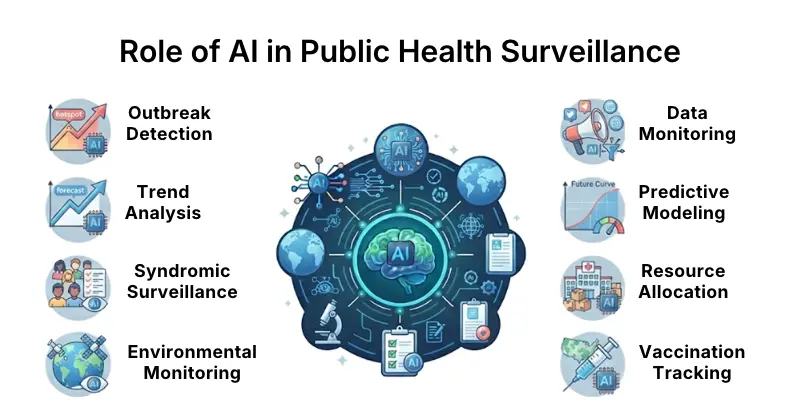
AI analyzes large datasets from hospitals, labs, social media, and wearable devices. It detects early warning signs faster than traditional methods. AI helps health authorities respond quickly and allocate resources efficiently. In this guide, we will cover all major roles of AI in public health surveillance and explain each role in detail.
Let’s get a comprehensive understanding of everything.
Impact of AI in Public Health Surveillance
AI strengthens public health surveillance by analyzing massive datasets, predicting disease outbreaks, and supporting data driven decisions. It helps prevent widespread infections and improves population health management.
Here are the major roles of AI in public health surveillance:
- Early Outbreak Detection
- Disease Trend Analysis and Prediction
- Syndromic Surveillance
- Remote Sensing and Environmental Monitoring
- Social Media and Web Data Monitoring
- Predictive Modeling for Epidemics
- Health Resource Allocation and Planning
- Vaccination Tracking and Coverage Analysis
- Monitoring Antimicrobial Resistance
- Integration with Electronic Health Records (EHR)
- Real Time Reporting and Alerts
- Policy Support and Decision Making
Let us cover all these roles in detail.
1. Early Outbreak Detection
AI identifies outbreaks by analyzing patient data, lab results, and environmental factors. It detects unusual patterns in disease occurrence. Health authorities receive alerts promptly. Early detection prevents disease spread. AI reduces response time. Communities stay safer. Public health systems act faster.
Additional Points
- Monitors hospital and lab data
- Detects abnormal disease patterns
- Alerts health authorities early
- Supports rapid intervention
- Prevents widespread outbreaks
Ultimately, AI powered early outbreak detection is helping health authorities identify emerging threats sooner, respond faster, and protect communities before diseases spread widely.
2. Disease Trend Analysis and Prediction
AI analyzes historical and current health data. It predicts future disease trends. Authorities plan preventive measures based on predictions. AI improves accuracy in trend forecasting. Health campaigns become more effective. Resources are allocated efficiently. Communities benefit from proactive measures.
Additional Points
- Tracks disease incidence over time
- Predicts future outbreaks
- Supports preventive strategies
- Guides public health campaigns
- Optimizes resource use
By transforming health data into predictive insights, AI is helping public health authorities anticipate disease trends and prepare more effective prevention strategies.
3. Syndromic Surveillance
AI monitors symptoms reported in hospitals and clinics. It identifies clusters of similar symptoms that may indicate an outbreak. Early signals trigger investigations. Doctors and health officials act quickly. AI reduces delayed detection. Populations receive timely interventions. Public health outcomes improve.
Additional Points
- Tracks patient symptoms continuously
- Detects clusters of illness
- Alerts health officials promptly
- Supports timely interventions
- Improves surveillance accuracy
AI driven syndromic surveillance is strengthening early warning systems by turning symptom patterns into timely insights that support faster public health interventions.
4. Remote Sensing and Environmental Monitoring
AI uses satellite and sensor data to monitor environmental factors. It tracks air quality, water contamination, and vector habitats. Environmental changes may indicate disease risk. Authorities prepare preventive measures. AI identifies high risk zones efficiently. Public health responses become proactive. Communities remain safer.
Additional Points
- Monitors environmental risk factors
- Detects vector borne disease hotspots
- Supports preventive planning
- Guides resource deployment
- Enhances community safety
By connecting environmental changes with potential health risks, AI is helping authorities identify vulnerable areas and develop smarter preventive measures.
5. Social Media and Web Data Monitoring
AI scans social media and web platforms for health related posts. It detects disease related discussions and symptoms trends. Early warnings are generated from public posts. Authorities respond quickly to emerging health threats. AI analyzes data in real time. Communities receive timely alerts. Disease spread is contained faster.
Additional Points
- Monitors online health discussions
- Detects emerging outbreaks
- Generates early warnings
- Supports rapid public health response
- Improves situational awareness
AI powered online monitoring is expanding public health awareness by identifying emerging health signals and helping authorities respond to potential threats more quickly.
6. Predictive Modeling for Epidemics
AI builds models to simulate disease spread. It predicts infection patterns and population impact. Health authorities prepare interventions based on simulations. AI reduces uncertainty in epidemic response. Models guide lockdowns, vaccination, and resource deployment. Communities benefit from data driven decisions. Disease burden decreases.
Additional Points
- Simulates epidemic spread
- Predicts population impact
- Guides intervention strategies
- Supports vaccination planning
- Reduces outbreak severity
Through advanced epidemic modeling, AI is helping health authorities understand possible disease scenarios, evaluate interventions, and prepare for future outbreaks.
7. Health Resource Allocation and Planning
AI optimizes distribution of healthcare resources like hospital beds, vaccines, and medical staff. It predicts demand based on trends. Health facilities operate efficiently. Patients receive timely care. AI reduces wastage. Planning becomes data driven. Public health systems become more resilient.
Additional Points
- Forecasts resource demand
- Optimizes allocation of medical supplies
- Reduces operational inefficiency
- Supports emergency preparedness
- Improves healthcare delivery
AI is making healthcare resource planning more efficient, helping public health systems direct essential supplies, medical staff, and services where they are needed most.
8. Vaccination Tracking and Coverage Analysis
AI monitors vaccination rates and population coverage. It identifies under vaccinated areas. Authorities target campaigns effectively. AI reduces gaps in immunization. Communities receive better protection. Data driven strategies improve public health. Outbreaks decrease.
Additional Points
- Tracks vaccine coverage
- Identifies high risk populations
- Supports targeted campaigns
- Reduces immunization gaps
- Improves population immunity
By identifying vaccination gaps and underserved populations, AI is helping health authorities strengthen immunization strategies and improve community protection.
9. Monitoring Antimicrobial Resistance
AI tracks patterns of antibiotic use and resistance. It identifies resistant strains early. Health authorities implement preventive measures. Doctors receive guidance on effective treatments. AI reduces the spread of resistant infections. Patient outcomes improve. Public health strategies become proactive.
Additional Points
- Monitors antibiotic resistance patterns
- Supports effective treatment decisions
- Prevents resistant infections
- Guides public health interventions
- Improves patient safety
AI is strengthening antimicrobial resistance surveillance by identifying emerging resistance patterns and supporting informed strategies to protect patients and public health.
10. Integration with Electronic Health Records (EHR)
AI integrates health data from multiple hospitals and clinics. It analyzes patient records for disease trends. Authorities gain a comprehensive view of public health. AI identifies high risk populations. Timely interventions are possible. Communities benefit from accurate data. Health outcomes improve.
Additional Points
- Combines data from multiple sources
- Tracks disease patterns
- Identifies high risk groups
- Supports timely interventions
- Improves public health management
Integrating electronic health records with AI is creating more connected surveillance systems, enabling health authorities to identify disease patterns and make informed decisions.
11. Real Time Reporting and Alerts
AI generates real time reports for public health officials. It sends alerts when unusual disease patterns appear. Authorities respond immediately. Community health risks reduce. Decisions are faster and more accurate. AI improves situational awareness. Populations receive timely interventions.
Additional Points
- Provides instant reporting
- Sends early warnings
- Supports emergency response
- Reduces outbreak impact
- Improves public health decisions
With faster reporting and timely alerts, AI is helping public health authorities recognize emerging threats and coordinate responses before risks escalate.
12. Policy Support and Decision Making
AI supports policymakers by providing actionable insights. It helps design health interventions, vaccination policies, and emergency protocols. Data driven policies reduce errors. AI predicts the outcomes of health strategies. Communities benefit from effective planning. Public health systems become stronger. Decisions are transparent and evidence based.
Additional Points
- Provides actionable insights for policymakers
- Guides public health strategies
- Predicts outcomes of interventions
- Improves policy efficiency
- Enhances healthcare planning
Ultimately, AI powered insights are helping policymakers develop evidence based public health strategies, strengthen emergency preparedness, and build more resilient healthcare systems.
Future of AI in Public Health Surveillance
The future of the role of AI in public health surveillance is very promising. By 2026, AI could support over 80 percent of outbreak detection and epidemic prediction tasks globally. AI will improve early detection of infectious diseases, vaccination planning, and resource allocation.
Real time monitoring will reduce response times. Public health systems will become more proactive. Communities will receive faster protection, and disease spread will be minimized. AI will transform population health management worldwide.
Final Note
In this guide, we covered the role of AI in public health surveillance and explained how it helps detect outbreaks, predict trends, monitor populations, and guide preventive strategies. We discussed all major roles in detail. Now here I am just dropping my personal thoughts. I believe AI will make public health systems faster, smarter, and more effective. It will save lives and improve community health worldwide.
Thank you for reading, goodbye, and now see the FAQs below.
FAQs About the Role of AI in Public Health Surveillance
Artificial intelligence is transforming public health surveillance by improving disease detection, outbreak prediction, and health monitoring.
These frequently asked questions explain how AI supports disease prevention, healthcare planning, and faster public health responses.
1. What is AI in public health surveillance?
AI in public health surveillance uses intelligent algorithms to analyze health data and identify disease patterns, emerging outbreaks, and potential health risks. It helps authorities monitor diseases, plan interventions, and respond more quickly, improving community protection and public health outcomes.
2. How does AI detect outbreaks early?
AI detects disease outbreaks by continuously analyzing information from hospitals, laboratories, and environmental sources.
The process includes:
- Collecting health and environmental data.
- Identifying unusual disease patterns.
- Detecting potential outbreak signals.
- Alerting health authorities for investigation.
This supports earlier detection and faster responses to emerging health threats.
3. Can AI predict epidemic trends?
Yes, AI can predict epidemic trends by analyzing historical disease records, population data, and current infection patterns.
- Disease forecasting: Estimates possible infection trends.
- Spread prediction: Identifies potential transmission patterns.
- Intervention planning: Supports preventive strategies.
- Resource preparation: Helps authorities prepare for changing healthcare demands.
These insights support proactive epidemic management.
4. Does AI replace public health officials?
No, AI does not replace public health officials. It supports their work by providing faster analysis, identifying health risks, and generating useful insights.
| AI’s Role | Public Health Officials’ Role |
| Analyzes health data | Interpret findings |
| Detects disease patterns | Investigate potential threats |
| Provides predictive insights | Make policy decisions |
| Generates alerts | Plan and implement interventions |
Human expertise remains essential for responsible public health decisions.
5. How does AI help vaccination campaigns?
AI improves vaccination campaigns by analyzing immunization data and identifying populations with lower vaccine coverage.
Key applications include:
- Tracking vaccination rates.
- Identifying under vaccinated communities.
- Supporting targeted vaccination campaigns.
- Improving immunization planning.
These applications help authorities address vaccination gaps and strengthen community protection.
6. Can AI monitor antimicrobial resistance?
Yes, AI helps monitor antimicrobial resistance by analyzing laboratory results, infection records, and antibiotic resistance patterns.
How AI supports resistance monitoring:
- Collects laboratory and hospital data.
- Identifies patterns of resistant infections.
- Detects emerging resistance signals.
- Supports treatment and infection control decisions.
This helps healthcare professionals respond to resistant infections and improve patient safety.
7. Is AI useful for real time health alerts?
Yes, AI supports real time public health alerts by detecting unusual disease patterns and generating timely notifications.
| Application | Public Health Benefit |
| Real time data analysis | Identifies emerging threats |
| Automated reporting | Improves information sharing |
| Early warning notifications | Supports faster responses |
| Continuous monitoring | Strengthens situational awareness |
These capabilities help authorities respond promptly and reduce potential outbreak impacts.
8. How does AI integrate with EHRs?
AI integrates with electronic health records (EHRs) by analyzing patient information collected from hospitals and healthcare facilities.
Integration process:
- Collects relevant electronic health records.
- Combines information from different healthcare sources.
- Identifies disease trends and high risk populations.
- Supports timely public health interventions.
This integration improves health monitoring and helps authorities make informed decisions.
9. Can AI optimize health resource allocation?
Yes, AI helps optimize healthcare resource allocation by predicting demand for hospital beds, medical staff, vaccines, and essential supplies.
Benefits include:
- Forecasting healthcare resource demand.
- Identifying areas with limited supplies.
- Improving distribution planning.
- Reducing operational inefficiencies.
AI supported planning helps healthcare facilities prepare for emergencies and deliver more efficient patient care.
10. What is the future of AI in public health surveillance?
The future of AI in public health surveillance is promising, with continued advancements in disease monitoring, predictive analysis, and outbreak response.
Future developments may include:
- Faster outbreak detection and early warning systems.
- More advanced epidemic forecasting.
- Improved health data integration.
- Smarter vaccination and prevention strategies.
- More efficient public health resource planning.
As AI technology advances, it is expected to strengthen public health preparedness and support more proactive, data driven healthcare systems.




- Be Respectful
- Stay Relevant
- Stay Positive
- True Feedback
- Encourage Discussion
- Avoid Spamming
- No Fake News
- Don't Copy-Paste
- No Personal Attacks
- Be Respectful
- Stay Relevant
- Stay Positive
- True Feedback
- Encourage Discussion
- Avoid Spamming
- No Fake News
- Don't Copy-Paste
- No Personal Attacks
