Role of AI in Personalized Therapy – Discover the Power of Precision Care
Published: 18 Nov 2026
The role of artificial intelligence in personalized therapy is transforming modern healthcare. Personalized therapy focuses on tailoring treatment to a patient’s unique genetic, medical, and lifestyle profile.
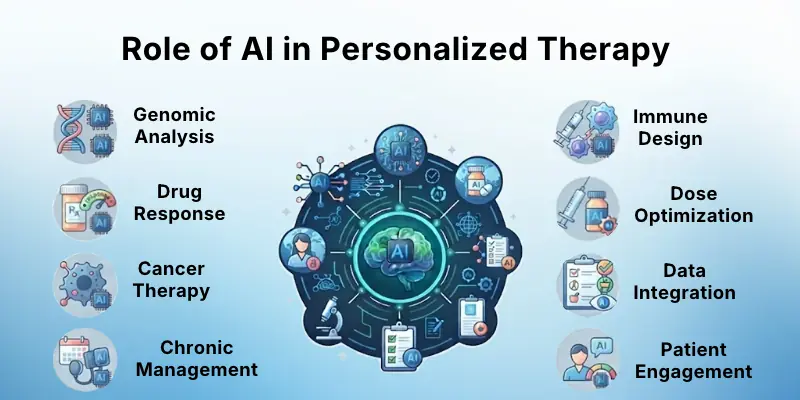
AI helps analyze patient data, predict treatment responses, and recommend customized therapies. It improves outcomes, reduces side effects, and increases patient satisfaction. AI also supports clinical decision making and research. In this guide, we will cover all major roles of AI in personalized therapy and explain each role in detail.
Let us learn about everything in detail.
Impact of AI in Personalized Therapy
AI strengthens personalized therapy by analyzing patient data, predicting treatment effectiveness, and supporting doctors in designing tailored treatment plans. It helps patients receive therapies that work best for them while reducing risks.
Here are the major roles of AI in personalized therapy:
- Genetic and Genomic Data Analysis
- Predicting Drug Response
- Personalized Cancer Therapy Planning
- Chronic Disease Management
- Immune System Based Therapy Design
- Medication Optimization and Dosing
- Integration of Clinical and Lifestyle Data
- Biomarker Discovery and Analysis
- Clinical Decision Support Systems
- Remote Monitoring and Therapy Adjustment
- Risk Prediction for Adverse Effects
- Patient Engagement and Feedback Tracking
Let us cover all these roles in detail.
1. Genetic and Genomic Data Analysis
AI analyzes a patient’s genetic and genomic data to identify disease susceptibility. It detects mutations and genetic markers. Doctors use these insights to design targeted therapies. AI identifies which treatments may work best for each patient. It reduces trial and error. Patients receive safer and more effective care. AI accelerates precision medicine research.
Additional Points
- Detects genetic mutations
- Supports disease risk prediction
- Helps design targeted treatments
- Reduces trial and error therapy
- Improves patient outcomes
Ultimately, AI transforms genetic information into valuable medical insights, helping doctors move beyond one size fits all treatments toward more precise, personalized, and effective therapies.
2. Predicting Drug Response
AI predicts how patients respond to specific drugs. It analyzes past treatment data and patient profiles. Doctors choose therapies with the highest likelihood of success. AI reduces adverse reactions. It supports dosage optimization. Patients experience fewer side effects. This improves overall treatment efficiency.
Additional Points
- Predicts drug effectiveness
- Optimizes medication selection
- Reduces side effects
- Supports safer treatment planning
- Improves therapy success rates
By predicting how individual patients may respond to medications, AI helps healthcare professionals make smarter treatment choices, minimize unnecessary side effects, and improve therapeutic outcomes.
3. Personalized Cancer Therapy Planning
AI analyzes tumor data and patient biology. It recommends treatments like chemotherapy, immunotherapy, or targeted therapy. Doctors review AI suggestions. Early and precise therapy improves outcomes. AI reduces ineffective treatment cycles. It predicts tumor response. Patients gain better survival chances.
Additional Points
- Analyzes tumor and patient data
- Suggests targeted therapies
- Reduces ineffective treatments
- Improves survival rates
- Supports precision oncology
With AI powered insights, cancer treatment is becoming more targeted and patient specific, offering new possibilities for effective therapies and better outcomes in precision oncology.
4. Chronic Disease Management
AI monitors chronic diseases like diabetes, heart disease, and autoimmune conditions. It predicts disease progression and recommends adjustments. Doctors personalize therapy plans. AI reduces complications and hospital visits. Patients maintain better control. Therapy becomes continuous and adaptive. Outcomes improve with real time insights.
Additional Points
- Tracks chronic disease data
- Predicts progression trends
- Supports therapy adjustments
- Reduces complications
- Improves patient control
Overall, AI makes chronic disease management more proactive and personalized, helping patients maintain better health control while reducing the risk of long term complications.
5. Immune System Based Therapy Design
AI analyzes immune system data for therapies like immunotherapy. It predicts patient response to treatment. Doctors customize immune based interventions. AI reduces side effects and increases effectiveness. Therapy becomes patient specific. It improves cancer and autoimmune disease outcomes. AI enhances precision immunology.
Additional Points
- Analyzes immune system profiles
- Supports immunotherapy planning
- Predicts treatment response
- Reduces adverse effects
- Improves patient outcomes
By understanding individual immune system responses, AI helps researchers and doctors develop more targeted immunotherapies, bringing personalized treatment strategies closer to reality.
6. Medication Optimization and Dosing
AI determines the right medication and dosage. It considers age, weight, genetics, and health conditions. Doctors prescribe safer and effective doses. AI reduces overdose and underdose risks. Therapy becomes more precise. Patients experience fewer complications. This enhances overall treatment safety.
Additional Points
- Optimizes drug dosing
- Considers patient specific factors
- Reduces risks of incorrect doses
- Improves treatment safety
- Enhances therapy effectiveness
Ultimately, AI helps healthcare professionals make more informed medication decisions, ensuring that treatment plans better reflect each patient’s unique health needs and safety requirements.
7. Integration of Clinical and Lifestyle Data
AI combines clinical data with lifestyle and behavior patterns. It analyzes diet, activity, and habits. Doctors plan therapy considering holistic patient health. AI supports adaptive treatment strategies. Patients follow personalized recommendations. Therapy becomes more effective. Outcomes improve faster.
Additional Points
- Integrates clinical and lifestyle data
- Supports adaptive therapy
- Considers holistic patient health
- Improves adherence to treatment
- Enhances overall effectiveness
By combining medical information with everyday lifestyle patterns, AI creates a more complete picture of patient health, supporting treatment plans that are personalized, practical, and adaptable.
8. Biomarker Discovery and Analysis
AI identifies biomarkers linked to therapy response. It helps predict which patients benefit from specific treatments. Doctors use biomarkers to tailor therapy. AI accelerates discovery of new biomarkers. Treatment becomes more precise. It supports research and personalized care. Patients receive therapies based on real biological evidence.
Additional Points
- Detects predictive biomarkers
- Guides treatment selection
- Supports research innovation
- Improves therapy precision
- Enhances patient outcomes
AI is opening new possibilities in biomarker research, helping doctors identify biological clues that can guide treatment selection and make personalized therapy more precise.
9. Clinical Decision Support Systems
AI integrates with hospital systems to assist doctors. It provides real time treatment suggestions based on patient data. Doctors validate AI recommendations. This reduces errors and improves decision making. Therapy plans become more effective. AI supports evidence based practices. Patient care improves overall.
Additional Points
- Provides real time recommendations
- Reduces clinical errors
- Supports evidence based care
- Enhances decision making
- Improves patient outcomes
By combining advanced data analysis with medical expertise, AI empowers doctors to make more confident, evidence based treatment decisions and deliver patient centered care.
10. Remote Monitoring and Therapy Adjustment
AI monitors patients remotely through devices and apps. It tracks therapy effectiveness and side effects. Doctors adjust treatment in real time. Patients avoid unnecessary hospital visits. Therapy becomes continuous and adaptive. Outcomes improve with timely interventions. AI enhances patient convenience.
Additional Points
- Monitors patients remotely
- Tracks therapy progress
- Supports real time adjustments
- Reduces hospital visits
- Improves patient experience
Ultimately, AI makes personalized therapy more continuous and accessible, allowing healthcare professionals to track treatment progress and respond to changing patient needs more effectively.
11. Risk Prediction for Adverse Effects
AI predicts potential adverse effects of therapies. It analyzes patient data, genetics, and past reactions. Doctors modify therapy proactively. AI reduces complications and hospitalizations. Patients receive safer treatment. It improves treatment compliance. Therapy becomes more reliable.
Additional Points
- Predicts therapy side effects
- Supports proactive adjustments
- Reduces complications
- Improves patient safety
- Enhances therapy reliability
Through early risk identification, AI helps doctors anticipate potential treatment complications, make proactive adjustments, and prioritize patient safety throughout the therapy journey.
12. Patient Engagement and Feedback Tracking
AI tracks patient feedback and adherence. It reminds patients to follow treatment plans. Doctors receive real time engagement data. AI helps adjust therapy for better compliance. Patients feel more involved in care. Communication improves outcomes. Therapy success rates increase.
Additional Points
- Monitors patient adherence
- Tracks treatment feedback
- Sends reminders and notifications
- Supports therapy adjustments
- Enhances patient engagement
By keeping patients informed, involved, and connected with their healthcare teams, AI strengthens treatment adherence and supports more personalized, patient focused healthcare experiences.
Future of AI in Personalized Therapy
The future of the role of AI in personalized therapy looks promising. By 2026, studies suggest that AI could influence over 65 percent of therapy planning and adjustments in advanced hospitals. AI will improve drug selection, immunotherapy, and chronic disease management. Therapies will become safer, faster, and more precise. Patient satisfaction and survival rates will increase. AI will reshape personalized healthcare globally.
Final Note
In this guide, we covered the role of AI in personalized therapy and explained how it helps tailor treatments, predict therapy responses, and improve patient outcomes. We discussed all major roles in detail, from genetic analysis to remote monitoring and risk prediction. Now here I am just dropping my personal thoughts.
I believe AI will make healthcare more precise and patient centered than ever before. It will save lives and improve quality of care. Thank you for reading, goodbye, and now see the FAQs below.
FAQs about AI in personalized therapy
Artificial intelligence is transforming personalized therapy by helping doctors understand individual patient needs and make more informed treatment decisions.
Explore these common questions about AI powered treatments, their benefits, applications, and future in healthcare.
1. What is AI in personalized therapy?
AI in personalized therapy uses advanced algorithms to analyze individual patient information and support customized treatment plans. It considers genetics, medical history, lifestyle, and health conditions to identify suitable treatment options. Doctors review AI generated insights to make safer and more informed decisions.
2. How does AI predict drug response?
AI predicts drug response by analyzing patient information and previous treatment outcomes.
Here is how the process works:
- Collects patient data: Examines genetic information and medical history.
- Analyzes treatment patterns: Studies how similar patients responded to medications.
- Predicts drug effectiveness: Identifies treatments that may work better for individual patients.
- Supports doctors: Provides insights for selecting suitable medications.
This approach can help reduce unnecessary side effects and improve treatment planning.
3. Can AI support cancer treatment planning?
Yes, AI helps doctors develop more personalized cancer treatment strategies by analyzing tumor characteristics and individual patient data.
Key applications include:
- Identifying tumor patterns.
- Supporting chemotherapy planning.
- Evaluating potential immunotherapy options.
- Predicting possible treatment responses.
- Supporting targeted cancer therapies.
Doctors validate AI recommendations before making treatment decisions, helping improve precision in cancer care.
4. Does AI replace doctors in personalized therapy?
No, AI supports medical professionals rather than replacing them. Doctors remain responsible for diagnosis, treatment selection, and final clinical decisions.
| AI’s Contribution | Doctor’s Responsibility |
| Analyzes patient data | Reviews medical findings |
| Predicts treatment responses | Selects suitable therapies |
| Provides recommendations | Makes final decisions |
| Identifies potential risks | Evaluates patient safety |
Combining AI insights with medical expertise can improve treatment accuracy and patient care.
5. How does AI help manage chronic diseases?
AI supports chronic disease management by continuously analyzing patient health information and identifying changes that may require medical attention.
Its main functions include:
- Monitoring vital signs and laboratory results.
- Tracking treatment adherence.
- Predicting possible disease progression.
- Identifying potential complications.
- Supporting timely treatment adjustments.
This helps doctors develop adaptive treatment plans and manage long term health conditions more effectively.
6. Can AI personalize immune or gene based therapies?
Yes, AI supports personalized immune and gene based therapies by analyzing genetic information and individual immune system profiles.
The process involves:
- Examining genetic markers and immune profiles.
- Identifying patterns associated with treatment response.
- Predicting which therapies may be suitable.
- Helping doctors customize treatment strategies.
These applications support precision medicine and may improve treatment selection for individual patients.
7. Is AI used for remote monitoring in personalized therapy?
Absolutely! AI powered remote monitoring helps doctors follow patient progress without requiring frequent hospital visits.
A typical monitoring checklist includes:
- Wearable devices collect patient health data.
- AI analyzes vital signs and health patterns.
- Abnormal readings trigger alerts.
- Doctors review concerning changes.
- Treatment plans are adjusted when necessary.
This makes personalized therapy more accessible and supports timely medical intervention.
8. How does AI reduce adverse effects?
AI helps reduce potential treatment related side effects by identifying patient specific risk factors before or during therapy.
| AI Function | Potential Benefit |
| Genetic analysis | Identifies possible medication risks |
| Patient data analysis | Highlights individual risk factors |
| Side effect prediction | Supports early risk identification |
| Treatment recommendations | Helps doctors consider safer options |
Doctors can use these insights to adjust treatment plans proactively and improve patient safety.
9. Can AI improve patient engagement in therapy?
Yes, AI improves patient engagement by keeping individuals informed, involved, and connected with their healthcare providers. It supports patient participation through:
- Automated medication reminders.
- Treatment adherence tracking.
- Personalized health notifications.
- Patient feedback collection.
- Communication with healthcare teams.
These features encourage patients to follow treatment plans and help doctors identify areas where additional support may be needed.
10. What is the future of AI in personalized therapy?
The future of AI in personalized therapy looks promising, with advancements in predictive analytics, genetic research, and precision medicine creating new opportunities for customized healthcare.
Some expected developments include:
- More accurate treatment response predictions.
- Advanced genetic and genomic analysis.
- Safer medication selection and dosing.
- Greater use of remote patient monitoring.
- More personalized cancer and immune based therapies.
- Improved integration of AI into clinical decision making.
By 2026 and beyond, continued AI development could make personalized healthcare more precise and accessible. However, clinical validation and medical supervision will remain essential for safe and effective treatment.




- Be Respectful
- Stay Relevant
- Stay Positive
- True Feedback
- Encourage Discussion
- Avoid Spamming
- No Fake News
- Don't Copy-Paste
- No Personal Attacks
- Be Respectful
- Stay Relevant
- Stay Positive
- True Feedback
- Encourage Discussion
- Avoid Spamming
- No Fake News
- Don't Copy-Paste
- No Personal Attacks
