Role of AI in Microbiology – How Machine Intelligence Is Redefining the Future of Microbial Science
Published: 4 Nov 2026
When I look at modern microbiology laboratories today, I clearly see artificial intelligence transforming how microorganisms are studied, identified, and controlled. Tasks that once required long hours of manual analysis are now performed faster and more accurately with smart systems.
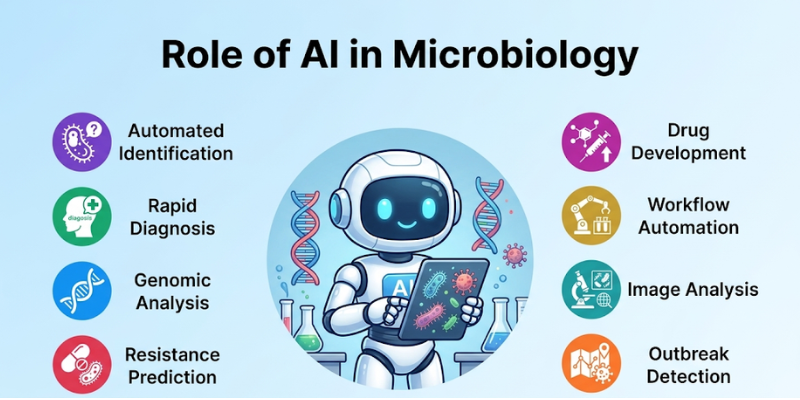
In simple words, microbiology is the branch of science that studies microorganisms such as bacteria, viruses, fungi, and parasites. Artificial intelligence helps microbiologists analyze large datasets, detect pathogens, automate laboratory processes, and predict disease outbreaks. It does not replace scientists, but it supports them by improving speed, accuracy, and efficiency.
In this guide, I’ll explain the top 10 roles of AI in microbiology, how it enhances laboratory work, and why it is becoming essential in research and healthcare systems worldwide.
Mostly, our focus will be on clearly understanding the role of AI in microbiology.
Contribution of AI in Microbiology
To properly understand the role of AI in microbiology, you need to see where it creates the biggest scientific and clinical impact. Below are the top 10 applications of artificial intelligence in microbiological research and diagnostics.
After listing them, I’ll explain each role in detail so you can clearly understand how AI supports microbiologists, laboratories, and healthcare systems.
- Automated Pathogen Identification
- Rapid Disease Diagnosis
- Genomic Data Analysis
- Antimicrobial Resistance Prediction
- Drug and Vaccine Development
- Laboratory Workflow Automation
- Image Analysis of Microorganisms
- Outbreak Detection and Surveillance
- Personalized Infection Treatment
- Microbiome Research Enhancement
Let us cover all in detail.
1. Automated Pathogen Identification
AI helps laboratories quickly identify bacteria, viruses, and fungi from patient samples. Traditional identification methods may take hours or even days, but AI powered systems analyze data within minutes.
By studying patterns in culture results, genetic sequences, and biochemical tests, AI accurately classifies microorganisms. This reduces diagnostic delays and improves patient treatment decisions.
How It Works: AI algorithms compare sample data with large microbial databases to recognize specific pathogens.
Benefits:
- Faster identification
- Higher diagnostic accuracy
- Reduced laboratory workload
- Improved patient care
This allows laboratories to identify harmful microorganisms faster, reduce diagnostic delays, and support timely treatment decisions.
2. Rapid Disease Diagnosis
AI speeds up the diagnosis of infectious diseases by analyzing clinical reports and laboratory findings together. It connects symptoms with microbiological data to suggest possible infections.
This is especially important in serious conditions like sepsis or viral outbreaks, where early detection can save lives. Faster diagnosis leads to quicker treatment and better outcomes.
How It Works: AI integrates lab results, patient symptoms, and medical history to generate diagnostic predictions.
Benefits:
- Early disease detection
- Reduced diagnostic errors
- Faster treatment decisions
- Improved survival rates
By connecting patient symptoms with laboratory findings, AI helps healthcare professionals detect infections earlier and begin appropriate treatment without unnecessary delays.
3. Genomic Data Analysis
Modern microbiology relies heavily on genome sequencing. AI analyzes massive genetic datasets to identify mutations, strain variations, and evolutionary patterns.
For example, during the global spread of COVID-19, AI played a key role in analyzing viral genomes to track mutations. This helped scientists understand transmission patterns and variant development.
How It Works: AI processes DNA and RNA sequences using machine learning models to detect genetic patterns.
Benefits:
- Faster genome analysis
- Accurate mutation detection
- Better understanding of pathogens
- Improved research efficiency
This enables researchers to understand microbial genetic changes, track emerging variants, and gain deeper insights into pathogen evolution.
4. Antimicrobial Resistance Prediction
Antimicrobial resistance is a growing global concern. AI helps predict whether a microorganism will resist certain antibiotics based on genetic and laboratory data.
By identifying resistance patterns early, doctors can choose the most effective treatment and avoid ineffective drugs. This supports global efforts against antibiotic misuse.
How It Works: AI models analyze microbial genes and compare them with known resistance databases.
Benefits:
- Smarter antibiotic selection
- Reduced treatment failure
- Support for antibiotic stewardship
- Better infection control
With early resistance predictions, doctors can select suitable antibiotics, avoid ineffective treatments, and make better decisions against drug resistant infections.
5. Drug and Vaccine Development
AI accelerates the development of new antibiotics and vaccines. It analyzes microbial structures and predicts which compounds can effectively target them.
Instead of testing thousands of chemicals manually, AI narrows down the most promising options. This reduces research time and development costs significantly.
How It Works: AI simulates interactions between microbial proteins and potential drug molecules.
Benefits:
- Faster drug discovery
- Lower research costs
- Improved vaccine design
- Enhanced pharmaceutical innovation
By identifying promising drug compounds and vaccine targets, AI helps researchers accelerate the development of new treatments and preventive solutions.
6. Laboratory Workflow Automation
AI automates routine microbiology laboratory tasks such as sample sorting, culture monitoring, and result reporting. This reduces manual errors and increases productivity.
Automated systems also ensure standardized procedures, which improve consistency in diagnostic testing.
How It Works: AI integrates with laboratory information systems to manage processes efficiently.
Benefits:
- Increased efficiency
- Reduced human error
- Faster turnaround times
- Better laboratory management
This allows microbiology laboratories to handle routine tasks more efficiently, maintain consistent testing procedures, and deliver results in less time.
7. Image Analysis of Microorganisms
Microscopic examination is a key part of microbiology. AI enhances digital microscopy by identifying microorganisms in images with high precision.
It can differentiate between bacterial species or detect abnormal growth patterns. This improves diagnostic accuracy and reduces reliance on manual interpretation.
How It Works: AI uses computer vision algorithms to analyze microscopic images.
Benefits:
- Improved image accuracy
- Faster slide analysis
- Reduced observer bias
- Enhanced diagnostic reliability
As a result, microbiologists can examine microscopic images more accurately, recognize microorganisms faster, and make more reliable diagnostic assessments.
8. Outbreak Detection and Surveillance
AI helps monitor infectious disease trends by analyzing public health data and laboratory reports. It can detect unusual patterns that may indicate an outbreak.
During global health emergencies, such as the Ebola virus disease outbreaks, AI supported surveillance systems assisted in tracking spread patterns. Early detection allows faster public health responses.
How It Works: AI scans large datasets from hospitals and labs to identify abnormal infection trends.
Benefits:
- Early outbreak alerts
- Faster public health response
- Improved disease containment
- Data driven surveillance
This helps health authorities recognize unusual infection patterns earlier, monitor disease transmission, and take timely action to prevent further spread.
9. Personalized Infection Treatment
AI supports personalized medicine by analyzing patient specific infection data. It considers the exact pathogen strain, resistance profile, and patient health condition.
This helps doctors design targeted treatment plans instead of using general antibiotics. Personalized care improves recovery and reduces complications.
How It Works: AI combines microbiological findings with patient data to recommend customized therapies.
Benefits:
- More effective treatment
- Reduced side effects
- Lower resistance risk
- Better patient outcomes
This makes infection management more precise by helping doctors match treatment choices with individual pathogens, resistance patterns, and patient needs.
10. Microbiome Research Enhancement
The human microbiome plays a major role in digestion, immunity, and overall health. AI analyzes complex microbiome datasets to understand microbial balance and its impact on diseases.
By studying gut bacteria and other microbial communities, AI helps researchers discover links between microbes and chronic conditions. This opens new opportunities for therapeutic development.
How It Works: AI examines patterns in microbiome sequencing data to identify beneficial or harmful microbial interactions.
Benefits:
- Deeper microbiome insights
- Improved disease research
- Better probiotic development
- Advanced precision medicine
These findings help scientists understand how microbial communities influence human health and identify new possibilities for microbiome based treatments.
Future of AI in Microbiology
The future of AI in microbiology looks highly promising. Laboratories will become more automated and data driven. AI powered genomic tools will improve global disease surveillance and antimicrobial resistance control.
As infectious diseases continue to evolve, artificial intelligence will help scientists respond faster and more accurately. AI will remain a powerful partner in advancing microbiological research and public health protection.
Conclusion
In this guide, we covered the top 10 roles of artificial intelligence in microbiology in detail. From pathogen identification and genomic analysis to outbreak detection and drug development, AI is transforming modern microbiology laboratories.
As technology continues advancing, artificial intelligence will play an even greater role in improving diagnostic accuracy, speeding up research, and strengthening global healthcare systems.
FAQs: Role of AI in Microbiology
Artificial intelligence is transforming microbiology by improving microbial identification, disease diagnosis, laboratory testing, and scientific research.
Here are some common questions about its applications, benefits, challenges, and future possibilities.
1. What is the role of AI in microbiology?
AI helps microbiologists study bacteria, viruses, fungi, and other microorganisms. It analyzes large amounts of laboratory data, identifies patterns, and supports faster research and disease detection.
2. How does AI help identify bacteria?
AI identifies bacteria by examining different types of laboratory data, including:
- Microscopic images of bacterial samples.
- Genetic sequences and microbial DNA.
- Patterns from biochemical laboratory tests.
It compares these findings with existing microbial databases to support faster and more accurate identification.
3. Can AI detect infections early?
Yes! AI can recognize early signs of infection by connecting patient information with laboratory findings.
Here is how it works:
- Collects patient samples and laboratory results.
- Examines patterns linked to infectious diseases.
- Identifies possible signs of infection.
- Helps healthcare professionals make quicker treatment decisions.
4. Is AI used in antibiotic research?
Yes, AI supports antibiotic research by studying bacterial characteristics and predicting how microorganisms respond to different drugs.
| Application | How it helps |
| Drug discovery | Identifies promising antibiotic compounds |
| Resistance analysis | Detects patterns linked to drug resistance |
| Drug testing | Predicts potential bacterial responses |
These applications help researchers search for new ways to fight antibiotic resistant infections.
5. How does AI support virus research?
AI helps scientists understand viruses by analysing their genetic information and identifying mutation patterns. It can:
- Track changes in viral genomes.
- Study how viruses evolve.
- Predict potential transmission patterns.
- Support research into disease prevention.
This gives researchers valuable insights into viral behaviour and emerging infectious threats.
6. Does AI improve laboratory efficiency?
Absolutely! AI makes microbiology laboratories more efficient by automating repetitive tasks and reducing manual work.
Key improvements include:
- Automated sample processing.
- Faster laboratory testing and reporting.
- Reduced human errors.
- More consistent laboratory procedures.
7. Can AI help control disease outbreaks?
Yes, AI supports disease surveillance by monitoring infection reports and identifying unusual patterns.
The process involves:
- Collecting infection data from hospitals and laboratories.
- Analysing changes in disease patterns.
- Identifying possible outbreak signals.
- Alerting health authorities to support timely responses.
This helps public health teams monitor disease spread and improve outbreak management.
8. What are the benefits of AI in microbiology?
AI offers several important advantages for microbiological research and healthcare:
- Faster research: Analyses complex microbial data quickly.
- Better diagnosis: Supports accurate pathogen identification.
- Improved treatment: Helps guide infection management.
- Laboratory efficiency: Reduces repetitive manual tasks.
- Public health protection: Supports disease surveillance and outbreak monitoring.
9. What challenges does AI face in microbiology?
Despite its advantages, AI faces several challenges that can affect its use in microbiological research and laboratory settings.
| Challenge | Possible limitation |
| Data quality | Poor data can affect prediction accuracy |
| High costs | Advanced systems require investment |
| Data privacy | Patient information needs protection |
| Technical limitations | Some models may produce unreliable results |
Addressing these issues is important for making AI applications more reliable and accessible.
10. What is the future of AI in microbiology?
The future of AI in microbiology looks promising, with several important developments expected:
- Faster identification of infectious microorganisms.
- More advanced antibiotic and vaccine discovery.
- Smarter laboratory automation.
- Improved genomic and microbiome research.
- Better disease surveillance and prevention.
These developments could make microbiological research more efficient and strengthen global efforts to protect human health.




- Be Respectful
- Stay Relevant
- Stay Positive
- True Feedback
- Encourage Discussion
- Avoid Spamming
- No Fake News
- Don't Copy-Paste
- No Personal Attacks
- Be Respectful
- Stay Relevant
- Stay Positive
- True Feedback
- Encourage Discussion
- Avoid Spamming
- No Fake News
- Don't Copy-Paste
- No Personal Attacks
