Role of AI in Mathematics – Could Technology Unlock the Secrets Behind Complex Equations?
Published: 4 Nov 2026
When I look at the field of mathematics today, I clearly see artificial intelligence transforming how problems are solved and theories are developed. What once required months of manual calculations can now be analyzed in seconds using intelligent systems.
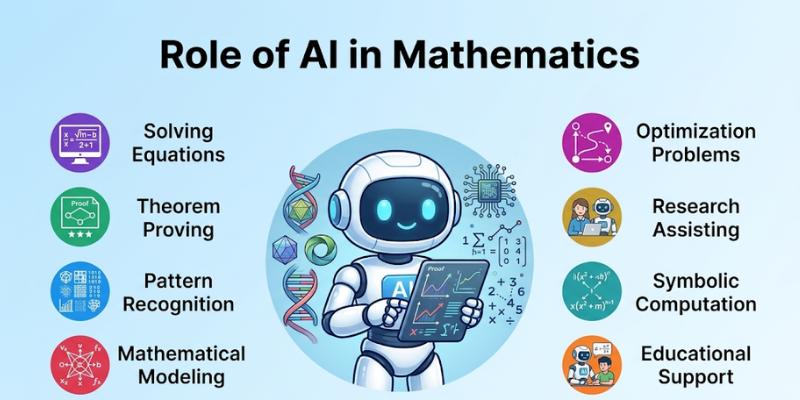
In simple words, mathematics is the study of numbers, patterns, structures, and logical relationships. Artificial intelligence helps mathematicians solve complex equations, analyze large datasets, verify proofs, and discover new patterns. It does not replace human thinking, but it enhances speed, accuracy, and analytical power.
In this guide, I’ll explain the top 10 roles of AI in mathematics, how it supports research and education, and why it is becoming increasingly important in modern mathematical studies.
Mostly, our focus will be on clearly understanding the role of AI in mathematics.
Impact of AI in Mathematics
To properly understand the role of AI in mathematics, you need to see where it creates the greatest academic and practical impact. Below are the top 10 applications of artificial intelligence in mathematics.
After listing them, I’ll explain each role in detail so you can clearly understand how AI supports mathematicians, students, and researchers.
- Solving Complex Equations
- Automated Theorem Proving
- Pattern Recognition in Data
- Mathematical Modeling
- Optimization Problems
- Assisting Mathematical Research
- Symbolic Computation
- Educational Support and Tutoring
- Statistical Analysis and Prediction
- Discovery of New Mathematical Conjectures
Let us cover all in detail.
1. Solving Complex Equations
AI systems can solve highly complex equations that involve multiple variables and constraints. These problems may take humans a long time to compute manually.
By using advanced algorithms, AI quickly processes calculations and provides accurate solutions. This is especially helpful in higher mathematics, engineering, and scientific research.
How It Works: AI applies numerical methods and computational algorithms to evaluate and solve equations efficiently.
Benefits:
- Faster problem solving
- Reduced calculation errors
- Support for advanced research
- Improved computational efficiency
This makes solving complicated mathematical equations faster, more accurate, and more manageable across advanced research and practical applications.
2. Automated Theorem Proving
AI plays a major role in verifying mathematical proofs. It checks logical steps and confirms whether a theorem follows valid reasoning rules.
Systems like Wolfram Mathematica assist in symbolic reasoning and proof verification. AI reduces human mistakes and ensures logical consistency in complex proofs.
How It Works: AI uses formal logic systems and rule based algorithms to validate mathematical statements.
Benefits:
- Accurate proof verification
- Reduced logical errors
- Time saving for researchers
- Stronger mathematical validation
As a result, mathematicians can verify complex proofs with greater accuracy, reduce logical mistakes, and strengthen the reliability of mathematical research.
3. Pattern Recognition in Data
Mathematics often involves identifying patterns in numbers and structures. AI is extremely powerful in detecting hidden patterns within large datasets.
It can find trends, correlations, and sequences that may not be obvious to humans. This supports research in statistics, number theory, and applied mathematics.
How It Works: Machine learning models analyze large numerical datasets to detect repeating structures and relationships.
Benefits:
- Discovery of hidden trends
- Improved data analysis
- Faster pattern detection
- Better research insights
This helps mathematicians uncover hidden numerical relationships, identify meaningful patterns, and gain deeper insights from complex datasets.
4. Mathematical Modeling
AI supports the creation of mathematical models used in science, economics, and engineering. These models simulate real world systems using equations and algorithms.
For example, AI helps build predictive models based on probability theory and calculus. These models assist in forecasting outcomes and testing different scenarios.
How It Works: AI combines statistical techniques and computational power to simulate complex systems mathematically.
Benefits:
- Accurate simulations
- Improved forecasting
- Better decision making
- Advanced real world applications
These capabilities allow researchers to build more reliable mathematical models, simulate real world situations, and predict possible outcomes with greater confidence.
5. Optimization Problems
Many mathematical problems involve finding the best possible solution under certain conditions. AI is widely used in solving optimization problems efficiently.
It calculates optimal paths, minimal costs, or maximum profits using advanced algorithms. This is useful in logistics, finance, and operations research.
How It Works: AI uses optimization algorithms like linear programming and gradient descent methods.
Benefits:
- Efficient resource management
- Faster optimal solutions
- Reduced computational time
- Practical problem solving support
This enables businesses and researchers to identify better solutions, use resources efficiently, and solve challenging optimization problems in less time.
6. Assisting Mathematical Research
AI helps researchers explore new mathematical ideas by analyzing previous studies and generating suggestions. It processes large volumes of academic papers quickly.
This allows mathematicians to focus more on creative thinking rather than repetitive analysis. AI becomes a research assistant that speeds up discovery.
How It Works: Natural language processing models analyze research documents and extract key mathematical insights.
Benefits:
- Faster literature review
- Enhanced research productivity
- Improved idea generation
- Efficient knowledge organization
With these capabilities, mathematicians can explore research more efficiently, develop new ideas, and dedicate more time to solving challenging mathematical questions.
7. Symbolic Computation
Symbolic computation involves solving algebraic expressions and equations symbolically rather than numerically. AI supports advanced symbolic operations.
Platforms like MATLAB integrate AI features for symbolic mathematics and complex calculations. This improves the speed and accuracy of algebraic manipulation.
How It Works: AI processes symbolic expressions using rule based and algebraic transformation techniques.
Benefits:
- Accurate algebraic solutions
- Faster symbolic processing
- Reduced manual work
- Advanced equation handling
This makes complex algebraic operations easier to handle, reduces manual calculations, and improves efficiency in advanced mathematical computations.
8. Educational Support and Tutoring
AI powered tools help students understand mathematical concepts step by step. Intelligent tutoring systems provide personalized explanations and practice exercises.
These systems adapt to the student’s learning pace and highlight mistakes instantly. This improves understanding and builds confidence in mathematics learning.
How It Works: AI analyzes student responses and provides customized feedback and guidance.
Benefits:
- Personalized learning
- Instant feedback
- Improved student performance
- Stronger conceptual understanding
This makes mathematics learning more interactive and accessible, helping students understand difficult concepts and develop stronger problem solving skills.
9. Statistical Analysis and Prediction
Statistics is a major branch of mathematics. AI enhances statistical analysis by processing large datasets and generating accurate predictions.
It identifies probabilities, trends, and forecasting models that support business and scientific research. AI makes statistical computation faster and more reliable.
How It Works: AI applies machine learning algorithms to analyze statistical distributions and generate predictive models.
Benefits:
- Faster data analysis
- Improved prediction accuracy
- Better research outcomes
- Enhanced statistical modeling
These capabilities help researchers interpret complex statistical data, make more reliable predictions, and reach better informed mathematical conclusions.
10. Discovery of New Mathematical Conjectures
AI is now capable of suggesting new mathematical conjectures by analyzing patterns and relationships. It can explore vast mathematical structures beyond human limits.
For example, AI systems like DeepMind AlphaFold demonstrate how advanced algorithms analyze complex structures using mathematical principles. Similar AI approaches are used to explore new mathematical hypotheses.
How It Works: AI examines large mathematical datasets and proposes possible relationships or conjectures based on patterns.
Benefits:
- New idea generation
- Expanded research possibilities
- Support for theoretical mathematics
- Accelerated discovery process
This opens new possibilities for mathematical exploration by helping researchers identify unexpected relationships, develop promising conjectures, and investigate unexplored mathematical ideas.
Future of AI in Mathematics
The future of AI in mathematics looks extremely promising. AI systems will become more capable of assisting with complex proofs and large scale simulations. They may collaborate with mathematicians to solve long standing unsolved problems.
Artificial intelligence will continue enhancing research, education, and applied mathematics. Instead of replacing mathematicians, it will act as a powerful analytical partner.
Conclusion
In this guide, we covered the top 10 roles of artificial intelligence in mathematics in detail. From solving equations and proving theorems to supporting research and education, AI is transforming mathematical practice.
As computational power continues to grow, artificial intelligence will play an even greater role in advancing mathematical knowledge and innovation worldwide.
FAQs: Role of AI in Mathematics
Artificial intelligence is changing mathematics by simplifying complex calculations, improving problem solving, and supporting advanced research.
Here are some frequently asked questions about its applications, benefits, challenges, and future possibilities.
1. What is the role of AI in mathematics?
AI helps mathematicians solve complex problems, perform calculations, and identify hidden numerical patterns. It supports mathematical research, improves learning experiences, and makes problem solving more efficient across different fields.
2. Can AI solve equations automatically?
Yes, AI can solve different types of mathematical equations, including:
- Algebraic equations: Finds unknown values and simplifies expressions.
- Differential equations: Helps solve problems involving changing quantities.
- Integral equations: Supports advanced calculations involving integration.
This saves time and helps students, researchers, and professionals handle difficult mathematical problems.
3. How does AI help in data analysis?
AI examines large datasets to identify mathematical patterns, relationships, and trends. It also uses statistical models to predict possible outcomes.
Its applications include:
- Science and scientific research.
- Financial forecasting and analysis.
- Engineering calculations and simulations.
- Statistical modelling and prediction.
4. Can AI help with learning mathematics?
Absolutely! AI powered learning tools make mathematics more interactive by providing:
- Step by step explanations of difficult problems.
- Instant feedback on incorrect answers.
- Personalised practice exercises.
- Guidance based on individual learning progress.
These features help students understand mathematical concepts and build confidence in problem solving.
5. Is AI used in mathematical research?
Yes, AI supports mathematical research by helping researchers explore patterns, test hypotheses, and investigate possible theorems.
Here is how it assists researchers:
- Analyses existing mathematical information.
- Identifies relationships and possible patterns.
- Tests hypotheses through computational methods.
- Helps researchers investigate promising mathematical ideas.
This can accelerate research and support new mathematical discoveries.
6. How does AI help in applied mathematics?
AI applies mathematical models and simulations to solve practical problems in different industries.
| Field | Mathematical application |
| Traffic management | Predicting traffic patterns |
| Weather forecasting | Analysing atmospheric data |
| Finance | Calculating risks and predicting trends |
| Engineering | Simulating complex systems |
These applications help professionals understand real world challenges and make better informed decisions.
7. Can AI check the correctness of proofs?
Yes, AI supported mathematical systems can help verify proofs by examining their logical structure and checking whether each step follows established mathematical rules.
The verification process includes:
- Examining mathematical statements.
- Checking logical relationships.
- Identifying incorrect reasoning.
- Confirming whether the proof follows formal rules.
This improves proof verification and reduces errors in complex mathematical research.
8. What are the benefits of AI in mathematics?
AI offers several valuable advantages for mathematical learning, research, and practical applications:
- Faster calculations: Solves complex problems efficiently.
- Improved accuracy: Helps reduce computational errors.
- Advanced data analysis: Identifies patterns in large datasets.
- Better learning: Provides personalised mathematical guidance.
- Research support: Helps explore complex theories and hypotheses.
9. What challenges does AI face in mathematics?
Despite its advantages, AI still faces several limitations when handling mathematical problems.
| Challenge | Explanation |
| Data quality | Inaccurate data can affect results |
| Algorithm limitations | Some problems require advanced reasoning |
| Abstract mathematics | Highly theoretical problems can be difficult |
| Computational resources | Complex calculations may require significant computing power |
| Interpretability | Some AI generated solutions are difficult to explain |
Overcoming these challenges is important for making mathematical AI systems more reliable and effective.
10. What is the future of AI in mathematics?
The future of AI in mathematics is promising, with several developments expected to improve research, education, and practical problem solving.
Key possibilities include:
- More advanced automated theorem proving.
- Faster solutions to complex mathematical problems.
- Personalised mathematics education.
- Improved mathematical modelling and simulations.
- New discoveries through computational research.
These developments could make mathematics more accessible and expand its applications across science, technology, and everyday life.






- Be Respectful
- Stay Relevant
- Stay Positive
- True Feedback
- Encourage Discussion
- Avoid Spamming
- No Fake News
- Don't Copy-Paste
- No Personal Attacks
- Be Respectful
- Stay Relevant
- Stay Positive
- True Feedback
- Encourage Discussion
- Avoid Spamming
- No Fake News
- Don't Copy-Paste
- No Personal Attacks
