Role of AI in Business Automation – Build a Smarter and More Efficient Business
Published: 17 Nov 2026
Artificial intelligence is changing the way businesses work. Companies use different technologies to complete daily tasks, manage information, and serve customers. Business automation uses technology to perform repetitive tasks with little or no human intervention.
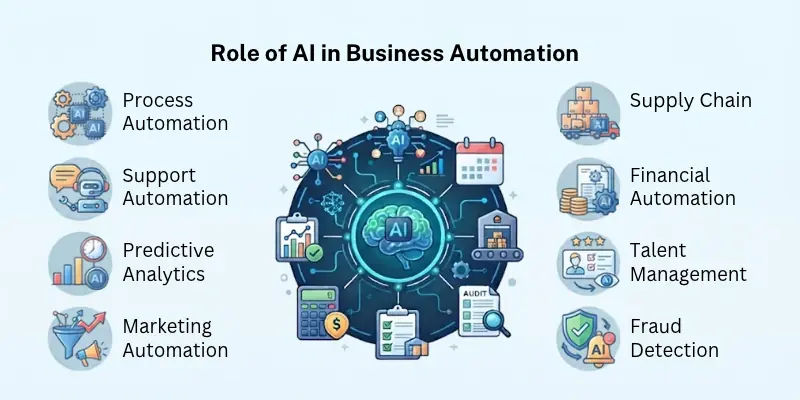
The role of AI in business automation goes beyond simple task automation. AI can analyze large amounts of data, identify patterns, optimize workflows, and support better decision-making. It helps businesses save time, reduce errors, and improve overall productivity.
AI also supports important business activities such as customer service, supply chain management, financial operations, marketing, and human resource management. By combining automation with intelligent systems, companies can improve their operations and allow employees to focus on more valuable work.
In this guide, we will explore the major roles of AI in business automation and explain how these technologies help businesses become more efficient and competitive.
Impact of AI in Business Automation
Artificial intelligence strengthens business automation by simplifying processes, analyzing business data, and supporting smarter decisions. It helps companies complete tasks faster, improve accuracy, and manage resources more effectively.
Here are 12 major roles of AI in business automation:
- Process Automation and Workflow Optimization
- Customer Support Automation
- Predictive Analytics for Business Decisions
- Sales and Marketing Automation
- Supply Chain and Inventory Management
- Financial and Accounting Automation
- Human Resource and Talent Management
- Data Collection and Reporting
- Fraud Detection and Security Monitoring
- Robotic Process Automation (RPA) Integration
- Personalized Customer Experience
- Decision Support Systems
Let’s explore each role in detail and understand how AI is helping businesses improve their daily operations.
1. Process Automation and Workflow Optimization
AI automates repetitive business tasks such as data entry, document processing, and appointment scheduling. These activities often take a lot of employee time when handled manually.
AI systems can identify workflow problems and suggest better ways to complete tasks. They help businesses organize work, reduce human errors, and maintain consistent processes. Employees can spend less time on routine activities and focus more on planning, problem-solving, and other important responsibilities.
As a result, business operations become faster, more organized, and more productive.
Additional Points:
- Automates repetitive tasks.
- Optimizes business workflows.
- Reduces common human errors.
- Improves operational efficiency.
- Increases overall productivity.
Why It Matters: Better workflows help businesses save valuable time and allow employees to focus on tasks that need human skills and attention.
2. Customer Support Automation
Customer support is an important part of every business. Customers expect quick answers when they have questions about products, services, orders, or payments.
AI supports customer service through chatbots, virtual assistants, and automated response systems. These tools can answer common questions, provide basic information, and guide customers through simple processes. Some systems also learn from previous interactions to improve their responses.
When a question is too complex, the system can direct the customer to a human support agent. This allows employees to focus on problems that need personal attention.
Additional Points:
- Provides quick answers to common questions.
- Reduces customer response times.
- Uses customer interactions to improve responses.
- Supports better customer satisfaction.
- Helps businesses manage more support requests.
Why It Matters: Automated support makes it easier for businesses to respond to customers quickly while giving human agents more time to solve complex issues.
3. Predictive Analytics for Business Decisions
Businesses collect large amounts of information about sales, customers, products, and market activity. AI can analyze historical data to identify patterns and estimate what may happen in the future.
For example, a company may use predictive analytics to estimate product demand, understand customer behavior, or identify possible business risks. These insights help managers prepare better plans and make decisions based on available evidence.
Although predictions are not always accurate, they can provide useful guidance when combined with human experience and business knowledge.
Additional Points:
- Analyzes historical business data.
- Identifies possible trends and risks.
- Supports strategic business decisions.
- Helps improve forecasting.
- Identifies potential growth opportunities.
Why It Matters: Predictive analytics helps businesses prepare for possible changes instead of depending only on past experience or guesswork.
4. Sales and Marketing Automation
Sales and marketing teams handle many activities, including finding potential customers, organizing leads, creating campaigns, and following up with prospects. AI helps automate several of these tasks.
It can support lead generation, audience segmentation, and campaign management. AI tools can also analyze customer information to suggest personalized marketing messages and identify suitable audiences for different offers.
Sales teams can use these insights to focus on promising leads and spend more time building customer relationships. Marketing teams can also review campaign performance and improve their strategies.
Additional Points:
- Automates lead management.
- Personalizes marketing campaigns.
- Improves audience targeting.
- Supports better conversion rates.
- Helps reduce operational costs.
Why It Matters: AI-supported sales and marketing automation helps businesses reach relevant audiences and manage campaigns with less manual effort.
5. Supply Chain and Inventory Management
Supply chain management involves purchasing, storing, and delivering products. Managing these activities manually can be difficult, especially for businesses with many products and customers.
AI helps monitor inventory levels, estimate product demand, and improve supply chain operations. It can analyze sales patterns and available stock information to suggest when businesses may need to order more products.
These insights can help companies avoid stock shortages and unnecessary extra inventory. AI can also support logistics planning and help businesses respond to changes in customer demand.
Additional Points:
- Monitors inventory levels.
- Predicts possible product demand.
- Optimizes supply chain operations.
- Helps reduce operational costs.
- Improves logistics efficiency.
Why It Matters: Smarter inventory and supply chain management helps businesses keep products available while reducing unnecessary storage and delivery costs.
6. Financial and Accounting Automation
Financial departments manage important activities such as invoicing, expense tracking, budgeting, and financial reporting. AI helps automate many repetitive accounting tasks and organize financial information.
For example, AI-supported systems can extract information from invoices, organize expenses, and assist with account reconciliation. They can also identify unusual patterns in financial records that may need further review.
These tools help reduce manual work and make financial reporting faster. However, important financial records and decisions should still receive suitable human review.
Additional Points:
- Automates invoicing and expense tracking.
- Identifies unusual financial patterns.
- Supports budgeting and reporting.
- Helps reduce accounting errors.
- Assists with financial planning.
Why It Matters: Financial automation helps accounting teams manage routine work more efficiently and spend more time on planning and financial analysis.
7. Human Resource and Talent Management
Human resource departments handle recruitment, employee onboarding, training, performance reviews, and workforce planning. AI can support these activities by automating repetitive administrative tasks.
For example, AI tools can help organize resumes, schedule interviews, answer common employee questions, and identify possible training needs. They can also organize performance information to help HR teams understand workforce development.
However, recruitment and employee decisions should not depend only on automated scores. Human review is important to reduce unfair outcomes and consider individual circumstances.
Additional Points:
- Supports recruitment processes.
- Organizes employee performance information.
- Helps improve employee engagement.
- Identifies training and development needs.
- Supports workforce management.
Why It Matters: AI can reduce administrative work in HR departments and give teams more time to support employees and improve workplace development.
8. Data Collection and Reporting
Businesses need accurate information to understand their performance and manage daily operations. Collecting and organizing data manually can take time and increase the possibility of mistakes.
AI helps collect, process, and analyze business information from different sources. It can also support automated report generation and help managers monitor Key Performance Indicators (KPIs).
These reports make it easier to review business activities, understand important changes, and identify areas that need improvement. Better data organization also supports faster and more informed decisions.
Additional Points:
- Automates data collection.
- Generates business reports.
- Monitors important KPIs.
- Supports evidence-based decisions.
- Reduces manual reporting work.
Why It Matters: Organized reports help businesses understand their performance and make decisions using clearer and more useful information.
9. Fraud Detection and Security Monitoring
Businesses handle sensitive information, financial transactions, and customer records. Protecting these resources is important for maintaining trust and avoiding financial losses.
AI can monitor transactions and digital systems to identify unusual activity. It can recognize patterns that may indicate fraud, suspicious account behavior, or possible security problems. When something unusual is detected, the system can send an alert for further investigation.
AI can also support compliance monitoring and help security teams respond to possible risks. However, automated alerts should be reviewed because unusual activity does not always mean fraud.
Additional Points:
- Detects potentially suspicious transactions.
- Monitors system security.
- Helps reduce financial losses.
- Supports compliance monitoring.
- Improves proactive risk management.
Why It Matters: AI-supported security monitoring helps businesses identify possible threats earlier and protect important business information.
10. Robotic Process Automation (RPA) Integration
Robotic Process Automation (RPA) uses software bots to perform repetitive tasks, such as copying information, moving data between systems, and processing standard forms.
AI can make RPA more capable by helping systems understand documents, classify information, and handle some tasks that involve less structured data. When integrated with existing business software, these technologies can reduce manual effort and improve process speed.
For example, a company may use RPA bots to transfer invoice information between applications, while AI helps extract important details from the documents.
Additional Points:
- Integrates AI with RPA tools.
- Automates structured and repetitive tasks.
- Reduces manual effort.
- Improves process speed and accuracy.
- Supports business growth and scalability.
Why It Matters: Combining AI with RPA helps businesses automate more work and allows employees to focus on activities that require judgment and problem-solving.
11. Personalized Customer Experience
Customers often expect businesses to understand their needs and provide relevant recommendations. AI helps companies analyze available customer information to create more personalized experiences.
It can study customer preferences, browsing activity, purchase history, and previous interactions. Businesses can use these insights to recommend products, customize offers, and improve customer communication.
For example, an online store may recommend products related to a customer’s previous purchases. A service provider may also use customer preferences to suggest suitable plans or services.
Additional Points:
- Delivers personalized experiences.
- Analyzes customer preferences.
- Improves customer engagement.
- Supports targeted marketing.
- Helps strengthen customer satisfaction and loyalty.
Why It Matters: Personalized experiences help customers find relevant products and services while building stronger relationships with businesses.
12. Decision Support Systems
Business leaders make decisions about finance, marketing, operations, employees, and future growth. AI-powered decision support systems help them understand available information and compare possible options.
These systems can analyze business data, identify patterns, and provide recommendations. For example, a manager may use an AI-supported system to review operational performance or understand which business areas need more resources.
AI provides useful insights, but human decision-makers should review its suggestions and consider business goals, risks, and real-world conditions before taking action.
Additional Points:
- Provides useful business insights.
- Supports strategic decision-making.
- Helps improve operational efficiency.
- Identifies possible risks.
- Supports business growth opportunities.
Why It Matters: Decision support systems help leaders make more informed choices while keeping human judgment at the center of important business decisions.
Future of AI in Business Automation
The future of AI in business automation looks promising as companies continue to adopt intelligent technologies. AI systems are expected to become more capable of handling repetitive work, analyzing business information, and supporting daily operations.
Businesses may use AI more widely in customer service, financial management, supply chains, recruitment, and marketing. Automation could also become more connected across different departments, allowing information to move between systems more smoothly.
In 2026 and beyond, AI may help companies improve workflow management, identify business risks, and make faster decisions. However, the level of automation will depend on the type of business, available technology, data quality, and human oversight.
Important Things to Remember:
- AI may automate more repetitive business activities.
- Customer support tools may become more helpful and responsive.
- Predictive analytics may support better planning.
- Businesses will need to protect data and maintain security.
- Human skills and judgment will remain important.
Companies that use AI responsibly and combine automation with employee expertise may be better prepared for changing business needs.
Final Note
In this guide, we explored the role of AI in business automation and discussed how it helps companies improve workflows, customer support, financial operations, marketing, and decision-making.
AI can make business activities faster and more organized by reducing repetitive work and providing useful insights. It also gives employees more time to focus on creative tasks, customer relationships, and important business decisions.
My advice is to start by identifying the tasks that take the most time in your business. Then, explore suitable AI tools that can simplify those activities. Always review automated results, protect business information, and make sure employees understand how these systems work.
Remember, successful automation is not about replacing every human task. It is about combining smart technology with human skills to build a more productive and reliable business.
Thank you for reading. Now, let’s explore some frequently asked questions about AI in business automation.
FAQs
Here are some commonly asked questions about the role of artificial intelligence in business automation. These answers will help you understand how AI supports business operations, employees, customers, and important decisions.
1. What is AI in business automation?
AI in business automation means using artificial intelligence to perform or support business tasks with less manual effort. It helps companies process information, identify patterns, and improve daily workflows.
For example, a business can use AI to answer common customer questions, organize invoices, analyze sales data, or support inventory management.
2. How does AI optimize business workflows?
AI helps businesses identify slow processes and automate repetitive activities. It can also suggest better ways to organize tasks. Some common improvements include:
- Automating data entry and document processing.
- Reducing repeated manual work.
- Identifying workflow delays.
- Improving task organization.
- Supporting faster business operations.
These improvements help employees complete their work more efficiently.
3. Can AI improve customer service?
Yes. AI can improve customer service through chatbots, virtual assistants, and automated response systems.
| AI Feature | Customer Service Benefit |
| Chatbots | Answer common questions |
| Virtual Assistants | Guide customers through simple tasks |
| Automated Responses | Reduce waiting time |
| Customer Data Analysis | Help understand customer needs |
Human support agents can then focus on complex questions that require personal attention.
4. Does AI replace employees?
No, AI does not have to replace employees. In many businesses, it works as a support tool that handles repetitive tasks and helps people complete their work more efficiently.
The main benefits for employees include:
- Less time spent on routine activities.
- More time for creative and strategic work.
- Better access to useful business information.
- Support with organizing and analyzing tasks.
Human judgment, communication, creativity, and problem-solving remain important in the workplace.
5. How does AI help in financial automation?
AI supports financial departments by automating routine accounting activities and analyzing financial information. For example, it can help with:
- Invoicing: Extracting information from invoices.
- Expense Tracking: Organizing business expenses.
- Reconciliation: Assisting with matching financial records.
- Anomaly Detection: Highlighting unusual transactions.
- Reporting: Preparing financial summaries.
Important financial records should still be checked by qualified employees.
6. Can AI improve marketing and sales automation?
Yes, AI can support many marketing and sales activities by analyzing customer information and automating repetitive tasks.
Quick Checklist:
- Identify potential customers.
- Organize leads into audience groups.
- Personalize marketing messages.
- Monitor campaign performance.
- Support sales follow-ups.
These features help teams manage campaigns more efficiently and focus on building customer relationships.
7. Is AI useful for supply chain management?
Yes, AI can support supply chain management by analyzing product demand, monitoring inventory, and helping businesses plan logistics.
For example, a retailer may use AI to estimate which products could sell more during a busy season. This information can help the company prepare stock and plan purchases.
AI can also help identify possible supply chain delays and support better operational planning.
8. How does AI support HR and talent management?
AI helps HR teams manage recruitment, employee information, onboarding, and training activities.
Common uses include:
- Organizing and reviewing resumes.
- Scheduling job interviews.
- Supporting employee onboarding.
- Identifying possible training needs.
- Organizing performance information.
AI can make HR work more efficient, but hiring and employee-related decisions should include fair human review.
9. Can AI detect fraud in business processes?
Yes, AI can analyze transactions and system activity to identify patterns that may indicate fraud or security problems.
For example, AI may help identify:
- Unusual payment activity.
- Suspicious account behavior.
- Repeated or abnormal transactions.
- Potentially fraudulent form submissions.
- Unusual access to business systems.
These alerts help security teams investigate possible threats. However, AI detection is not perfect, so suspicious activity should be reviewed before taking action.
10. What is the future of AI in business automation?
AI is expected to play a bigger role in business operations as automation technologies continue to improve. Some possible developments include:
- More intelligent workflow automation.
- Better customer service assistants.
- Improved demand and sales forecasting.
- Smarter financial and inventory management.
- More advanced business decision support.
Businesses may become more efficient by combining AI tools with employee expertise, reliable data, and responsible management.

Role of AI in Public Health Surveillance - Are We Ready for AI-Powered Health Protection?




- Be Respectful
- Stay Relevant
- Stay Positive
- True Feedback
- Encourage Discussion
- Avoid Spamming
- No Fake News
- Don't Copy-Paste
- No Personal Attacks
- Be Respectful
- Stay Relevant
- Stay Positive
- True Feedback
- Encourage Discussion
- Avoid Spamming
- No Fake News
- Don't Copy-Paste
- No Personal Attacks
