Role of AI in COVID-19 Pandemic – Discover the Technology Behind Faster Detection and Better Protection
Published: 4 Nov 2026
When I look at the global response to the COVID-19 pandemic, I clearly see how artificial intelligence played a major role in controlling and understanding the virus. AI has helped researchers, healthcare providers, and governments respond faster and more effectively.
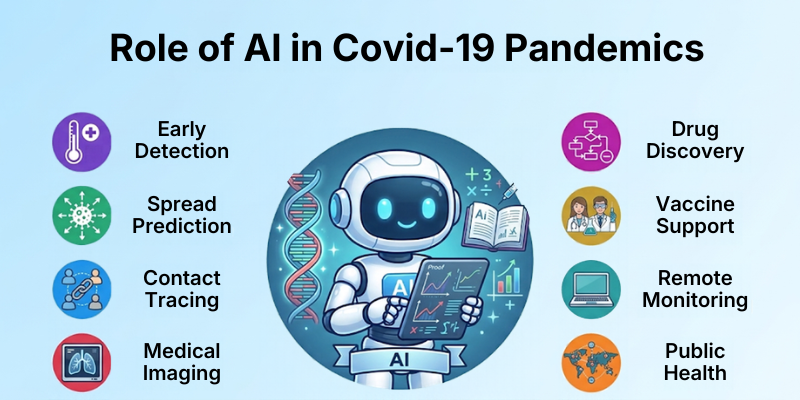
In simple words, COVID-19 is a highly contagious viral disease that caused a global health crisis starting in late 2019. Artificial intelligence has been used to track infections, analyze patient data, accelerate vaccine development, and predict outbreaks. It acts as a powerful tool to support human decision making during the pandemic.
In this guide, I’ll explain the top 10 roles of AI in the COVID-19 pandemic, how it supported healthcare and public health, and why it became crucial in managing the crisis.
Mostly, our focus will be on understanding the practical impact of AI during COVID-19.
Function of AI in the COVID-19 Pandemic
To properly understand the role of AI in the COVID-19 pandemic, you need to see where it created the most significant impact in healthcare, research, and public safety. Below are the top 10 applications of AI in managing and responding to COVID-19.
After listing them, I’ll explain each role in detail so you can clearly understand how AI supported global pandemic efforts:
- Early Detection and Diagnosis
- Predicting Virus Spread
- Contact Tracing and Risk Assessment
- Medical Imaging Analysis
- Drug Discovery and Repurposing
- Vaccine Development Support
- Monitoring Patient Health Remotely
- Public Health Policy Planning
- Chatbots and Virtual Health Assistants
- Pandemic Data Analysis and Forecasting
Let us cover all in detail.
1. Early Detection and Diagnosis
AI helped healthcare professionals detect COVID-19 cases quickly. By analyzing symptoms, lab tests, and patient data, AI assisted in identifying potential infections even before confirmatory testing in some cases.
AI also helped screen patients at airports and hospitals using symptom recognition systems. Early detection helped reduce virus spread and allowed faster treatment.
How It Works: AI algorithms analyze patient symptoms, medical records, and lab results to flag potential COVID-19 cases.
Benefits:
- Faster case identification
- Reduced virus transmission
- Supports testing prioritization
- Improves patient outcomes
This helped healthcare professionals identify suspected COVID-19 cases earlier, prioritize testing, and support timely medical care to limit further transmission.
2. Predicting Virus Spread
AI models predicted how COVID-19 would spread across regions and countries. By analyzing population data, mobility patterns, and previous infection rates, AI forecasted potential hotspots.
This helped governments plan lockdowns, allocate resources, and prepare hospitals. Predictive modeling became a key tool in pandemic management.
How It Works: Machine learning models analyze epidemiological and mobility data to predict infection trends.
Benefits:
- Anticipates outbreak hotspots
- Supports public health planning
- Guides resource allocation
- Reduces uncontrolled spread
These predictions helped governments anticipate infection hotspots, prepare healthcare facilities, and take timely measures to control the spread of COVID-19.
3. Contact Tracing and Risk Assessment
AI powered contact tracing apps and systems that tracked interactions between individuals. This helped identify people at risk of infection and contain outbreaks faster.
Risk assessment models also evaluated which patients were more likely to develop severe illness, helping hospitals prioritize care.
How It Works: AI processes location data, interaction histories, and health reports to identify high risk contacts.
Benefits:
- Faster identification of exposed individuals
- Reduced transmission
- Supports hospital triage
- Improves public safety
This enabled health authorities to identify exposed individuals more quickly, assess infection risks, and prioritize medical attention for vulnerable patients.
4. Medical Imaging Analysis
AI analyzed chest X-rays and CT scans to detect COVID-19 related lung abnormalities. It helped radiologists spot infections faster and with higher accuracy.
This was crucial in areas with limited testing capacity or overwhelmed healthcare systems. AI assisted imaging allowed quick diagnosis and patient management.
How It Works: Deep learning models analyze imaging scans to detect characteristic signs of COVID-19 pneumonia.
Benefits:
- Faster diagnosis
- High accuracy detection
- Supports overburdened radiologists
- Enhances patient care
As a result, AI assisted imaging helped radiologists examine lung abnormalities faster and support more informed decisions about COVID-19 patient care.
5. Drug Discovery and Repurposing
AI helped identify existing drugs that could be repurposed to treat COVID-19. It analyzed molecular structures, disease mechanisms, and previous drug data to find promising candidates.
This reduced the time needed for experimental trials and guided researchers toward the most effective options.
How It Works: AI models simulate drug virus interactions and predict potential therapeutic effectiveness.
Benefits:
- Accelerates treatment discovery
- Reduces research time
- Lowers development costs
- Supports clinical trials
This helped researchers identify promising existing medicines, narrow down treatment candidates, and accelerate the search for potential COVID-19 therapies.
6. Vaccine Development Support
AI assisted researchers in designing COVID-19 vaccines by predicting viral protein structures and immune responses. This supported faster development of safe and effective vaccines.
AI also helped prioritize vaccine candidates for trials based on predicted effectiveness and safety.
How It Works: AI analyzes viral genomics and immunological data to recommend vaccine designs.
Benefits:
- Faster vaccine development
- Improved candidate selection
- Supports global vaccination efforts
- Enhances immunization safety
These capabilities supported faster vaccine research, helped scientists evaluate promising candidates, and contributed to the development of COVID-19 vaccines.
7. Monitoring Patient Health Remotely
AI enabled tools and wearable devices monitored COVID-19 patients at home. These systems tracked oxygen levels, temperature, and other vital signs in real time.
Remote monitoring reduced hospital overcrowding and allowed early detection of worsening conditions.
How It Works: AI analyzes continuous health data from sensors and alerts doctors to abnormal changes.
Benefits:
- Continuous patient monitoring
- Reduces hospital load
- Early intervention for critical patients
- Improves home care
This allowed healthcare professionals to monitor COVID-19 patients outside hospitals, recognize warning signs earlier, and provide timely medical intervention when needed.
8. Public Health Policy Planning
AI supported governments and health organizations in planning effective COVID-19 interventions. By analyzing infection trends, AI helped guide lockdown decisions, testing strategies, and vaccination campaigns.
It enabled policymakers to make data driven decisions that minimized health risks while considering economic impacts.
How It Works: AI evaluates epidemiological data, social trends, and policy effects to recommend actions.
Benefits:
- Informed policy decisions
- Optimized resource use
- Reduced public health risks
- Supports pandemic management
This helped policymakers make evidence based decisions, direct healthcare resources effectively, and develop better strategies for managing the pandemic.
9. Chatbots and Virtual Health Assistants
AI powered chatbots provided instant guidance to the public during the pandemic. They answered questions about symptoms, testing locations, quarantine rules, and vaccine information.
These systems reduced the burden on healthcare hotlines and improved public access to accurate information.
How It Works: Natural language processing (NLP) enables chatbots to understand questions and provide accurate responses.
Benefits:
- Immediate information access
- Reduces healthcare staff workload
- Improves public awareness
- Supports remote guidance
As a result, people could access COVID-19 guidance more easily, receive timely health information, and find answers without placing additional pressure on healthcare services.
10. Pandemic Data Analysis and Forecasting
AI analyzed large scale global data, including case counts, mortality rates, and mobility trends, to forecast future waves of infection.
These forecasts helped health organizations prepare for hospital capacity, ventilator needs, and vaccine distribution.
How It Works: AI uses predictive analytics and machine learning to interpret global COVID-19 data trends.
Benefits:
- Accurate forecasting
- Better preparation for healthcare systems
- Supports vaccination planning
- Enables proactive pandemic response
These insights helped health organizations anticipate future infection waves, prepare medical resources, and strengthen their response to changing pandemic conditions.
Future of AI in Pandemic Management
The future of AI in pandemic management looks promising. AI will continue helping detect outbreaks faster, optimize healthcare resources, and accelerate treatment and vaccine development.
In future pandemics, AI driven surveillance, predictive modeling, and remote monitoring systems will become essential tools to protect public health.
Conclusion
In this guide, we covered the top 10 roles of artificial intelligence in the COVID-19 pandemic. From early detection and medical imaging to drug discovery, vaccine development, and public health planning, AI played a critical role in managing the crisis.
As technology evolves, AI will remain a vital partner in global pandemic response, improving preparedness, saving lives, and supporting healthcare systems worldwide.
FAQs: Role of AI in the COVID-19 Pandemic
Artificial intelligence played an important role in supporting the global response to COVID-19. These frequently asked questions explain how AI helped with disease detection, vaccine research, patient care, and pandemic management.
1. How was AI used in the COVID-19 pandemic?
AI supported several important areas during the pandemic, including:
- Disease detection: Analyzing symptoms and medical information.
- Contact tracing: Helping identify potential exposure.
- Outbreak prediction: Estimating infection trends.
- Medical research: Supporting treatment and vaccine development.
These applications helped health organizations respond more efficiently.
2. Did AI help in detecting COVID-19 infections?
Yes. AI supported COVID-19 screening by analyzing:
- Patient symptoms and health records.
- Laboratory test results.
- Chest X-rays and CT scan images.
These tools helped healthcare professionals assess suspected cases and support faster clinical decisions. However, they did not replace standard diagnostic tests.
3. How did AI support vaccine development?
AI helped scientists study viral structures, analyze immune responses, and identify promising vaccine targets. This supported research and development by helping researchers process complex scientific data more efficiently.
4. Can AI track the spread of COVID-19?
Yes. AI analyzed different types of data to help monitor infection patterns.
| Data analyzed | How it helped |
| COVID-19 case reports | Identified infection trends |
| Population movement | Helped assess possible transmission patterns |
| Regional health data | Highlighted potential outbreak areas |
These insights supported public health planning and intervention decisions.
5. Were AI powered chatbots helpful during the pandemic?
Yes. AI powered chatbots provided quick answers to common public health questions. They helped people:
- Understand common COVID-19 symptoms.
- Learn about safety measures and precautions.
- Find relevant health information.
- Get basic guidance without waiting for a hotline response.
This reduced pressure on some healthcare communication services.
6. Did AI assist in drug discovery for COVID-19?
Yes. AI supported drug discovery through several research steps:
- Analyzing existing medicines for possible antiviral activity.
- Predicting how drug compounds might interact with the virus.
- Identifying promising treatment candidates.
- Helping researchers prioritize further laboratory testing.
These applications supported the search for potential COVID-19 treatments.
7. How did AI improve patient monitoring?
AI assisted monitoring systems helped healthcare teams track patient health by analyzing vital signs, such as:
- Heart rate
- Oxygen saturation
- Respiratory rate
- Other important health measurements
When readings showed concerning changes, these systems could alert medical staff and support timely intervention.
8. Can AI prevent future pandemics?
AI cannot guarantee that future pandemics will be prevented, but it can help health authorities identify and respond to emerging threats.
A typical process includes:
- Collecting disease surveillance data.
- Identifying unusual infection patterns.
- Predicting possible outbreak trends.
- Supporting faster public health responses.
9. What challenges did AI face during COVID-19?
Despite its potential, AI faced several challenges during the pandemic:
- Data privacy: Protecting sensitive patient information.
- Data quality: Working with incomplete or inconsistent records.
- Limited access: Unequal availability of technology and digital infrastructure.
- Implementation: Integrating AI tools into existing healthcare systems.
These limitations affected how effectively AI could be used in different regions.
10. What is the future role of AI in pandemics?
AI is expected to remain an important support tool in future pandemic preparedness and response. Its potential applications include:
- Early disease detection and outbreak monitoring.
- Drug discovery and vaccine research.
- Remote patient monitoring.
- Disease spread prediction.
- Public health planning and resource management.
Continued development and responsible use could help health systems prepare for future outbreaks and respond more effectively.
Role of AI in Mathematics - Could Technology Unlock the Secrets Behind Complex Equations?




- Be Respectful
- Stay Relevant
- Stay Positive
- True Feedback
- Encourage Discussion
- Avoid Spamming
- No Fake News
- Don't Copy-Paste
- No Personal Attacks
- Be Respectful
- Stay Relevant
- Stay Positive
- True Feedback
- Encourage Discussion
- Avoid Spamming
- No Fake News
- Don't Copy-Paste
- No Personal Attacks
