The Role of AI in Pharmaceuticals in 2026 – Work Faster, Cure Sooner, and Transform Healthcare
Published: 9 Nov 2026
So guys, to understand the role of AI in pharmaceuticals means to explore how technology is changing the pharmaceutical industry. I want to show how AI is helping drug companies, researchers, and healthcare providers work faster and smarter.
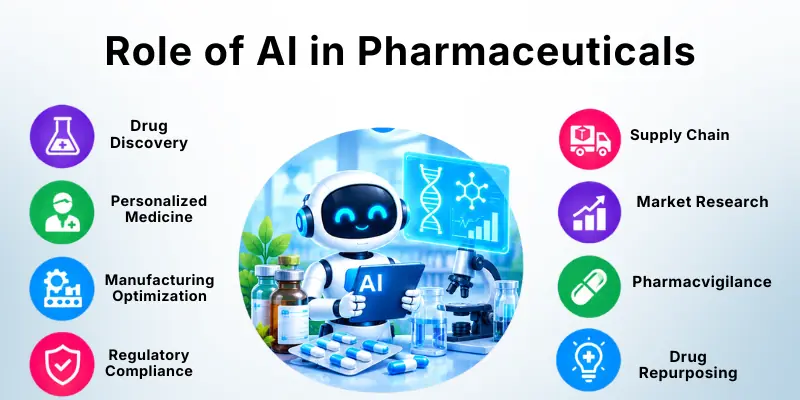
We will see how tasks that used to take months can now be done in weeks or days. AI improves drug discovery, clinical trials, patient care, and business operations.
Let’s explore the main roles of AI in pharmaceuticals.
Importance of AI in Pharmaceuticals
Here is the list of all the major roles of artificial intelligence in pharma sector:
- Drug Discovery and Design
- Clinical Trial Optimization
- Personalized Medicine
- Predictive Analytics for Drug Safety
- Manufacturing Process Optimization
- Supply Chain Management
- Market Research and Sales Forecasting
- Regulatory Compliance and Reporting
- Pharmacovigilance and Adverse Event Monitoring
- AI-Powered Patient Support
- Formulation Development
- Drug Repurposing
- Real World Data Analysis
- AI in Medical Imaging
- Research Collaboration and Knowledge Management
Let’s cover all these use cases in detail.
1. Drug Discovery and Design
I have seen AI help researchers find new drug candidates faster. It analyzes molecular structures and predicts which compounds might work. I feel more confident in choosing promising molecules. AI can simulate experiments and reduce lab time. It also identifies potential side effects early. This makes the drug discovery process much faster and cheaper.
Benefits:
- Speeds up drug discovery process
- Reduces research costs
- Predicts potential side effects early
- Identifies promising compounds efficiently
Examples:
- AI predicts molecular interactions in new drugs
- Platforms simulate drug activity before lab experiments
AI is making drug discovery faster, more cost effective, and more efficient by helping researchers identify promising drug candidates.
2. Clinical Trial Optimization
I notice AI helps design better clinical trials. It identifies suitable patients and predicts trial outcomes. I feel trials are safer and more efficient. AI can monitor patient data in real time. It reduces delays and costs. This improves the success rate of trials.
Benefits:
- Improves patient selection
- Reduces trial duration
- Enhances monitoring and safety
- Reduces costs and errors
Examples:
- AI identifies eligible patients for oncology trials
- Platforms predict dropout rates and outcomes
By reducing delays and improving trial design, AI supports faster, safer, and more cost effective clinical research.
3. Personalized Medicine
I see AI analyze patient data to recommend personalized treatments. It considers genetics, lifestyle, and medical history. I feel patients get care that works best for them. AI predicts response to drugs and dosage optimization. This helps improve treatment outcomes. Personalized medicine becomes more precise with AI support.
Benefits:
- Provides customized treatment plans
- Improves patient outcomes
- Optimizes drug dosage
- Reduces adverse reactions
Examples:
- AI recommends cancer therapy based on genetic profile
- Personalized drug plans for chronic diseases
AI is helping researchers and healthcare providers develop personalized treatments that better match each patient’s needs.
4. Predictive Analytics for Drug Safety
I notice AI predicts adverse reactions before drugs reach patients. It uses historical data and simulations. I feel safer launching new medicines. AI identifies potential risks and interactions early. It supports regulatory submissions and safety monitoring. This makes drug safety management more proactive.
Benefits:
- Predicts adverse effects before patient exposure
- Improves drug safety monitoring
- Supports regulatory compliance
- Reduces risks in drug development
Examples:
- AI predicts interactions between multiple drugs
- Platforms analyze historical trial data for safety patterns
AI-powered predictive analytics helps pharmaceutical companies identify potential drug safety risks earlier and improve patient protection.
5. Manufacturing Process Optimization
I see AI improve pharmaceutical manufacturing efficiency. It monitors production lines and identifies bottlenecks. I feel processes are more reliable and consistent. AI predicts maintenance needs and prevents downtime. This reduces waste and improves quality. Production becomes faster and safer with AI.
Benefits:
- Increases production efficiency
- Reduces errors and downtime
- Improves product quality
- Optimizes resource usage
Examples:
- AI predicts equipment maintenance in manufacturing
- Platforms monitor production parameters automatically
With AI-powered manufacturing, pharmaceutical companies can optimize production processes, reduce errors, and improve operational efficiency.
6. Supply Chain Management
I notice AI helps track inventory and shipments in real time. It predicts demand and prevents shortages. I feel confident medicines reach patients on time. AI optimizes logistics and reduces costs. This ensures smooth supply of critical drugs.
Benefits:
- Tracks inventory and shipments efficiently
- Prevents shortages and stockouts
- Reduces logistics costs
- Improves delivery reliability
Examples:
- AI predicts demand for vaccines in hospitals
- Platforms optimize pharmaceutical delivery routes
AI helps pharmaceutical companies manage inventory, forecast medicine demand, and deliver essential medicines more reliably.
7. Market Research and Sales Forecasting
I see AI analyze market trends and sales data. It predicts demand for medicines in different regions. I feel companies can plan production and marketing better. AI identifies new opportunities and customer needs. It helps sales teams focus on high impact areas.
Benefits:
- Predicts sales trends accurately
- Supports market strategy decisions
- Identifies new opportunities
- Optimizes marketing efforts
Examples:
- AI forecasts demand for seasonal flu vaccines
- Platforms analyze doctor prescribing trends
AI helps pharmaceutical companies understand market trends, forecast medicine demand, and make smarter business decisions.
8. Regulatory Compliance and Reporting
I notice AI ensures all processes follow pharmaceutical regulations. It monitors documentation and generates reports automatically. I feel compliance is easier and faster. AI reduces human errors in filings. It helps pass audits and inspections smoothly.
Benefits:
- Simplifies compliance management
- Reduces regulatory errors
- Speeds up report generation
- Supports audit readiness
Examples:
- Platforms check trial protocols against regulations
- AI auto generates regulatory submission documents
AI simplifies pharmaceutical regulatory compliance by automating documentation, reducing errors, and supporting accurate reporting.
9. Pharmacovigilance and Adverse Event Monitoring
I see AI monitor adverse events reported by patients or hospitals. It identifies safety concerns quickly. I feel safer managing post market drug risks. AI can detect patterns that humans may miss. This improves patient safety and reduces liabilities.
Benefits:
- Detects adverse events faster
- Improves patient safety
- Supports regulatory reporting
- Reduces risk and liability
Examples:
- AI analyzes social media for side effect reports
- Platforms track hospital adverse event data
AI strengthens pharmacovigilance by detecting potential drug safety concerns faster and supporting timely adverse event reporting.
10. AI-Powered Patient Support
I notice AI chatbots and virtual assistants help patients with medicine reminders, queries, and dosage guidance. Patients get instant help anytime. I feel this improves adherence and health outcomes. AI supports education and communication with patients. It reduces pressure on healthcare staff.
Benefits:
- Provides 24/7 patient support
- Improves medication adherence
- Reduces staff workload
- Enhances patient education
Examples:
- Chatbots answer questions about prescription drugs
- AI reminds patients to take medication on time
AI-powered patient support helps improve medication adherence, provide timely information, and make pharmaceutical services more accessible.
11. Formulation Development
AI helps predict the best drug formulations. It can suggest combinations, stability, and solubility. I feel development is faster and more precise. AI reduces trial and error in labs. Formulations are safer and more effective.
Benefits:
- Speeds up formulation design
- Improves drug stability and efficacy
- Reduces lab trial errors
- Optimizes resource usage
Examples:
- AI predicts tablet dissolution rates
- Platforms suggest optimal excipient combinations
With AI assisted formulation design, researchers can reduce trial and error and develop promising medicine formulations more efficiently.
12. Drug Repurposing
I notice AI finds new uses for existing drugs. It analyzes molecular data and previous studies. I feel companies can save time and money in research. Repurposing helps treat new diseases faster. AI identifies promising candidates efficiently.
Benefits:
- Reduces research costs
- Speeds up treatment discovery
- Finds new drug applications
- Supports innovative therapy development
Examples:
- AI identifies existing drugs for COVID-19 treatment
- Platforms analyze old compounds for new targets
By analyzing scientific studies and drug data, AI supports drug repurposing and helps researchers discover promising treatment opportunities.
13. Real World Data Analysis
AI analyzes patient data from clinics, wearables, and hospitals. I feel researchers get insights on drug effectiveness. It identifies trends, side effects, and outcomes. AI supports evidence based decision making. This improves clinical and commercial strategies.
Benefits:
- Provides insights from real patient data
- Detects trends and outcomes
- Supports evidence based decisions
- Improves drug development and marketing
Examples:
- Platforms analyze electronic health records
- AI evaluates wearable health data for trials
AI-powered real world data analysis helps researchers understand medicine effectiveness, identify safety trends, and make evidence based decisions.
14. AI in Medical Imaging
AI helps analyze imaging data for disease diagnosis or treatment monitoring. I feel doctors can detect conditions faster. It identifies patterns invisible to the human eye. AI improves accuracy in clinical decisions. This supports personalized medicine and research.
Benefits:
- Improves diagnostic accuracy
- Speeds up image analysis
- Supports clinical decision making
- Reduces human error
Examples:
- AI detects tumors in MRI scans
- Platforms analyze X-rays for early disease signs
AI in medical imaging helps healthcare professionals analyze scans more efficiently and supports disease detection and treatment monitoring.
15. Research Collaboration and Knowledge Management
AI helps organize research data and share insights among teams. I feel collaboration is smoother and faster. It finds relevant studies and past experiments quickly. AI supports knowledge management and innovation. Teams can build on prior work efficiently.
Benefits:
- Organizes research data effectively
- Improves collaboration among teams
- Speeds up innovation
- Supports knowledge sharing
Examples:
- AI platforms store and index published research
- Teams get automated recommendations for relevant studies
AI improves pharmaceutical research collaboration by organizing scientific knowledge, finding relevant studies, and helping teams share insights.
Benefits of AI in Pharmaceuticals (Role Based)
I have seen how AI helps everyone in pharmaceuticals: from researchers to patients. It makes work faster, easier, and more accurate.
For Researchers and Scientists:
- Speeds up drug discovery and testing
- Reduces errors in experiments and documentation
- Predicts potential side effects early
- Suggests better drug formulations
For Clinical Teams and Trial Managers:
- Helps select the right patients for trials
- Monitors patient safety during trials
- Reduces delays and trial costs
- Improves accuracy in trial results
For Production and Manufacturing Staff:
- Optimizes manufacturing processes
- Reduces errors in production lines
- Predicts equipment maintenance needs
- Improves product quality and consistency
For Regulatory and Compliance Teams:
- Organizes data for audits and submissions
- Ensures adherence to laws and guidelines
- Reduces human errors in reporting
- Supports faster regulatory approvals
For Marketing and Sales Teams:
- Predicts demand for medicines accurately
- Optimizes marketing and sales strategies
- Helps understand customer and market trends
- Increases efficiency in campaigns and launches
For Healthcare Providers and Patients:
- Offers personalized treatment suggestions
- Improves patient support and adherence
- Provides insights for safer therapy decisions
- Enhances communication and education for patients
Overall, AI helps pharmaceutical companies discover medicines faster, improve drug quality, reduce costs, and support safer and more effective patient care.
Challenges of AI in Pharmaceuticals
I have noticed that AI also brings challenges for pharmaceutical companies and researchers. It needs careful use and supervision to be effective.
Challenges (Overall):
- AI tools can be expensive to implement fully.
- Requires high quality and accurate data.
- Cannot fully replace human judgment in research.
- Privacy and security concerns with patient data.
- Some staff resist adopting new AI technology.
- AI may misinterpret complex biological systems.
- Ethical concerns in automated decision making.
- Limited understanding of rare or new conditions.
Overall, pharmaceutical companies must address these challenges carefully to ensure AI is used safely, ethically, and accurately while maintaining human supervision.
Future of AI in Pharmaceuticals
I believe AI will transform the pharmaceutical industry further in the coming years. More companies will adopt AI for drug discovery, clinical trials, and personalized medicine. Studies show AI could reduce drug development costs by up to 30% and shorten timelines by several months. I see AI improving patient care, predicting risks, and accelerating innovation. Companies that embrace AI will be faster, smarter, and more competitive.
Final Note
In this guide, we have explored the role of AI in pharmaceuticals, covering its main applications, benefits, challenges, and future potential. We explained how AI supports drug discovery, trials, patient care, and business operations with practical examples. AI is here to assist, not replace humans, making pharmaceutical work faster and smarter. To learn more, see the FAQs below. Goodbye!
FAQs: AI and Pharmaceuticals
Artificial intelligence in pharmaceuticals is transforming drug discovery, medicine production, clinical trials, and patient care. Here are answers to common questions about AI in the pharmaceutical industry and how it supports faster, smarter, and more efficient processes.
1. What is pharmaceutical technology?
Pharmaceutical technology involves the tools, techniques, and processes used to develop, manufacture, and test medicines. It helps improve drug quality, safety, and production efficiency. AI is making pharmaceutical technology more advanced by automating tasks and analyzing research data.
2. What does pharmaceutical technical mean?
Pharmaceutical technical refers to the practical methods and processes involved in pharmaceutical research, drug manufacturing, and quality control.
Key areas include:
- Laboratory testing and experiments
- Medicine production techniques
- Quality assurance and control
- Equipment monitoring and process optimization
AI helps pharmaceutical technical teams reduce errors and save time.
3. How is AI pharmaceuticals used in drug discovery?
AI in pharmaceuticals supports drug discovery through these steps:
- Analyze data: Examine molecular structures and scientific research.
- Identify candidates: Find compounds that may be effective against specific diseases.
- Predict outcomes: Estimate drug activity and potential risks.
- Support testing: Help researchers prioritize promising candidates for laboratory experiments.
These applications can accelerate early stage research and reduce development costs.
4. What is AI in pharma?
AI in pharma refers to using artificial intelligence to improve pharmaceutical research, production, and healthcare related activities.
Common applications include:
- Drug discovery and development
- Clinical trial optimization
- Manufacturing and quality control
- Drug safety monitoring
- Patient support and data analysis
5. How does pharmaceutical AI improve production?
Pharmaceutical AI improves production by monitoring manufacturing processes, detecting unusual patterns, and predicting equipment maintenance needs.
| Application | Main benefit |
| Production monitoring | Improves process efficiency |
| Predictive maintenance | Helps prevent unexpected downtime |
| Quality control | Identifies potential defects |
| Resource optimization | Reduces waste |
These applications support more consistent and efficient medicine manufacturing.
6. What is artificial intelligence in pharma and biotech?
Artificial intelligence in pharma and biotech uses AI software to analyze scientific data, support research, and accelerate the development of medicines and therapies.
It helps organizations:
- Identify promising drug candidates
- Analyze biological and molecular data
- Improve clinical trial planning
- Explore new treatment approaches
7. What do pharma companies do?
Pharma AI companies develop technologies that help pharmaceutical and biotechnology organizations improve research and operations. Their solutions commonly support drug discovery, clinical trials, manufacturing, and patient services.
They may provide AI software, predictive analytics, research platforms, and automated data analysis tools.
8. Can AI replace scientists in pharma?
No, AI cannot fully replace pharmaceutical scientists. Instead, it supports their work by analyzing large datasets, automating repetitive tasks, and identifying promising research opportunities.
Human expertise remains essential for:
- Interpreting scientific findings
- Designing and validating experiments
- Evaluating safety and effectiveness
- Making critical research decisions
9. How does AI help patients in pharmaceuticals?
AI can support patients by helping healthcare professionals personalize treatment, monitor potential medication risks, and improve communication.
Examples include:
- Medication reminders that support adherence
- Data analysis to help predict treatment responses
- Tools that assist with monitoring potential adverse reactions
- Virtual assistants that provide general medication information
Clinical decisions and personalized treatment recommendations should be appropriately reviewed by qualified healthcare professionals.
10. What is the future of AI in pharmaceuticals?
The future of AI in pharmaceuticals looks promising, with potential advances across drug research, manufacturing, and patient care.
Key developments to watch include:
- Faster identification of potential drug candidates
- More efficient clinical trials
- Improved manufacturing and quality control
- Better analysis of drug safety data
- Greater support for personalized medicine
As AI technology advances, pharmaceutical companies will need to prioritize data quality, patient safety, human oversight, and regulatory compliance.




- Be Respectful
- Stay Relevant
- Stay Positive
- True Feedback
- Encourage Discussion
- Avoid Spamming
- No Fake News
- Don't Copy-Paste
- No Personal Attacks
- Be Respectful
- Stay Relevant
- Stay Positive
- True Feedback
- Encourage Discussion
- Avoid Spamming
- No Fake News
- Don't Copy-Paste
- No Personal Attacks
