Role of AI in Healthcare in 2026 – Future Tech in Modern Treatments
Published: 29 Oct 2026
When I look at how technology is changing hospitals today, I see something truly powerful happening.
In healthcare, artificial intelligence means using smart computer systems that can learn from medical data to help doctors, nurses, and patients make better decisions. It helps read scans, predict diseases, manage records, and even assist during surgeries.
In this guide, I’ll walk you through how AI is being used across hospitals and clinics, how it’s helping in diagnosis and treatment, where it supports medical teams, and what challenges and future opportunities come with it. Mostly, our focus will be on comprehending the role of AI in healthcare.
What are the Major Roles of AI in Healthcare
Guys, to really understand the role of AI in healthcare, you first need to know where and how it’s being used. So here, I’ll start by listing the main applications of artificial intelligence in healthcare.
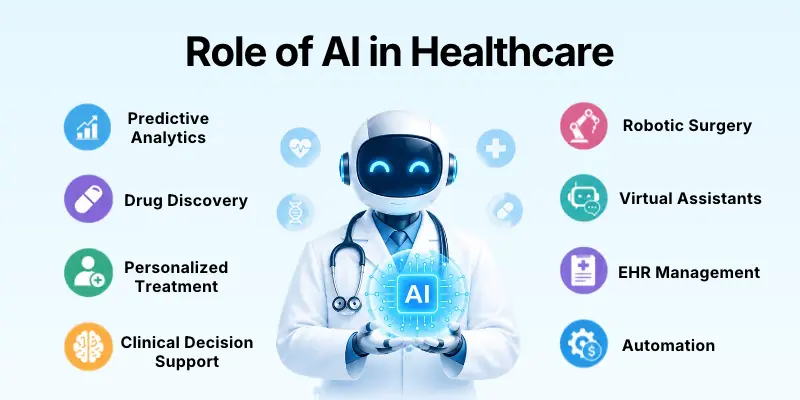
After that, I’ll explain the benefits of each one in detail so you can see how it helps doctors, nurses, and patients every single day.
List of 20 AI Applications in Healthcare:
- Disease Diagnosis and Early Detection
- Medical Imaging and Scan Analysis
- Predictive Analytics for Health Risks
- Drug Discovery and Development
- Personalized Treatment Plans
- Clinical Decision Support Systems
- Robotic Assisted Surgery
- Virtual Health Assistants and Chatbots
- Electronic Health Records (EHR) Management
- Administrative and Billing Automation
- Medication Management
- Patient Monitoring and Wearable Health Devices
- Clinical Trials and Data Analysis
- Natural Language Processing for Medical Notes
- Assessing Emergency and Ambulance Needs
- Healthcare Data Entry and Reporting
- Remote Patient Care and Telemedicine
- Mental Health and Behavioral Analysis Tools
- AI in Traditional Medicine and Holistic Care
- Hospital Workflow and Resource Optimization
Now, let’s cover each of these applications in detail and see how they’re improving healthcare for everyone.
1. Disease Diagnosis and Early Detection
AI helps doctors spot diseases much earlier than traditional methods. It studies thousands of medical records and test results within seconds.
By comparing patterns, it can alert doctors when something looks unusual. This makes it easier to identify issues like cancer, diabetes, or heart disease at an early stage. The goal is to start treatment before the illness gets worse.
How It Works: AI tools analyze lab tests, imaging results, and patient histories to find early warning signs.
Benefits:
- Detects diseases early
- Improves survival rates
- Reduces manual workload for doctors
- Helps plan preventive care
Early disease detection can help doctors start treatment sooner and improve patient care. AI in healthcare also helps medical teams find warning signs and focus on patients who may need quick attention. Doctors still review AI results before making final treatment decisions.
2. Medical Imaging and Scan Analysis
Doctors rely on scans like X-rays, MRIs, and CTs to see inside the body. AI supports them by reading these images faster and more accurately.
It draws attention to minute details that the human eye may overlook. This helps radiologists make stronger and quicker decisions. It’s especially useful in detecting tumors, fractures, or organ damage.
How It Works: AI uses deep learning to study thousands of medical images and identify patterns linked to diseases.
Benefits:
- Improves diagnostic accuracy
- Saves time for radiologists
- Detects minor issues early
- Reduces the chances of human error
AI in medical imaging helps doctors review X-rays, MRIs, and CT scans more quickly. It can highlight possible problems and support faster diagnosis and better patient care. A qualified doctor or radiologist should always confirm the final results.
3. Predictive Analytics for Health Risks
Predictive analytics means using data to forecast what might happen next. In hospitals, it helps doctors predict which patients are at higher risk of certain diseases.
It studies medical history, age, lifestyle, and lab reports to make these predictions. This allows doctors and nurses to take action before the condition becomes serious. It also helps hospitals plan emergency needs better.
How It Works: AI models process large health datasets to find patterns that signal risk or potential health decline.
Benefits:
- Prevents complications before they happen
- Improves hospital planning and ambulance readiness
- Reduces emergency admissions
- Supports preventive healthcare
AI predictive analytics helps doctors identify patients who may face higher health risks. Early warnings can support better patient monitoring, preventive care, and faster medical action. These AI predictions support doctors but do not replace professional medical decisions.
4. Drug Discovery and Development
Creating a new drug usually takes years, but AI makes this process much faster. It studies chemical structures, disease behavior, and past drug data to find the best possible formulas.
It can also predict how a drug will react in the body before testing starts. This helps researchers avoid failed experiments and focus on promising compounds. As a result, life saving medicines reach patients sooner.
How It Works: AI analyzes biological and chemical data to identify drug candidates and simulate their performance.
Benefits:
- Speeds up drug research
- Lowers development costs
- Improves safety testing accuracy
- Boosts innovation in medicine
AI in drug discovery helps researchers find promising medicines faster and with less time and cost. It can also help scientists study possible drug effects before moving to more advanced testing. This can support the development of safer and more effective medicines.
5. Personalized Treatment Plans
Every patient is different, and AI helps doctors treat them that way. It studies individual data like genetics, health history, and lifestyle habits.
Using this information, it suggests treatments designed for that one person instead of general plans. This makes care more accurate and effective. It’s like giving each patient a custom made therapy.
How It Works: AI combines genetic data and clinical information to find the most suitable treatment for each individual.
Benefits:
- Improves treatment results
- Reduces side effects
- Makes care patient centered
- Helps doctors choose the right medicine or dosage
In personalized medicine this AI helps doctors create treatment plans based on each patient’s needs. By studying health and genetic data, AI can support better medicine choices and more accurate treatment. This can improve patient care while reducing the risk of unwanted side effects.
6. Clinical Decision Support Systems
Doctors often need to make quick and complex decisions. AI-based clinical support systems help them by giving evidence based suggestions. These tools study symptoms, reports, and medical literature to recommend the best steps.
They don’t replace doctors but make their choices smarter and safer. As discussed earlier, this system may also work with EHR data for more precise guidance.
How It Works: AI scans large medical databases to match a patient’s condition with proven treatment options.
Benefits:
- Supports faster decision making
- Reduces medical errors
- Ensures treatments follow latest research
- Saves time during diagnosis
In clinical decisions it gives doctors useful information when they need to make important medical decisions. It can help them review patient data, find treatment options, and follow the latest medical research. These systems support doctors while keeping human judgment at the center of patient care.
7. Robotic Assisted Surgery
In modern operating rooms, AI powered robots work side by side with surgeons. They help in making precise cuts, reducing blood loss, and minimizing recovery time.
Surgeons still stay in full control, but the robot provides stability and accuracy. This is very useful in complex or delicate surgeries where precision matters most.
How It Works: Robots use AI algorithms, cameras, and sensors to assist in surgical movements.
Benefits:
- Improves surgical accuracy
- Reduces operation time
- Shortens patient recovery
- Lowers complication risks
AI powered robotic surgery can help surgeons perform delicate procedures with greater control and precision. It may also support faster recovery and better patient care in suitable cases. The surgeon remains responsible for the procedure and makes the final medical decisions.
8. Virtual Health Assistants and Chatbots
Virtual assistants talk to patients just like a nurse or receptionist would. They help book appointments, remind people to take medicines, and answer simple health questions.
These tools are available 24/7, which makes healthcare more accessible. Patients get instant guidance without waiting in long queues.
How It Works: These assistants use natural language processing to understand patient questions and respond with helpful answers.
Benefits:
- Improves patient engagement
- Reduces hospital front desk load
- Provides quick access to health info
- Supports remote patient care
AI health assistants make it easier for patients to get basic healthcare information and support at any time. They can reduce waiting times and help healthcare staff manage routine questions and tasks. For serious symptoms or medical concerns, patients should still speak with a qualified healthcare professional.
9. Electronic Health Records (EHR) Management
Hospitals collect huge amounts of data every day. Managing these records manually takes time and often causes errors. AI helps organize and update patient files quickly and correctly.
It also keeps information safe and easy to find for doctors and nurses. As discussed earlier, this data can also support clinical decision tools.
How It Works: AI systems automatically scan, sort, and update EHRs while maintaining privacy rules.
Benefits:
- Keeps records accurate and updated
- Saves time for medical staff
- Reduces paperwork errors
- Supports better patient tracking
In healthcare records this helps medical teams find important patient information more quickly and easily. Better EHR management can reduce paperwork and support more organized patient care. Strong privacy and security measures are also important when handling sensitive health data.
10. Administrative and Billing Automation
Behind every hospital visit, there’s a lot of paperwork and billing work. AI takes care of those routine jobs so staff can focus more on patient care.
It handles appointment scheduling, insurance claims, and billing with high accuracy. This reduces costs and keeps things running smoothly.
How It Works: AI tools process administrative data, automate repetitive tasks, and flag billing errors.
Benefits:
- Cuts administrative workload
- Speeds up billing and claims
- Lowers operational costs
- Improves hospital efficiency
AI automation helps hospitals handle routine administrative tasks with less manual work. Faster billing, scheduling, and claims processing can save time and improve healthcare services. This allows staff to spend more time supporting patients and other important hospital tasks.
11. Medication Management
Managing medicines is a daily task in every hospital and clinic. AI helps doctors, nurses, and patients track the right drugs, doses, and timings.
It warns when two medicines might react badly together. It can also remind patients when to take their prescriptions. This reduces mistakes and makes treatment safer for everyone.
How It Works: AI tools monitor prescriptions, flag unsafe combinations, and send alerts for dosage schedules.
Benefits:
- Prevents wrong medication use
- Improves treatment safety
- Reminds patients on time
- Helps doctors adjust doses accurately
AI medication management can help healthcare teams check prescriptions, doses, and possible drug interactions. Timely alerts can reduce medication mistakes and make treatment safer for patients.
Doctors and pharmacists should still review AI suggestions before making changes to medicines or doses.
12. Patient Monitoring and Wearable Health Devices
Today, patients can be monitored even when they’re at home. Smart wearable devices collect health data like heart rate, oxygen levels, and sleep patterns.
AI studies this data in real time and alerts doctors if anything unusual happens. This makes care continuous and not limited to hospital walls. It also helps patients stay more aware of their health.
How It Works: AI processes live data from smartwatches, sensors, or patches to detect health changes instantly.
Benefits:
- Enables remote health tracking
- Warns early about health issues
- Reduces hospital readmissions
- Keeps patients informed and active in their care
AI powered wearable health devices make it easier to track important health information outside the hospital. Real time monitoring can help doctors notice changes early and provide timely care. These tools also encourage patients to take a more active role in managing their health.
13. Clinical Trials and Data Analysis
AI makes clinical trials faster, safer, and more accurate. It helps choose the right participants and studies massive datasets to predict how people might respond to new drugs.
It can even track trial progress and spot unusual results early. As discussed earlier in the drug discovery section, this makes research more efficient and less costly.
How It Works: AI analyzes trial data in real time to improve study accuracy and patient selection.
Benefits:
- Shortens trial timelines
- Improves result reliability
- Lowers research costs
- Detects risks earlier in the process
In clinical trials, AI helps researchers manage large amounts of data and make studies more efficient. Faster data analysis can help researchers find useful results and possible safety concerns sooner. This can support the development of new medicines and improve clinical research.
14. Natural Language Processing for Medical Notes
Doctors write large amounts of notes every day. AI with natural language processing (NLP) can read and understand these notes automatically.
It converts unstructured text into useful, searchable medical data. This helps in better documentation and faster decision making. It also saves doctors time that they can spend with patients instead.
How It Works: NLP tools read, interpret, and organize free text notes, prescriptions, or reports.
Benefits:
- Converts handwritten or typed notes into data
- Reduces manual entry time
- Improves record accuracy
- Makes patient information easier to access
AI powered NLP makes it easier for healthcare teams to organize and search medical information. By reducing manual note taking and data entry, it gives doctors more time to focus on patient care. Accurate digital records can also support faster and better healthcare decisions.
15. Assessing Emergency and Ambulance Needs
AI helps hospitals and emergency teams plan better for critical cases. It predicts when and where ambulance needs may rise by studying patterns like time, traffic, and past emergencies.
This helps ensure quicker responses and better resource use. It can even guide ambulances to less crowded hospitals.
How It Works: AI systems analyze real time and historical data to forecast emergency demand and guide dispatch.
Benefits:
- Improves ambulance response time
- Helps hospitals prepare for surges
- Reduces delays in emergency care
- Saves more lives through faster actions
It helps emergency teams use real time data to plan faster responses when demand increases. Better ambulance planning can reduce delays and help hospitals prepare for incoming patients. In emergencies, these faster actions can support better patient outcomes.
16. Healthcare Data Entry and Reporting
Data entry is a tiring task for medical staff. AI makes it simple and accurate by filling in details automatically. It reads scanned forms, lab reports, or prescriptions and adds them to digital systems. As mentioned earlier in EHR management, this reduces errors and saves time for doctors and nurses.
How It Works: AI scans and extracts data from documents, then updates digital records automatically.
Benefits:
- Reduces manual data entry
- Improves accuracy and speed
- Saves hospital staff time
- Keeps records consistent
AI powered data entry helps healthcare workers move information from documents into digital systems more quickly. Accurate records can reduce common data entry mistakes and make patient information easier to manage. This allows doctors and nurses to spend less time on paperwork and more time caring for patients.
17. Remote Patient Care and Telemedicine
AI plays a big role in online doctor visits and remote care. It helps doctors examine symptoms through video calls and shared health data.
Patients living far from hospitals can now receive the same attention as those in cities. This is changing the way care is delivered around the world.
How It Works: AI tools assist telemedicine platforms by analyzing patient information and guiding online consultations.
Benefits:
- Expands access to healthcare
- Reduces hospital crowding
- Makes follow up visits easier
- Improves rural and remote care
In telemedicine AI makes remote healthcare more convenient for patients who cannot easily visit a hospital. It helps doctors review patient information and provide better support during online consultations. This can make healthcare more accessible for people in rural and remote areas.
18. Mental Health and Behavioral Analysis Tools
Mental health care is becoming more data driven. AI tools analyze speech, facial expressions, and typing behavior to spot signs of anxiety or depression early.
They can help therapists track patient progress more effectively. These tools never replace human care but give doctors more insight into emotional health.
How It Works: AI studies communication and behavioral patterns to detect mood changes or stress signals.
Benefits:
- Detects early signs of mental illness
- Supports therapists with real insights
- Monitors patient progress remotely
- Promotes timely mental health support
Mental health tools of AI can help healthcare professionals notice changes in behavior and provide support earlier. They can also make it easier to track a patient’s progress between appointments. These tools should support professional mental health care rather than replace therapists or doctors.
19. AI in Traditional Medicine and Holistic Care
Many cultures have strong roots in traditional and herbal medicine. AI helps merge those practices with modern healthcare.
It studies natural remedies, patient data, and medical history to find safe combinations. This helps doctors offer balanced, holistic care that respects both science and tradition.
How It Works: AI compares clinical and herbal data to understand interactions and benefits.
Benefits:
- Combines modern and traditional treatments
- Promotes safer use of herbal medicine
- Expands research in alternative therapies
- Supports personalized wellness plans
It can help researchers study traditional and herbal treatments using modern health data. This may improve understanding of possible benefits, risks, and interactions between different treatments. Medical professionals should still review the safety of herbal or alternative therapies before use.
20. Hospital Workflow and Resource Optimization
Hospitals run smoother when systems are well organized. AI helps manage beds, equipment, and staff schedules efficiently.
It predicts patient flow so hospitals can prepare resources ahead of time. This improves both care and cost control. As discussed earlier in administrative automation, this also supports hospital efficiency.
How It Works: AI studies hospital data to optimize schedules, staff allocation, and resource use.
Benefits:
- Reduces patient waiting time
- Improves use of hospital resources
- Cuts operational costs
- Enhances overall hospital performance
It helps hospitals manage staff, beds, equipment, and patient flow more efficiently. Better resource planning can reduce waiting times and help healthcare teams respond to changing patient needs. This can improve hospital operations while supporting better patient care.
Benefits of AI in Healthcare
AI is changing healthcare by making many medical tasks faster, easier, and more organized. It can support healthcare workers, improve patient experiences, and help hospitals use their resources more effectively in many ways.
1. For Doctors and Nurses
AI tools can help doctors and nurses handle daily tasks with less effort. They can quickly organize medical information, support diagnosis, and provide useful insights during patient care.
It helps find problems early, gives quick reports, and reduces paperwork. Doctors make better choices and save time.
- Faster diagnosis
- Less stress and paperwork
- Better teamwork
These benefits give healthcare professionals more time to focus on patients. AI can also support better communication and help medical teams make informed decisions.
2. For Patients
AI can make healthcare more convenient by helping patients receive information, reminders, and support when they need it. It can also make remote healthcare and regular health tracking easier.
- Safe and personal treatment
- Easy follow ups and reminders
- Care from anywhere
With AI powered healthcare tools, patients can stay more involved in their treatment and health. Faster support and easier access to care can also improve the overall patient experience.
3. For Hospitals
AI helps hospitals manage large amounts of data, staff, equipment, and daily tasks more efficiently. Better planning can reduce delays and help hospitals provide smoother healthcare services.
- Lower costs
- Better planning
- Faster service
AI can help hospitals reduce unnecessary work and make better use of their available resources. This can improve hospital efficiency while allowing staff to spend more time on patient care.
Challenges and Limitations of AI in Healthcare
AI offers many benefits in healthcare, but it also comes with some important challenges. Hospitals and healthcare teams need to consider these issues carefully before using AI systems.
Here are some common AI challenges in healthcare that can affect patient safety, costs, privacy, and the quality of medical care. I’ve also seen that using technology in healthcare is not always easy. There are still some big challenges to handle.
- Data Privacy: Patient records contain sensitive information and must be kept secure. Protecting large amounts of health data from unauthorized access can be difficult.
- High Costs: Setting up AI systems, software, and equipment can be expensive. Smaller hospitals may find it harder to afford these technologies.
- Lack of Training: Doctors, nurses, and other staff need proper training to use AI tools correctly. Without enough training, users may not get the full benefits of these systems.
- Errors and Bias: AI can sometimes give incorrect results when the data is incomplete, poor quality, or biased. This can lead to wrong suggestions or unfair results.
- Ethical Concerns: AI should support healthcare professionals rather than replace human judgment. Doctors must consider the patient’s needs, safety, and well being when making final decisions.
These challenges show why responsible AI in healthcare is important. Strong data security, proper staff training, regular testing, and human oversight can help reduce risks and make AI safer for patients.
Future of AI in Healthcare
From what I see, the future of healthcare looks even smarter and more connected. Technology will help doctors treat patients faster and more safely. Remote care will grow, and more people will get medical help at home.
Hospitals will use smart systems to plan work and manage patients better. I believe human care and technology will continue to work together to make health services stronger for everyone.
Conclusion
In this guide, we have covered how artificial intelligence in healthcare is reshaping modern medicine. I’ve explained how it helps doctors, nurses, and hospitals deliver smarter and faster care. The rise of healthcare AI brings better diagnosis, stronger data systems, and more personal treatment for patients.
From AI in hospitals to home based care tools, the future of medical artificial intelligence looks full of promise. As AI and healthcare continue to grow together, we’ll see more trust, better outcomes, and a stronger medical world for everyone.
FAQs About AI in Healthcare
These frequently asked questions explain the role of artificial intelligence in healthcare, its real world uses, and its benefits for patients and doctors. Learn how AI supports medical research, diagnosis, and hospital care.
1. What is AI in healthcare and how does it work?
AI in healthcare uses smart computer systems to analyze medical data and support healthcare professionals. It can help identify disease patterns, review medical scans, and support treatment decisions, but doctors remain responsible for patient care.
2. How has AI impacted the health industry so far?
AI is helping healthcare providers improve several tasks, including:
- Disease detection: Finding signs of illness in medical scans.
- Patient monitoring: Tracking health changes over time.
- Hospital management: Organizing records and routine tasks.
- Medical research: Supporting the search for new treatments.
3. What are some real life uses of artificial intelligence in the medical field?
Common uses of AI in the medical field include:
- Analyzing X-rays and other medical images.
- Helping doctors review patient records.
- Supporting drug discovery and medical research.
- Monitoring patients through digital health tools.
These applications can support medical teams, but their results need proper review.
4. How is artificial intelligence used in healthcare today?
Artificial intelligence is used in both patient care and hospital operations.
| Area | Example of AI Use |
| Medical diagnosis | Analyzing scans for possible warning signs |
| Patient care | Supporting health monitoring |
| Medical research | Studying data for drug discovery |
| Hospital operations | Helping organize records and schedules |
5. What benefits does healthcare AI bring to patients?
Healthcare AI can help patients receive more timely support and care suited to their needs. Its potential benefits include:
- Faster analysis of some medical tests.
- Reminders for appointments and medication.
- Remote health monitoring.
- Support for personalized treatment planning.
The actual benefits depend on the tool, the patient’s needs, and medical supervision.
6. How does AI support hospital operations and staff?
AI can reduce some routine administrative work, helping hospital staff spend more time on patient care. For example, it can assist with appointment scheduling, billing tasks, record management, and report preparation.
7. What is the role of AI in drug discovery and medical research?
AI in medical research helps scientists study large amounts of data and identify promising drug candidates. The process may involve these steps:
- Analyze biological and chemical data.
- Identify possible drug candidates.
- Help researchers prioritize further testing.
- Support the analysis of research results.
New medicines still require careful laboratory testing and clinical trials.
8. How is AI changing traditional medical practices?
AI is adding digital support to traditional medical practices rather than replacing doctors. Healthcare professionals can combine their medical knowledge with AI-generated insights to help assess conditions and plan care.
9. How is AI improving innovation in healthcare?
AI innovation in healthcare is supporting new ways to monitor health, analyze medical information, and assist with diagnosis. Wearable devices, predictive tools, and AI-assisted medical imaging are examples of this progress.
10. What challenges come with artificial intelligence in healthcare?
Despite its benefits, the use of AI applications in healthcare comes with important challenges:
- Data privacy: Protecting sensitive patient information.
- High costs: Paying for systems and maintenance.
- Accuracy: Checking results for errors or bias.
- Staff training: Teaching healthcare workers to use tools correctly.
- Human oversight: Keeping doctors involved in important decisions.
Responsible use, secure data handling, and regular checks can help reduce these risks.






- Be Respectful
- Stay Relevant
- Stay Positive
- True Feedback
- Encourage Discussion
- Avoid Spamming
- No Fake News
- Don't Copy-Paste
- No Personal Attacks
- Be Respectful
- Stay Relevant
- Stay Positive
- True Feedback
- Encourage Discussion
- Avoid Spamming
- No Fake News
- Don't Copy-Paste
- No Personal Attacks
