Role of AI in Legal Services in 2026: AI Is Transforming Law firms
Published: 14 Nov 2026
I have seen how technology changes the legal world. Computers can now read documents, find important rules, and help lawyers work faster. This makes the work easier and more accurate.
Today, I want to explain the role of AI in legal services. I will show how it helps lawyers, law firms, and clients in daily tasks. You will understand the main uses and why it matters for modern legal work.
So, what are you waiting for? Let’s dive in with me!
Function of AI in Legal Services
So guys, to understand the role of AI in legal services means to make a deep analysis of the applications of AI in legal work. I want to show how technology is making things easier for the legal services industry.
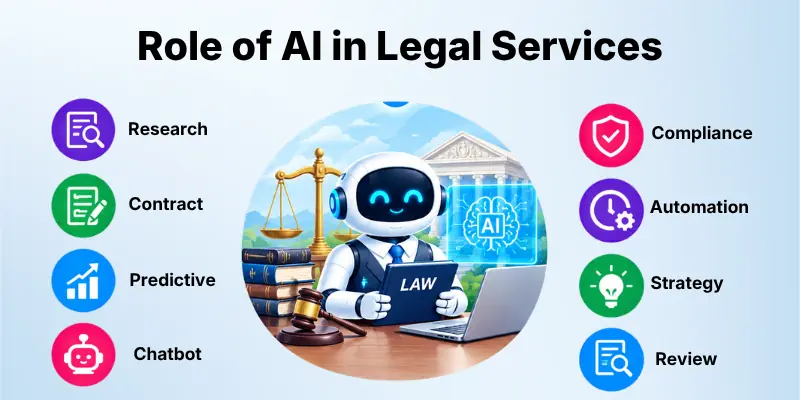
So, everyone, let’s explore the main role of AI in legal services.
- Legal Research Automation
- Contract Analysis and Management
- Predictive Analysis for Case Outcomes
- Document Review and eDiscovery
- Legal Chatbots and Client Support
- Compliance and Risk Monitoring
- Billing and Time Management Automation
- Intellectual Property Management
- Litigation Strategy Assistance
- Case Summarization
- Evidence Analysis
- Legal Translation Services
- Regulatory Change Tracking
- Fraud Detection and Prevention
- Client Onboarding Automation
- Legal Drafting Assistance
- Sentiment and Jury Analysis
- Case Prioritization
- Knowledge Management
- Workflow Automation
- Legal Training and Education Tools
- Due Diligence Automation
- Legal Risk Scoring
- Custom Alerts and Notifications
- Case Outcome Reporting
Let’s cover all these use cases in detail.
1. Legal Research Automation
I have noticed that finding the right case or law manually can take hours. With AI, I can quickly search through thousands of legal documents. It reads the content and finds what is important. I see it as a personal assistant that never misses a detail. This tool understands legal words and phrases. I can spend more time thinking about strategy instead of reading papers.
Benefits:
- Speeds up legal research
- Reduces mistakes in finding cases
- Saves lawyers’ time
- Helps in making better decisions
Examples:
- ROSS Intelligence helps lawyers find cases fast
- Casetext provides instant legal references
AI makes legal research faster, easier, and more accurate. This helps lawyers find relevant cases quickly and focus on building stronger legal strategies.
2. Contract Analysis and Management
I use AI to check contracts in minutes. It can find missing clauses or risks that I might miss. I see how it compares my contract with many templates. It points out errors and ensures compliance. This helps me feel confident before sending a contract. AI also tracks changes and organizes contracts for easy access.
Benefits:
- Reduces manual review time
- Ensures contracts are accurate
- Minimizes risks and errors
- Saves time in contract management
Examples:
- Kira Systems checks contracts for risks
- Luminance helps firms manage large agreements
AI helps lawyers review contracts with greater confidence. It turns a time consuming task into a faster and more organised process.
3. Predictive Analysis for Case Outcomes
I have tried using AI to predict case results. It studies past judgments and patterns. I can see possible outcomes and plan strategy better. This does not replace lawyers but helps me guide clients. AI can also suggest legal arguments that might work. I feel more prepared for every case with this support.
Benefits:
- Helps plan case strategy
- Reduces risk of surprises in court
- Supports data driven decisions
- Improves client advice
Examples:
- AI tools predict success rates in civil and criminal cases
- Law firms use predictions to decide settlements
AI helps lawyers predict possible case outcomes and prepare better legal strategies. This allows them to make informed decisions and guide clients with greater confidence.
4. Document Review and eDiscovery
I have seen how AI reviews thousands of files quickly. It finds relevant information for a case. I no longer spend days reading documents. AI highlights what matters. I can focus on using the information, not searching for it. This makes large cases easier to handle.
Benefits:
- Speeds up document review
- Reduces human errors
- Handles large volumes of data
- Saves time for lawyers
Examples:
- Relativity automates eDiscovery for big cases
- Everlaw organizes and reviews documents efficiently
AI helps lawyers find important details in thousands of documents in less time. As a result, they can organise evidence more easily and focus on the most important parts of a case.
5. Legal Chatbots and Client Support
I like using AI chatbots to answer client questions. They provide quick responses even when I am busy. Clients can ask routine questions about cases or documents. This frees me to handle more important tasks. Chatbots can schedule meetings or share information instantly. I feel my clients get better service this way.
Benefits:
- Improves client communication
- Saves time for lawyers
- Answers common questions fast
- Enhances client experience
Examples:
- DoNotPay helps with legal queries online
- Law firms use chatbots for appointment scheduling
AI chatbots make it easier for clients to get information and receive timely responses. As a result, lawyers can manage their workload better while improving the client experience.
6. Compliance and Risk Monitoring
I use AI to stay updated with new laws. It checks if actions follow regulations. This protects me and my clients from risks. AI tracks changes in laws automatically. I feel safer knowing nothing is missed. It also warns me about possible legal problems before they happen.
Benefits:
- Ensures compliance with laws
- Reduces legal risks
- Saves time in monitoring regulations
- Improves firm credibility
Examples:
- Compliance platforms track regulatory changes in real time
- AI alerts lawyers about risks in business agreements
AI makes it easier to follow changing laws and spot possible legal problems early. As a result, lawyers can manage risks better and protect their clients from avoidable issues.
7. Billing and Time Management Automation
I find it helpful when AI tracks billable hours. It records work automatically. I can generate invoices without errors. This reduces disputes with clients. It also helps me manage tasks and deadlines better. I feel more organized and efficient.
Benefits:
- Tracks time accurately
- Reduces billing errors
- Saves administrative work
- Improves efficiency for lawyers
Examples:
- Clio automates billing and time tracking
- Law firms use AI for invoice generation and task management
AI is making legal billing and time management faster and easier than ever. It helps lawyers stay organised, reduce manual work, and keep their daily responsibilities under control.
8. Intellectual Property Management
I see AI help track patents, trademarks, and copyrights. It searches existing IP and alerts me to conflicts. I can protect ideas faster. AI organizes IP portfolios and reminds me of renewals. I feel more secure managing intellectual property.
Benefits:
- Protects patents and trademarks
- Alerts on conflicts or expirations
- Organizes IP portfolios
- Saves time in IP management
Examples:
- TurboPatent automates patent analysis
- Firms use AI for trademark monitoring
AI helps lawyers protect valuable ideas by tracking intellectual property, detecting conflicts, and managing renewals more efficiently.
9. Litigation Strategy Assistance
I use AI to suggest strategies based on past cases. It shows which arguments worked before. I can plan steps more confidently. It does not replace my judgment but guides decisions. I feel prepared for different scenarios. AI can also highlight weaknesses in the case.
Benefits:
- Improves planning for court
- Provides data backed guidance
- Reduces strategic errors
- Increases chances of success
Examples:
- Tools analyze legal precedents for strategy
- Firms use AI to prepare trial simulations
AI helps lawyers build stronger arguments, identify case weaknesses, and prepare more confidently for court.
10. Case Summarization
I often have long legal documents that take hours to read. AI can summarize these into key points. I can understand the main ideas quickly. It highlights facts, arguments, and decisions. I feel more confident when preparing for meetings or court. This saves me a lot of time every day.
Benefits:
- Saves time reading long documents
- Highlights important points
- Improves understanding of cases
- Helps in quick decision making
Examples:
- Tools summarize judgments and case files automatically
- Law firms use AI to create briefs from lengthy documents
AI turns lengthy legal documents into clear summaries, helping lawyers understand cases faster and save valuable time.
11. Evidence Analysis
I see AI helping to examine large volumes of evidence. It identifies patterns or inconsistencies I might miss. I can focus on important details. AI organizes evidence for easy access in court. I feel better prepared with complete information. It also speeds up investigations significantly.
Benefits:
- Finds important details faster
- Reduces human errors in reviewing evidence
- Organizes data for easy access
- Supports case preparation
Examples:
- AI analyzes documents, emails, and videos in cases
- Law enforcement uses AI to detect evidence trends
AI helps lawyers uncover important evidence, identify inconsistencies, and prepare stronger cases with greater efficiency.
12. Legal Translation Services
I sometimes need to work with documents in different languages. AI can translate legal texts accurately. I can understand contracts or laws without waiting for translators. It maintains legal terms correctly. I feel more confident using AI translation for international cases.
Benefits:
- Provides accurate translations
- Saves time and cost
- Maintains legal terminology
- Supports cross border cases
Examples:
- AI tools translate contracts between English, Spanish, and French
- Firms use translation AI for international legal documents
AI makes cross border legal work easier by translating documents quickly and helping lawyers communicate across language barriers.
13. Regulatory Change Tracking
I struggle to keep up with new laws or amendments. AI monitors changes and alerts me instantly. I can stay updated without checking multiple sources. It tracks local and international regulations. I feel more secure knowing my actions follow the law. AI ensures I never miss critical updates.
Benefits:
- Keeps lawyers up to date
- Reduces compliance risk
- Monitors multiple regulations efficiently
- Saves time researching new laws
Examples:
- AI alerts lawyers about tax law updates
- Platforms track financial and labor law changes
Artificial intelligence helps lawyers stay informed about changing laws and regulations, reducing compliance risks and supporting better legal decisions.
14. Fraud Detection and Prevention
I notice AI helps spot unusual patterns in contracts or transactions. It can identify fraud before it becomes a problem. I feel safer using AI to check deals and agreements. It highlights suspicious activity quickly. This makes risk management easier for me and my clients.
Benefits:
- Detects fraud in legal documents
- Reduces financial and legal risk
- Alerts lawyers early
- Improves trust in transactions
Examples:
- AI checks for anomalies in contracts
- Law firms use AI to detect potential fraud in corporate deals
AI helps detect suspicious patterns early, allowing lawyers to identify potential fraud and protect their clients from costly risks.
15. Client Onboarding Automation
I use AI to collect client details efficiently. It helps gather forms, documents, and IDs automatically. I can start work faster and avoid repetitive tasks. Clients appreciate the quick process. It organizes information securely and systematically. I feel more productive with AI helping in onboarding.
Benefits:
- Simplifies client registration
- Reduces manual paperwork
- Organizes client data efficiently
- Speeds up initial legal processes
Examples:
- AI collects KYC documents automatically
- Platforms handle onboarding for law firms and corporate clients
AI simplifies client onboarding by reducing paperwork, organizing information, and helping law firms deliver a smoother client experience.
16. Legal Drafting Assistance
I see AI helping to draft contracts, agreements, and petitions. It suggests templates and correct wording. I save time and reduce errors in drafting. AI ensures all legal requirements are met. I feel more confident submitting accurate documents. It also speeds up editing and reviewing drafts.
Benefits:
- Reduces drafting errors
- Provides legal templates
- Speeds up document creation
- Ensures compliance with law
Examples:
- AI tools draft employment contracts automatically
- Law firms use AI for petitions and agreements
AI speeds up legal drafting and editing, helping lawyers create clearer documents while leaving final reviews to legal professionals.
17. Sentiment and Jury Analysis
I find AI can analyze public opinion or jury responses. It looks at past cases, social data, and trends. I can anticipate reactions and plan better. It does not replace my judgment but provides insights. I feel better prepared for court strategy. It also helps in media or public impact cases.
Benefits:
- Understands public or jury perception
- Supports trial strategy
- Reduces surprises during litigation
- Provides data backed insights
Examples:
- AI analyzes social media reactions for high profile cases
- Tools study jury responses in past cases
AI provides insights into public opinion and potential jury reactions, helping lawyers make more informed decisions when planning trial strategies.
18. Case Prioritization
I often have many cases to manage at once. AI can suggest which cases need attention first. It looks at deadlines, complexity, and urgency. I can plan my workday more efficiently. This helps me avoid missing important deadlines. I feel more organized and focused on critical tasks.
Benefits:
- Organizes caseload effectively
- Helps meet deadlines
- Reduces stress on lawyers
- Improves workflow efficiency
Examples:
- AI ranks cases based on urgency
- Law firms use AI dashboards to prioritize tasks
AI helps lawyers prioritize urgent cases, manage deadlines, and organize their workload for a more productive legal practice.
19. Knowledge Management
I see AI helping to organize all research and case data. It stores past cases, contracts, and documents in one place. I can search and access information instantly. AI remembers patterns and useful precedents. I feel more prepared with knowledge at my fingertips. It reduces time spent hunting for information.
Benefits:
- Centralizes law firm knowledge
- Speeds up research
- Improves access to important documents
- Supports better decision making
Examples:
- Platforms store and tag past case files
- AI suggests similar cases when researching
AI makes legal knowledge easier to find and reuse, helping law firms save research time and make better informed decisions.
20. Workflow Automation
I use AI to automate repetitive tasks in my law firm. It can schedule meetings, send reminders, and handle approvals. I save time and reduce mistakes. AI ensures tasks are completed on schedule. I feel more productive focusing on legal work instead of admin work. It also improves team coordination.
Benefits:
- Reduces repetitive administrative tasks
- Ensures tasks are completed on time
- Improves productivity
- Enhances team coordination
Examples:
- AI schedules court dates and meetings
- Platforms automate approvals and reminders
With AI-powered workflow automation, lawyers can manage tasks more efficiently and focus on providing better legal services.
21. Legal Training and Education Tools
I notice AI can create simulations and learning tools for lawyers. It teaches legal processes, case studies, and drafting techniques. I can learn faster and practice safely. AI can test knowledge and provide feedback. I feel more confident improving my skills continuously. It helps new lawyers adapt quickly.
Benefits:
- Provides interactive legal training
- Enhances learning and skill development
- Offers practical simulations
- Improves lawyer readiness
Examples:
- Platforms simulate courtroom scenarios
- AI quizzes for legal knowledge testing
AI makes legal training more interactive by helping lawyers develop practical skills and improve their legal knowledge.
22. Due Diligence Automation
I use AI to review documents during mergers or acquisitions. It checks compliance, contracts, and financial records. I can detect risks faster and more accurately. AI organizes findings clearly for easy review. I feel confident making recommendations to clients. It also reduces manual errors in analysis.
Benefits:
- Speeds up due diligence
- Reduces manual errors
- Detects risks efficiently
- Improves accuracy of reviews
Examples:
- AI analyzes contracts in M&A deals
- Platforms generate due diligence reports automatically
AI speeds up legal due diligence by identifying potential risks and helping lawyers review important documents more efficiently.
23. Legal Risk Scoring
I notice AI can evaluate risks in contracts or litigation cases. It assigns scores based on likelihood of issues. I can prioritize attention to high risk items. AI helps me advise clients effectively. I feel safer making informed decisions. It also improves planning and resource allocation.
Benefits:
- Identifies high risk cases or contracts
- Helps prioritize legal actions
- Supports informed decisions
- Reduces potential losses
Examples:
- Platforms score contracts for compliance risks
- AI predicts potential risks in lawsuits
By scoring potential legal risks, AI helps law firms improve risk management and protect clients from costly problems.
24. Custom Alerts and Notifications
I rely on AI to send me alerts about deadlines or legal updates. I never miss court dates or filing dates. AI reminds me about contract renewals and tasks. I feel more organized and less stressed. Alerts help me take action quickly. It keeps work smooth and error free.
Benefits:
- Sends timely reminders and alerts
- Reduces missed deadlines
- Improves organization
- Supports proactive legal work
Examples:
- AI sends notifications for court deadlines
- Platforms alert about legal amendments or client tasks
With timely notifications, AI helps law firms avoid missed deadlines and stay organized throughout the legal process.
25. Case Outcome Reporting
I see AI generate reports on past case results. It analyzes trends, success rates, and patterns. I can learn from data and improve strategy. AI provides clear charts and summaries. I feel more informed and ready for upcoming cases. This helps me make smarter decisions for clients.
Benefits:
- Summarizes past case trends
- Helps in strategic planning
- Provides data insights
- Improves client advice
Examples:
- Tools analyze civil and criminal case outcomes
- Law firms use AI for performance and strategy reporting
AI turns past case results into useful insights, helping lawyers improve their strategies and provide better client advice.
Benefits of AI in Legal Services
I have seen how AI helps lawyers, law firms, and clients in many ways. It makes work faster, smarter, and more accurate.
Benefits (Overall):
- AI makes legal research very fast.
- It reduces mistakes in contracts and documents.
- Case predictions become more accurate.
- Repetitive tasks like billing are done automatically.
- Clients get quick answers with chatbots.
- Lawyers can make better decisions using data.
- Legal information is easy to find and organize.
- It helps follow laws and stay compliant.
- Drafting and summarizing documents is faster.
- Lawyers get insights for court strategies.
AI is transforming legal services by saving time, improving accuracy, and helping lawyers make smarter decisions. These benefits allow law firms to work more efficiently and provide better support to their clients.
Challenges of AI in Legal Services
I have noticed that AI also brings some challenges for lawyers and law firms. It is not perfect and needs careful use.
Challenges (Overall):
- AI tools can be expensive.
- They need good quality data to work well.
- Relying too much can reduce human judgment.
- Sensitive data may face privacy risks.
- Some lawyers resist using new technology.
- AI can misunderstand complex legal language.
- It cannot always understand the legal context fully.
- Ethical concerns exist if AI makes decisions alone.
AI in legal services faces major challenges, including data privacy risks, high costs, inaccurate results, and ethical concerns. Law firms must address these issues carefully to use AI safely and effectively.
Future of AI in Legal Services
The future of AI in legal services looks very promising. AI can handle repetitive tasks like document review, contract analysis, and legal research faster than humans. Studies show that AI can reduce time spent on research by up to 40% and improve accuracy in predicting case outcomes by 30%.
With AI tools, law firms can offer more efficient services, lower costs, and focus more on strategy and client relationships. As technology evolves, AI will work alongside lawyers, making legal services smarter and more accessible.
Final Note
In this guide, we have explored the role of AI in legal services, its applications, benefits, and potential future impact. From research and document management to predictive analysis, AI is transforming the legal industry. To learn more and clarify your doubts, check out the FAQs below. Goodbye, and stay updated with the latest AI trends in law!
FAQs: AI in Legal Services
Here are some of the most commonly asked questions related to artificial intelligence in law.
1. What is the role of AI in legal services?
AI in legal services helps lawyers complete routine tasks faster and more efficiently. Its main uses include:
- Legal research and case analysis
- Contract review and document management
- Compliance monitoring and task automation
These tools save time and allow lawyers to focus on complex legal work.
2. Can AI replace lawyers completely?
No, AI cannot completely replace lawyers. Let’s compare AI and human lawyers to understand their key differences, strengths, and limitations.
| Feature / Capability | AI Capability | Human Lawyer Expertise |
| Data & Document Processing | Ultra fast search, extraction, and drafting | Quality control and context verification |
| Strategic Reasoning | Pattern recognition and predictive data analysis | Nuanced legal strategy, morals, and tactics |
| Client Interaction | 24/7 basic query responses and intake | Deep negotiation, empathy, and advocacy |
| Final Verdict & Judgment | Cannot perform | Essential and irreplaceable |
3. How does AI benefit law firms?
AI offers several benefits to law firms:
- Saves time: Automates repetitive legal tasks.
- Reduces costs: Improves workflow efficiency.
- Supports decisions: Analyses legal data and case patterns.
- Improves client service: Helps provide faster responses.
These benefits help law firms manage their workload more effectively.
4. What is an AI lawyer?
An AI lawyer is an AI-powered tool designed to assist with tasks traditionally performed by lawyers. It can review documents, draft contracts, answer legal questions, and support case analysis. However, it does not replace the professional judgment of a qualified lawyer.
5. Are there automated lawyers available today?
Yes, AI-powered legal platforms are available today. They can automate several routine legal tasks.
| Task | How AI helps |
| Contract drafting | Creates draft agreements |
| Legal questions | Provides basic information |
| Document review | Identifies important clauses |
| Case analysis | Organizes relevant information |
Complex legal matters still require appropriate professional review.
6. How is AI used in law firms?
Law firms can use AI in four main steps:
- Research: Find relevant cases and legal information.
- Review: Analyse contracts and legal documents.
- Automate: Handle routine tasks and compliance checks.
- Improve: Use data insights to support legal decisions.
These applications help reduce manual work and improve productivity.
7. Will lawyers lose jobs due to AI?
AI may change some legal jobs by automating repetitive tasks, but it is unlikely to eliminate the need for lawyers entirely. Legal professionals will continue to rely on skills such as critical thinking, negotiation, ethical judgment, and client communication.
8. What is an AI attorney?
An AI attorney is a term commonly used for AI tools that assist with legal tasks, such as reviewing documents, drafting contracts, and analysing cases.
Important: These tools are not necessarily licensed attorneys and should not be treated as substitutes for qualified legal advice.
9. How safe is artificial intelligence in the legal sector?
AI can support safer and more efficient legal work when used responsibly. Law firms should follow this checklist:
- Protect confidential client information.
- Verify AI generated legal information.
- Check compliance with relevant laws.
- Review important decisions with qualified professionals.
These precautions help reduce privacy, accuracy, and ethical risks.
10. How will AI and law work together in the future?
AI and law will increasingly work together to make legal services faster and more accessible.
- AI will support research, document review, and routine tasks.
- Lawyers will focus on strategy, advocacy, and client relationships.
- Law firms will combine technology with human judgment to improve service quality.
The future of AI in law will depend on using technology responsibly while keeping professional expertise at the centre of legal decisions.






- Be Respectful
- Stay Relevant
- Stay Positive
- True Feedback
- Encourage Discussion
- Avoid Spamming
- No Fake News
- Don't Copy-Paste
- No Personal Attacks
- Be Respectful
- Stay Relevant
- Stay Positive
- True Feedback
- Encourage Discussion
- Avoid Spamming
- No Fake News
- Don't Copy-Paste
- No Personal Attacks
