The Role of AI in Climate Change in 2026 – Helping Humans Work Faster to Protect Our Planet
Published: 13 Nov 2026
Understanding the role of AI in climate change means exploring how technology helps us study, predict, and reduce environmental impacts.
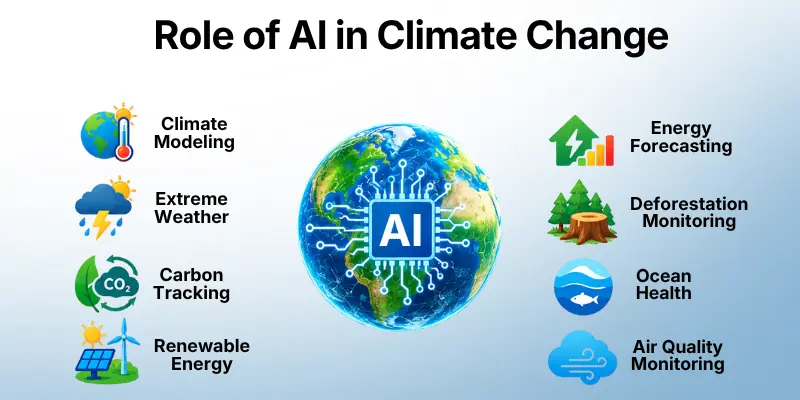
I’ve seen how AI can process huge amounts of data, identify patterns, and suggest smarter solutions to protect our planet. It doesn’t replace human effort but amplifies it by making decisions faster and more accurately.
In this guide, I’ll explain how AI is helping scientists, governments, and businesses fight climate change and work toward a sustainable future.
Contribution of AI in Climate Change
AI is being applied in multiple areas to understand and combat climate change. Here are some key roles:
- Climate Modeling
- Extreme Weather Prediction
- Carbon Emission Tracking
- Renewable Energy Optimization
- Energy Consumption Forecasting
- Deforestation Monitoring
- Ocean Health Analysis
- Air Quality Monitoring
- Disaster Response Planning
- Smart Agriculture
- Water Resource Management
- Climate Policy Support
- Carbon Capture Analysis
- Wildlife Protection
- Urban Heat Mapping
- Climate Risk Assessment
- Environmental Data Collection
- Reforestation Planning
- Predictive Maintenance in Energy Systems
- Public Awareness and Education
Let’s explore each role in detail.
1. Climate Modeling
AI helps scientists build models that predict long term climate changes. I’ve seen how it processes massive datasets from satellites, sensors, and historical records. This helps us understand how the Earth’s temperature, rainfall, and sea levels may change in the future. AI can simulate scenarios faster than traditional methods. It allows policymakers to plan effective strategies. With AI, climate predictions are more accurate and reliable.
Benefits:
- Improves climate forecasting accuracy.
- Supports decision making for governments.
- Helps plan climate mitigation strategies.
Example: AI models predict rising sea levels and temperature changes globally.
2. Extreme Weather Prediction
AI detects patterns that lead to hurricanes, floods, or heatwaves. I find it amazing how it can predict events days or even weeks in advance. This helps communities prepare and respond quickly. AI reduces human error in weather forecasting. It also helps governments issue early warnings. By saving lives and resources, AI plays a vital role in disaster management.
Benefits:
- Provides early warnings for extreme events.
- Minimizes damage and casualties.
- Enhances disaster preparedness.
Example: AI predicts hurricane paths using satellite data and historical storm patterns.
3. Carbon Emission Tracking
AI monitors carbon emissions from factories, vehicles, and power plants. I’ve noticed it can track emissions in real time. This helps businesses reduce their carbon footprint. It also assists governments in enforcing regulations. By detecting high emission areas, AI supports cleaner practices. Tracking emissions is essential for meeting climate targets.
Benefits:
- Helps measure carbon footprint accurately.
- Supports emission reduction strategies.
- Improves regulatory compliance.
Example: Cities use AI to track CO2 emissions from traffic and industry.
4. Renewable Energy Optimization
AI helps improve solar, wind, and hydro power systems. I’ve seen how it predicts energy production based on weather conditions. This reduces wasted energy and increases efficiency. It also helps balance supply and demand in power grids. AI ensures renewable energy is reliable and cost effective. Optimizing renewable systems makes clean energy more practical.
Benefits:
- Maximizes renewable energy output.
- Reduces energy waste.
- Supports sustainable power systems.
Example: AI predicts solar panel output using sunlight and weather data.
5. Energy Consumption Forecasting
AI predicts how much energy homes, industries, and cities will use. I’ve seen it help reduce unnecessary energy consumption. This saves money and lowers emissions. Businesses can plan production schedules efficiently. Cities can prevent energy shortages. AI ensures energy is used wisely.
Benefits:
- Reduces energy waste.
- Improves grid efficiency.
- Lowers greenhouse gas emissions.
Example: Smart meters use AI to forecast electricity demand in urban areas.
6. Deforestation Monitoring
AI analyzes satellite images to detect illegal logging or forest loss. I’ve seen how it identifies changes quickly. This helps governments and organizations act before damage spreads. AI can predict areas at risk for deforestation. It supports conservation and reforestation projects. Protecting forests is crucial for reducing climate change impacts.
Benefits:
- Detects deforestation early.
- Supports forest conservation efforts.
- Helps maintain biodiversity.
Example: Global Forest Watch uses AI to monitor tropical rainforests in real time.
7. Ocean Health Analysis
AI studies ocean temperatures, currents, and pollution levels. I’ve noticed it helps detect harmful algae blooms and coral bleaching. This informs conservation strategies. AI can predict ocean changes that affect fisheries and ecosystems. Healthy oceans are key to regulating climate. Monitoring ocean health protects marine life and communities.
Benefits:
- Tracks ocean pollution and health.
- Supports marine conservation.
- Predicts ecosystem changes.
Example: AI models predict coral bleaching due to rising ocean temperatures.
8. Air Quality Monitoring
AI monitors pollution levels in cities and industrial areas. I’ve seen it detect harmful chemicals in the air instantly. This helps issue warnings for public health. It also guides policy for cleaner air. AI ensures communities breathe safer air. Real time monitoring improves awareness and action.
Benefits:
- Provides accurate pollution data.
- Protects public health.
- Supports environmental policies.
Example: Smart city sensors use AI to track PM2.5 and NO2 levels.
9. Disaster Response Planning
AI helps plan evacuation routes and emergency resources for floods, fires, or storms. I’ve seen it model multiple scenarios to reduce risks. This improves response time during disasters. It also prioritizes the most vulnerable areas. AI helps save lives and property. Disaster planning becomes more precise and efficient.
Benefits:
- Enhances emergency preparedness.
- Reduces casualties during disasters.
- Guides resource allocation efficiently.
Example: AI maps flood prone areas to plan emergency shelters.
10. Smart Agriculture
AI predicts crop yields, monitors soil health, and manages water use. I’ve noticed how it helps farmers adapt to changing climate patterns. It reduces pesticide use and improves productivity. AI ensures food security under climate stress. Farmers can make better decisions using AI insights. Agriculture becomes sustainable and resilient to climate change.
Benefits:
- Increases crop yield.
- Reduces environmental impact.
- Optimizes resource use.
Example: AI predicts drought prone areas and guides irrigation planning.
11. Water Resource Management
AI tracks river levels, rainfall, and water usage. I’ve seen it help prevent water shortages. It predicts areas at risk of drought. AI guides efficient water distribution. Communities and farms can plan water use wisely. AI ensures sustainable water management.
Benefits:
- Prevents water scarcity.
- Improves irrigation efficiency.
- Supports sustainable use of water resources.
Example: AI forecasts water demand for urban supply networks.
12. Climate Policy Support
AI analyzes large datasets to support climate policies. I’ve noticed it helps governments understand what strategies work best. Policies can target emissions reduction, renewable energy, or forest protection. AI provides evidence based guidance. Decision making becomes faster and more reliable. Policies backed by AI are more effective.
Benefits:
- Supports better policymaking.
- Guides environmental regulations.
- Improves climate action outcomes.
Example: AI models suggest optimal carbon tax levels to reduce emissions.
13. Carbon Capture Analysis
AI helps monitor carbon capture technologies for effectiveness. I’ve seen it predict how much CO2 can be removed. It guides improvements in capture methods. Businesses and governments can track emission reductions. AI ensures carbon removal strategies are efficient. Carbon capture is key to achieving net zero goals.
Benefits:
- Monitors carbon removal efficiency.
- Supports emission reduction targets.
- Improves climate mitigation strategies.
Example: AI predicts CO2 absorption rates in industrial capture plants.
14. Wildlife Protection
AI tracks endangered species and habitats. I’ve noticed it helps detect poaching or habitat loss early. Conservation efforts become more targeted. AI can predict which areas need protection. Protecting wildlife helps maintain ecological balance. AI ensures better management of natural habitats.
Benefits:
- Protects endangered species.
- Prevents habitat destruction.
- Supports biodiversity conservation.
Example: AI cameras track tiger populations in forests.
15. Urban Heat Mapping
AI studies temperature patterns in cities. I’ve seen it identify heat islands and suggest cooling measures. It helps city planners design greener spaces. AI can predict areas at risk during heatwaves. Urban heat mapping reduces health risks. Cities become more climate resilient using AI.
Benefits:
- Identifies hot spots in urban areas.
- Guides urban planning.
- Reduces heat related health risks.
Example: AI maps NYC heat islands to plan tree plantations.
16. Climate Risk Assessment
AI evaluates risks to infrastructure, communities, and ecosystems. I’ve noticed it helps plan for storms, floods, or droughts. Businesses and governments can take preventative action. AI ensures better resource allocation. Risk assessment improves resilience against climate change. AI makes long term planning smarter.
Benefits:
- Predicts areas at high risk.
- Improves disaster preparedness.
- Guides infrastructure planning.
Example: AI predicts flood risks for coastal cities.
17. Environmental Data Collection
AI gathers and analyzes data from satellites, sensors, and drones. I’ve seen it provide insights faster than manual methods. Researchers can track forests, oceans, and weather patterns in real time. AI ensures accurate and reliable data. It also reduces human error. Environmental monitoring becomes more efficient with AI.
Benefits:
- Provides large scale environmental data.
- Reduces manual errors.
- Supports climate research.
Example: AI processes satellite imagery to track deforestation globally.
18. Reforestation Planning
AI identifies the best locations for planting trees. I’ve noticed it predicts soil quality, rainfall, and species survival. This improves tree survival rates. AI helps plan large scale reforestation projects. It supports carbon sequestration and biodiversity. Reforestation becomes more effective using AI insights.
Benefits:
- Improves tree survival rates.
- Supports carbon capture.
- Guides efficient reforestation projects.
Example: AI maps degraded lands to plan reforestation in Africa.
19. Predictive Maintenance in Energy Systems
AI predicts when renewable energy systems like wind turbines may fail. I’ve seen it prevent downtime and improve efficiency. Maintenance can be scheduled before issues occur. AI ensures continuous energy supply. It reduces costs and increases reliability. Energy systems become smarter with predictive AI.
Benefits:
- Prevents unexpected failures.
- Improves system efficiency.
- Reduces maintenance costs.
Example: AI predicts wind turbine failures in real time using sensor data.
20. Public Awareness and Education
AI creates interactive tools to educate people about climate change. I’ve seen it provide personalized tips for energy saving or carbon reduction. It helps governments spread information quickly. Citizens can make smarter decisions in daily life. AI increases engagement and knowledge. Education powered by AI inspires climate action.
Benefits:
- Raises awareness about climate change.
- Encourages eco friendly behavior.
- Reaches large audiences effectively.
Example: AI-powered apps track individual carbon footprints and suggest improvements.
Benefits of AI in Climate Change
Some of the major advantages of using AI in climate change are:
- Provides accurate climate predictions.
- Helps prevent and manage disasters.
- Monitors carbon emissions and pollution.
- Supports renewable energy efficiency.
- Guides sustainable urban planning.
- Improves conservation and wildlife protection.
- Enhances public awareness and education.
AI helps fight climate change by improving predictions, reducing pollution, and protecting our planet. It supports smarter decisions for a cleaner and more sustainable future.
Challenges of AI in Climate Change
Some of the challenges of AI in climate change are:
- Requires large amounts of quality data.
- High cost for AI infrastructure.
- Needs skilled personnel to operate AI systems.
- Predictions may fail in unexpected scenarios.
- Privacy concerns for environmental data collection.
Despite its benefits, AI in climate change faces challenges such as high costs, limited data, and a lack of skilled workers. Addressing these issues is essential for better and more reliable results.
Future of AI in Climate Change
I believe AI will play an even bigger role in fighting climate change. It will predict disasters more accurately, optimize renewable energy, and support smarter urban planning. Governments and businesses will rely on AI to meet sustainability goals. AI will help us reduce emissions faster and protect natural ecosystems. The future of climate action is smarter and more efficient with AI.
Final Note
In this guide, we explored the role of AI in climate change in detail. I covered 20 major roles, benefits, challenges, and future prospects. AI is helping us understand and fight climate change more effectively. If we adopt AI tools responsibly, we can make a real difference in protecting our planet. Start supporting AI driven climate solutions today to build a sustainable future.
FAQs About AI and Climate Change
AI in climate change helps scientists, governments, and businesses understand environmental risks and develop smarter solutions. Here are answers to common questions about how artificial intelligence supports climate action and environmental protection.
1. What is artificial intelligence and the environment?
Artificial intelligence and the environment refers to using AI technology to monitor, understand, and protect nature. It helps with:
- Tracking pollution and deforestation.
- Monitoring wildlife and ecosystems.
- Supporting sustainable practices.
2. How does artificial intelligence global warming help?
AI helps address global warming by analyzing climate data and identifying potential risks. It can:
- Predict temperature trends and extreme weather patterns.
- Monitor greenhouse gas emissions.
- Help governments and businesses plan emission reduction strategies.
3. What is AI for climate change?
AI for climate change means using artificial intelligence to reduce environmental harm and adapt to changing climate conditions. Common applications include renewable energy optimization, disaster prediction, and emissions monitoring.
4. How does artificial intelligence for climate change work?
AI supports climate action through these steps:
- Collect data: Gather information from satellites, sensors, and weather records.
- Analyze patterns: Identify environmental changes and potential risks.
- Predict outcomes: Estimate possible climate impacts.
- Support action: Help experts make informed decisions about energy, resources, and disaster preparation.
5. How does AI affect climate change?
AI can support climate action by improving energy efficiency, monitoring emissions, and predicting environmental risks. It also helps industries and farmers use resources more efficiently. However, AI systems consume energy and require computing resources, so their environmental impact must also be considered.
6. Can machine learning and climate change work together?
Yes, machine learning helps researchers identify patterns in complex climate data. It can support:
- Flood and drought risk forecasting.
- Temperature and weather analysis.
- Renewable energy planning.
- Long term climate research.
7. How can AI help climate change?
AI can help address climate change through several practical actions:
- Monitor greenhouse gas emissions and pollution.
- Improve renewable energy production and distribution.
- Support reforestation and wildlife conservation.
- Help communities prepare for extreme weather.
- Reduce waste and improve resource management.
8. Will AI solve climate change?
No, AI alone cannot solve climate change. However, it can help scientists, policymakers, and businesses make better decisions. Effective climate action still requires human involvement, strong policies, cleaner energy, and cooperation.
9. How does AI impact climate change?
AI influences climate action by improving how people monitor, predict, and respond to environmental problems.
| AI application | Potential climate benefit |
| Emissions monitoring | Helps identify sources of pollution |
| Renewable energy | Improves energy forecasting and efficiency |
| Conservation | Supports ecosystem and wildlife monitoring |
| Climate prediction | Helps communities prepare for environmental risks |
10. Can AI predict future climate risks?
Yes, AI can help estimate future climate risks by analyzing historical and current environmental data. The process typically involves:
- Collecting weather and climate records.
- Identifying patterns linked to potential hazards.
- Estimating risks such as heatwaves, floods, and storms.
- Helping communities and authorities prepare in advance.
AI predictions are not always accurate, especially in unusual or rapidly changing conditions, but they can support better climate preparedness.






- Be Respectful
- Stay Relevant
- Stay Positive
- True Feedback
- Encourage Discussion
- Avoid Spamming
- No Fake News
- Don't Copy-Paste
- No Personal Attacks
- Be Respectful
- Stay Relevant
- Stay Positive
- True Feedback
- Encourage Discussion
- Avoid Spamming
- No Fake News
- Don't Copy-Paste
- No Personal Attacks
