Role of AI in Agriculture in 2026 – How Smart Farming Is Changing the Future
Published: 11 Nov 2026
Agriculture is one of the oldest and most important industries in the world. It feeds people, supports the economy, and shapes our environment. Modern systems are now helping farmers grow more with less effort.
These systems study soil, weather, and crops to improve farming results. They help manage fields, water, and resources in smart ways.
In this guide, we will cover what these tools do in farming, how they work, their main roles, benefits, challenges, and future scope.
Contribution of AI in Agriculture
Here we will cover the main discussion of our article. These are the major roles that modern tools play in today’s farming industry. Each role helps farmers and producers manage land, crops, and livestock more effectively.
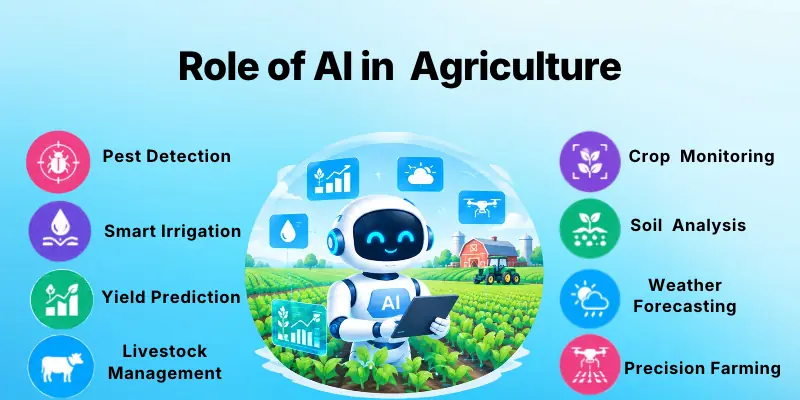
The main applications of AI in agriculture are:
- Crop Monitoring
- Soil Analysis
- Weather Forecasting
- Precision Farming
- Pest Detection
- Smart Irrigation
- Yield Prediction
- Livestock Management
- Farm Automation
- Supply Chain Tracking
Let us learn about each of these in detail.
1. Crop Monitoring
Crop monitoring means keeping a close eye on how plants grow. I use these systems to check field conditions and plant health. They collect pictures and data to find dry or damaged areas. This helps farmers take quick action before crops are harmed. It keeps the harvest healthy and strong.
Benefits:
- Finds crop issues early
- Reduces field visits
- Saves time and water
- Improves harvest quality
Example: A farmer uses sensors to check crop color and growth, helping spot stress before it spreads.
2. Soil Analysis
Soil analysis helps understand the nutrients and quality of the soil. I have seen how these systems can test moisture and pH levels in minutes. This helps decide which seeds to plant and when to fertilize. Farmers can balance soil conditions easily. Healthy soil means better crops every season.
Benefits:
- Detects poor soil early
- Helps use the right fertilizer
- Reduces waste and pollution
- Increases soil health
Example: A farm system scans soil before planting and gives instant fertilizer advice.
3. Weather Forecasting
Weather affects every step of farming. I use predictive tools that collect local climate data and share updates. Farmers get early warnings about rain, frost, or heat. This helps plan irrigation, seeding, and harvest days. With this, weather surprises become easier to handle.
Benefits:
- Protects crops from bad weather
- Improves planting schedules
- Saves water and energy
- Increases farm safety
Example: A farmer gets an alert about a coming storm and delays crop spraying.
4. Precision Farming
Precision farming means using exact data to grow crops. It helps apply water, fertilizer, and pesticides in the right amount. I like how it reduces waste and increases yield. Each part of the field gets what it needs most. This turns farming into a smart and accurate process.
Benefits:
- Cuts input costs
- Improves crop growth
- Saves time and effort
- Protects soil health
Example: A GPS based sprayer targets only dry soil patches with water.
5. Pest Detection
Pest detection tools help identify insects or diseases early. I use camera based systems that scan plants daily. They send alerts when leaves show signs of trouble. Farmers can act quickly and prevent damage. This keeps fields clean and production stable.
Benefits:
- Stops pest spread fast
- Reduces pesticide use
- Saves crops and money
- Improves farm hygiene
Example: A camera on a tractor spots pest damage on corn leaves in real time.
6. Smart Irrigation
Smart irrigation helps deliver the right water at the right time. I’ve seen farmers using sensors that check soil dryness before watering. This saves water and prevents over irrigation. It makes farming more eco-friendly and cost effective.
Benefits:
- Saves large amounts of water
- Keeps crops evenly watered
- Cuts power bills
- Supports sustainable farming
Example: Sensors turn irrigation on only when soil gets too dry.
7. Yield Prediction
Yield prediction means estimating how much crop will be harvested. These systems study plant growth, soil, and weather data. I use this to plan selling and storage in advance. Farmers can also manage prices and reduce losses.
Benefits:
- Predicts total harvest early
- Improves sales planning
- Reduces storage waste
- Supports financial stability
Example: A wheat farmer uses data to estimate yield before harvest time.
8. Livestock Management
Livestock management means caring for animals using tracking tools. I’ve seen collars that monitor animal health and movement. Farmers get alerts if an animal stops eating or walking. This keeps herds safe and productive.
Benefits:
- Tracks animal health daily
- Prevents disease spread
- Improves milk and meat quality
- Reduces vet costs
Example: A dairy farmer checks herd activity levels through a mobile app.
9. Farm Automation
Farm automation uses machines to handle regular farm jobs. I’ve used auto tractors and harvesters that work without breaks. They save time, fuel, and labor. This makes big farms easier to run with fewer workers.
Benefits:
- Reduces manual effort
- Works faster and safer
- Cuts long term costs
- Boosts productivity
Example: A self driving harvester collects wheat without human help.
10. Supply Chain Tracking
Supply chain tracking means following crops from field to market. It keeps records of how and where food moves. I use tracking systems to keep quality high. This builds trust between farmers, sellers, and buyers.
Benefits:
- Tracks food freshness
- Prevents loss in transport
- Increases transparency
- Builds brand trust
Example: A fruit exporter tracks shipment temperature through sensors.
Benefits of Artificial Intelligence in Farming
Guys, in this section we will learn the main benefits that come from these systems. These advantages show how farmers, consumers, and the environment all benefit from smarter agriculture.
For Farmers:
- Grows crops with less effort
- Saves money and time
- Improves yield and profit
- Protects soil for future use
For Consumers:
- Gets better and safer food
- Enjoys stable food prices
- Gains trust in food quality
For the Environment:
- Uses water and fertilizer wisely
- Reduces pollution and waste
- Protects natural balance
Challenges of Implementing AI Smart Agriculture
Although AI is improving agriculture, farmers still face several challenges when adopting smart farming technologies. Guys, in this section we will learn the main challenges this industry faces.
- Setting up new systems costs a lot of money.
- Many remote areas still have weak internet service.
- Farmers often lack the skills to use modern tools.
- Data storage systems are not well managed.
- Many farmers are not aware of these new methods.
- Machines need regular care, which increases costs.
- Personal and farm data can be misused if not protected.
- Language gaps make it hard to use smart tools.
- Old machines are hard to connect with new systems.
- Rules and policies for smart farming grow very slowly.
Overcoming these challenges can help farmers adopt AI more easily and make agriculture smarter and more efficient.
Future of AI in Agriculture
The future of farming looks brighter with these tools. We will see more sensors, robots, and connected devices in every field. Farms will use real time data for every decision. This will increase global food supply and reduce waste. With cleaner and smarter methods, the next generation of farmers will grow more while saving the planet.
Final Note
In this guide, we have covered the complete concept of the role of AI in agriculture. We discussed how these tools support farmers, crops, animals, and the food chain. We also explored their benefits, challenges, and future use. To learn more, you can explore the FAQ section below.
FAQs
Discover how AI in agriculture is transforming modern farming, saving resources, and helping farmers grow healthier crops through smarter technology. Here are some of the most commonly asked questions related to the technology and agriculture:
1. What is artificial intelligence in agriculture?
Artificial intelligence in agriculture helps farmers make smarter decisions using soil, water, weather, and crop data. It improves productivity, saves time, and reduces effort.
2. How is AI in agriculture changing modern farming?
AI is making farming faster and more accurate through:
- Smart monitoring: Tracks crop and animal health.
- Better decisions: Uses sensors and cameras to collect useful data.
- Resource savings: Helps farmers produce more with less waste.
3. What is AI farming, and how does it work?
AI farming uses smart tools to analyze crop and soil data. It works in three simple steps:
- Collect data: Gather information about soil and crops.
- Analyse results: Identify what crops need.
- Take action: Adjust watering or fertilizer use to support healthy growth.
4. How does an automation farming system help farmers?
An automated farming system handles routine tasks such as planting and irrigation. It reduces manual labour, saves time, and allows farmers to focus on planning and farm management.
5. What is the new technology for farming today?
Modern farming uses several smart technologies:
| Technology | Main benefit |
| Sensors | Monitor soil and crop conditions |
| Drones | Survey fields and detect crop problems |
| Smart irrigation | Saves water by improving watering decisions |
6. What is the most recent technology in agriculture?
Emerging agricultural technologies include satellite monitoring, AI-powered crop analysis, and predictive tools. These help farmers spot potential problems early and take action to protect their crops.
7. What will farming in the future look like?
Future farming is expected to become more connected, automated, and data driven. Smart machines may handle more fieldwork, while farmers use digital tools to monitor operations and make decisions.
8. What are the new technologies in agriculture that help save water?
Farmers can use these water saving technologies:
- Soil moisture sensors: Check when crops need water.
- Smart irrigation: Delivers water when needed.
- AI-based monitoring: Helps reduce unnecessary watering.
9. How does agriculture AI support sustainable farming?
Agricultural AI supports sustainable farming by helping farmers use resources more efficiently. It can reduce water waste, improve fertiliser use, and support healthier soil management.
10. What is machine learning in agriculture used for?
Machine learning analyses farming data to identify patterns and make predictions. Common uses include:
- Predicting crop yields
- Identifying possible pest risks
- Supporting weather related decisions
- Helping farmers plan resources more effectively




- Be Respectful
- Stay Relevant
- Stay Positive
- True Feedback
- Encourage Discussion
- Avoid Spamming
- No Fake News
- Don't Copy-Paste
- No Personal Attacks
- Be Respectful
- Stay Relevant
- Stay Positive
- True Feedback
- Encourage Discussion
- Avoid Spamming
- No Fake News
- Don't Copy-Paste
- No Personal Attacks
