Role of AI in Data Analytics in 2026 – Ways to Save Time and Reduce Errors
Published: 19 Nov 2026
So guys, to understand the role of AI in data analytics, let’s talk about how it helps in reading, sorting, and understanding large sets of data.
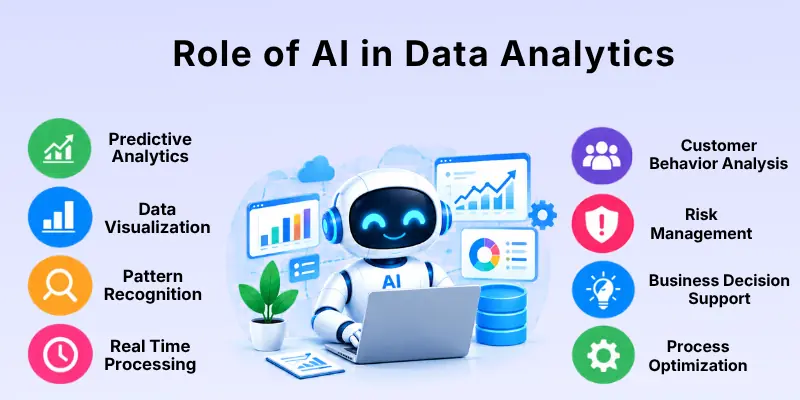
AI in data analytics means using smart tools that study numbers, patterns, and trends to give clear results. I have seen how it helps companies save time, reduce errors, and make better decisions. It finds insights that people may miss and turns them into useful information.
In this tutorial, I’ll share the different roles of AI in data analytics, their benefits, and the main challenges that come with them.
Participation of AI in Data Analytics
Here is a list of the main roles of artificial intelligence in data analytics:
- Data Collection and Cleaning
- Data Classification
- Predictive Analytics
- Data Visualization
- Pattern Recognition
- Real Time Data Processing
- Sentiment Analysis
- Customer Behavior Analysis
- Risk Management
- Business Decision Support
- Anomaly Detection
- Automation in Reporting
- Market Trend Analysis
- Data Security Monitoring
- Process Optimization
Let’s now explore each role one by one.
1. Data Collection and Cleaning
I have seen that data often comes from many sources and can be very messy. AI helps collect data automatically and removes unwanted parts. It checks for missing or repeated information and fixes it. I like how this makes data ready for use in just minutes. Clean data always gives better results and saves human effort.
Benefits:
- AI saves hours by cleaning and sorting data automatically.
- It reduces human mistakes and makes reports more accurate.
- It helps teams focus more on decision making instead of fixing errors.
Challenges:
- If data is mixed or unclear, AI may clean it wrongly.
- The system setup can be costly and needs trained people.
- Some data sources may not match well, which can cause errors.
With proper setup and good data, AI can reduce manual work and improve the quality of data analysis.
2. Data Classification
I have seen that AI is great at putting data into the right groups. It studies the content and automatically assigns it to a category. This makes data easy to find later without spending time searching. I think this saves companies a lot of manual work. It also keeps files and information well organized for analysis.
Benefits:
- AI sorts data quickly and keeps it neat and easy to find.
- It reduces mistakes that happen when people sort data by hand.
- Teams can focus on using the data instead of organizing it.
Challenges:
- Sometimes AI may group data incorrectly if the topic is unclear.
- It needs proper training data to learn how to sort accurately.
- Regular updates are needed to keep the system working well.
In short, AI makes data easier to organize, find, and use, helping teams work faster and more efficiently
3. Predictive Analytics
I find this one very useful because it helps companies plan for the future. AI studies old data and finds patterns that help guess what will happen next. It can predict sales, demand, or customer actions. I’ve seen how it reduces risks and improves decisions. It helps teams be ready for future changes in business.
Benefits:
- AI helps companies plan better by predicting trends early.
- It saves money by avoiding poor business decisions.
- It improves customer satisfaction by preparing for their needs.
Challenges:
- Predictions may go wrong if the data is outdated.
- AI cannot predict sudden changes like natural events.
- It needs regular data updates to stay accurate.
AI powered predictive analytics helps businesses prepare for future trends, reduce risks, and make smarter decisions.
4. Data Visualization
AI helps turn boring numbers into simple pictures, charts, and graphs. It makes data easy to understand at a single look. I think this helps managers and teams make quick choices. It also shows hidden patterns that are hard to see in raw data. I find it very useful for explaining reports to others.
Benefits:
- AI makes complex data clear with visual charts and dashboards.
- It saves time by showing important trends quickly.
- It helps in sharing ideas and results more effectively.
Challenges:
- Some visual tools may show wrong results if data is poor.
- It takes effort to design visuals that are easy to read.
- Too many visuals can confuse users instead of helping them.
AI turns complex data into clear visuals, helping teams understand important trends and make faster decisions.
5. Pattern Recognition
AI is very good at spotting patterns in large data sets. It finds hidden links that people may not notice. I’ve seen how it helps businesses know what’s working well. It’s used in fraud detection, healthcare, and customer studies. This makes it one of the most powerful uses of AI.
Benefits:
- AI finds useful trends that improve planning and strategy.
- It helps detect risks and problems early.
- It supports data based decision making for all teams.
Challenges:
- Wrong data can lead to false patterns.
- It takes large amounts of data to train the system.
- The process may be slow for very complex patterns.
AI helps businesses discover hidden patterns, identify risks, and find valuable insights in large datasets.
6. Real Time Data Processing
I have seen how AI looks at data instantly as it’s created. It gives updates in real time without delay. This helps companies act fast and fix problems quickly. I think it’s very helpful for online stores, banks, and delivery apps. It keeps systems smooth and updated all the time.
Benefits:
- AI allows faster decisions using live data.
- It helps catch errors or issues right away.
- It improves customer experience by providing instant updates.
Challenges:
- Real time systems can be expensive to set up.
- They need strong internet and hardware support.
- Handling large live data may cause delays sometimes.
With the right systems in place, AI enables faster actions, instant updates, and more efficient daily operations.
7. Sentiment Analysis
AI helps understand how people feel from their words or reviews. It reads text from social media, emails, or surveys. I find this helpful for brands to know what customers really think. It helps companies improve their services and image. I’ve seen it work well for customer support and marketing.
Benefits:
- AI helps understand public opinion in real time.
- It allows quick action on negative feedback.
- It builds better trust between brands and people.
Challenges:
- AI can misunderstand sarcasm or jokes.
- It may not work well with mixed or unclear messages.
- It needs updates to keep up with new slang and language.
By analyzing customer comments and reviews, AI helps brands improve their services and understand what people think.
8. Customer Behavior Analysis
AI studies how people act, buy, or browse online. It helps companies know what users want next. I think this is very useful for improving ads and product offers. It keeps customers engaged and loyal. I have seen it work great on online shopping sites.
Benefits:
- AI helps understand customer needs and habits better.
- It improves sales by offering what customers want.
- It creates more personal and satisfying user experiences.
Challenges:
- Collecting user data must follow privacy rules.
- Sometimes AI can make wrong guesses about people.
- It needs fresh data to stay accurate.
AI helps businesses understand customer habits, personalize offers, and create better shopping experiences.
9. Risk Management
AI helps find and stop risks before they grow big. It studies data and points out warning signs. I think it’s very useful for banks, finance, and health sectors. It keeps money and systems safe from fraud or errors. I’ve seen it reduce losses in many industries.
Benefits:
- AI helps detect and prevent risk early.
- It saves companies from financial loss.
- It builds trust with clients and users.
Challenges:
- AI may miss rare or new types of risks.
- Wrong data can lead to false alerts.
- It needs constant tracking to stay useful.
AI helps businesses detect potential risks early, prevent losses, and protect their operations from unexpected problems.
10. Business Decision Support
AI helps leaders make smart and fast choices. It collects reports and shows key points for better planning. I think it removes guesswork from important decisions. It helps all departments work with clear goals. This makes business performance stronger overall.
Benefits:
- AI provides real time insights for better decisions.
- It reduces time spent on manual reports.
- It helps companies react quickly to market changes.
Challenges:
- Decisions can go wrong if the input data is wrong.
- Some managers may rely too much on AI.
- It needs trained people to read AI results correctly.
When combined with human judgment, AI can improve planning, reduce guesswork, and support stronger business results.
11. Anomaly Detection
AI can catch data that looks strange or wrong. It helps in finding errors and fraud quickly. I have seen how it saves companies from big losses. It’s used in finance, healthcare, and online systems. I think it’s very important for keeping data safe.
Benefits:
- AI finds unusual data fast before it causes damage.
- It improves data accuracy and quality.
- It protects businesses from fraud and system issues.
Challenges:
- AI may mark normal data as a mistake sometimes.
- It needs a lot of examples to learn correctly.
- False alerts can confuse teams.
AI helps detect unusual data, identify possible fraud, and protect businesses from costly errors.
12. Automation in Reporting
AI makes reports automatically without human help. It collects, sorts, and writes the key points for easy reading. I think it saves huge amounts of time. Teams can focus on planning instead of manual work. It also helps share results quickly across the company.
Benefits:
- AI makes accurate and clear reports instantly.
- It reduces manual work and boosts productivity.
- Reports are more consistent and error free.
Challenges:
- AI tools need setup and maintenance.
- It may not capture special details that humans notice.
- Complex reports still need a human touch.
AI automates routine reporting tasks, saves valuable time, and helps teams focus on more important work.
13. Market Trend Analysis
AI helps study market data and customer activity. It finds what’s popular and what’s losing interest. I think this is great for making smart marketing moves. It helps plan products and prices better. I’ve seen it give great results for sales teams.
Benefits:
- AI predicts future trends and helps plan ahead.
- It gives a clear view of what customers want.
- It helps companies stay ahead of competitors.
Challenges:
- Trends can change fast, making AI results outdated.
- Wrong data can lead to poor predictions.
- It needs ongoing updates to stay correct.
AI helps businesses understand changing market trends, discover customer needs, and plan more effective strategies.
14. Data Security Monitoring
AI keeps an eye on systems and data safety. It watches for signs of hacking or leaks. I think it’s very helpful for keeping sensitive data safe. It alerts teams when something unusual happens. This helps stop damage before it spreads.
Benefits:
- AI detects security threats faster than humans.
- It keeps data and systems safe all the time.
- It gives quick alerts so action can be taken early.
Challenges:
- AI may send false warnings sometimes.
- It needs expert setup to work smoothly.
- Hackers may try to trick AI systems too.
AI strengthens data security by detecting suspicious activity early and helping teams respond to threats faster.
15. Process Optimization
AI helps find better ways to do work faster. It studies how tasks are done and suggests improvements. I have seen it make companies more efficient. It removes waste and saves time for teams. I think it’s great for both small and large businesses.
Benefits:
- AI helps improve workflows and saves resources.
- It boosts productivity by removing delays and errors.
- It helps in better use of money and time.
Challenges:
- Some workers may resist changing old methods.
- AI suggestions may not fit every company’s style.
- It needs regular updates to stay useful.
By identifying inefficiencies and suggesting improvements, AI helps companies increase productivity and achieve better results.
Future of AI in Data Analytics (with Stats)
I think the future of data analytics is very bright. AI will help people understand data faster and more easily.
According to recent studies, the AI in data analytics market is expected to reach $50 billion by 2026. This shows how fast businesses are adopting AI to study data. I have seen that companies using AI report 25 – 30% faster decision making and 30% lower operational costs.
More than 70% of enterprises plan to increase AI spending in analytics in the next three years. This means AI will play a bigger role in sales, marketing, and customer analysis. I believe AI will turn large, complicated data into simple stories that anyone can understand. It will make analysis faster, easier, and more accurate for all businesses.
Final Note
In this guide, I shared the role of AI in data analytics. You learned how it helps in collecting, cleaning, studying, and showing data. I also explained its benefits, challenges, and future scope. AI is not just a tool; it’s now a part of how data experts and companies make smart choices. I hope you got a clear idea about how it supports better work and faster results.
Now, let’s move to the FAQs for quick answers to common questions.
FAQs About AI and Data Analytics
AI in data analytics helps businesses process large amounts of information, discover useful patterns, and make better decisions. Here are answers to common questions about AI analytics tools, predictive analytics, and their business benefits.
Here are some of the most commonly asked questions related to AI and data analytics.
1. What is AI in data analytics?
AI in data analytics uses smart computer tools to study large amounts of data and find useful insights. It helps businesses:
- Identify patterns and trends quickly.
- Reduce manual work and common errors.
- Make better decisions using data.
2. How does artificial intelligence in analytics improve business decisions?
Artificial intelligence in analytics helps businesses make informed decisions by studying past and current data. It can help companies:
- Forecast sales and product demand.
- Improve marketing strategies.
- Manage stock and business resources more effectively.
3. What are the best AI data tools for beginners?
The best AI data tools for beginners are easy to use and can simplify data analysis without requiring advanced coding skills.
| Tool | Main use |
| Microsoft Power BI | Data visualization and reports |
| Tableau | Interactive charts and dashboards |
| Google Gemini in Google Sheets | Help with spreadsheet analysis |
| ChatGPT | Exploring data and understanding trends |
The right tool depends on your budget, data needs, and experience level.
4. How can predictive analytics AI help in planning?
Predictive analytics AI helps businesses prepare for future changes by analyzing historical data.
How it works:
- Collect past sales, customer, or market data.
- Identify patterns and trends.
- Forecast possible future outcomes.
- Use predictions to improve planning and reduce risks.
5. Can AI business analytics increase sales?
Yes, AI business analytics can help increase sales by revealing customer preferences and improving marketing decisions. It can help businesses recommend relevant products, personalize offers, and identify sales opportunities. However, results depend on data quality and how businesses use these insights.
6. How is AI data analysis different from traditional analysis?
AI data analysis can automate complex tasks and identify patterns across large datasets. Traditional analysis often relies more on manual processes and predefined methods.
| Feature | AI data analysis | Traditional analysis |
| Speed | Automates many tasks | May require more manual work |
| Data handling | Can process large datasets | Depends on tools and methods |
| Pattern detection | Can identify complex patterns | Often relies on predefined methods |
| Human input | Requires oversight and interpretation | Often requires direct analyst involvement |
Both methods can be useful depending on the task and available resources.
7. What role does machine learning in analytics play?
Machine learning in analytics helps computers learn patterns from data and use them to make predictions.
Its main roles include:
- Finding relationships in large datasets.
- Predicting future outcomes.
- Improving predictions as models learn from new data.
- Supporting faster, data driven decisions.
8. How can data science AI help businesses understand customers?
Data science AI helps businesses understand customer needs by analyzing information such as purchases, website clicks, and product reviews.
A simple checklist of its benefits:
- Identify customer preferences and buying habits.
- Discover trends in customer feedback.
- Create more relevant marketing campaigns.
- Improve products and customer service.
Businesses should use customer data responsibly and follow privacy rules.
9. What is the benefit of AI analytics software?
AI analytics software makes data analysis easier by automating repetitive tasks and presenting useful information clearly.
Key benefits include faster reporting, improved data organization, fewer manual errors, and better decision making. These tools also help teams spend more time acting on insights instead of preparing reports.
10. How does AI in big data work?
AI in big data uses artificial intelligence techniques to analyze huge amounts of information and uncover valuable insights. The process generally involves:
- Data collection: Gather information from different sources.
- Data processing: Organize and prepare the data.
- Pattern discovery: Identify trends, relationships, and unusual activity.
- Insight generation: Use the results to improve forecasting, planning, and business decisions.





- Be Respectful
- Stay Relevant
- Stay Positive
- True Feedback
- Encourage Discussion
- Avoid Spamming
- No Fake News
- Don't Copy-Paste
- No Personal Attacks
- Be Respectful
- Stay Relevant
- Stay Positive
- True Feedback
- Encourage Discussion
- Avoid Spamming
- No Fake News
- Don't Copy-Paste
- No Personal Attacks
