Role of AI in Real Estate in 2026: Smarter Property Deals, Pricing, and Management
Published: 14 Nov 2026
When we talk about the role of AI in real estate, we mean how smart technology is changing the way properties are bought, sold, and managed.
I see AI as a tool that helps agents, buyers, sellers, and investors make faster and smarter decisions. It can predict property prices, automate marketing, screen tenants, and even give virtual property tours.
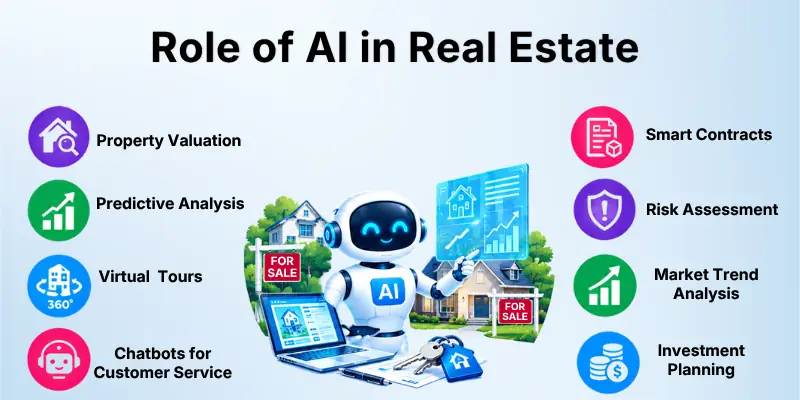
In this article, I’ll explain the key roles AI plays in real estate, the benefits it brings, the challenges it faces, and what the future looks like. By the end, you’ll understand how AI is shaping the property industry.
What are the Major Contributions of AI in Real Estate?
The role of artificial intelligence in real estate is to make property processes smarter, faster, and more accurate. Here are the main roles of AI in real estate:
- Property Valuation
- Predictive Analysis
- Virtual Tours
- Chatbots for Customer Service
- Smart Contracts
- Risk Assessment
- Market Trend Analysis
- Investment Planning
- Lead Generation
- Property Management
- Automated Marketing
- Tenant Screening
Let’s cover each role in detail.
1. Property Valuation
AI helps determine the accurate price of properties. I see how it studies past sales, location, and property features. It saves me time compared to manual research. AI can also adjust valuations quickly if market conditions change. This gives buyers, sellers, and investors a realistic price. It makes negotiations easier and faster.
Benefits:
- Provides accurate property prices instantly
- Reduces human error in calculations
- Speeds up property appraisal process
Example: AI estimates the value of a house using nearby sales and features.
2. Predictive Analysis
AI predicts future property trends and price changes. I like how it helps me know which areas will grow in value. It studies patterns from historical data and market demand. Investors can plan purchases wisely. Agents can advise clients more accurately. AI makes decision making safer and smarter.
Benefits:
- Forecasts property value changes
- Helps investors make smart decisions
- Improves market strategy accuracy
Example: AI predicts a neighborhood’s rising property prices for next year.
3. Virtual Tours
AI enables virtual property tours anytime. I enjoy how it lets buyers explore homes without visiting in person. It saves travel time and makes viewing more convenient. AI can also highlight features automatically. Sellers can show properties to more clients at once. It creates a modern, interactive experience.
Benefits:
- Lets buyers view homes remotely
- Highlights key property features
- Saves time for buyers and sellers
Example: AI creates a 3D virtual walkthrough of a house online.
4. Chatbots for Customer Service
AI chatbots answer client questions instantly. I find this helpful because it keeps leads engaged 24/7. They can schedule viewings, provide details, or suggest properties. This reduces the workload for agents. Clients feel supported anytime. It improves overall satisfaction and response time.
Benefits:
- Provides instant answers to clients
- Engages leads around the clock
- Reduces workload for agents
Example: A chatbot schedules property visits for buyers automatically.
5. Smart Contracts
AI supports smart contracts that automate agreements. I like how it ensures rules are followed without delays. Payments, deposits, and legal terms can be managed digitally. It reduces errors and fraud. Both parties feel secure and confident. AI makes transactions faster and transparent.
Benefits:
- Automates contract management securely
- Reduces fraud and errors
- Speeds up transaction process
Example: AI triggers rental payments automatically on contract dates.
6. Risk Assessment
AI analyzes potential risks in property investments. I notice it considers market trends, legal issues, and economic factors. Investors can make safer choices. It highlights areas with high or low risk. Agents can advise clients more confidently. AI reduces financial losses and surprises.
Benefits:
- Identifies investment risks early
- Helps make safer property decisions
- Reduces chances of financial loss
Example: AI warns about a property in a flood prone zone before purchase.
7. Market Trend Analysis
AI studies housing markets and predicts hot locations. I see how it helps agents target high demand areas. It tracks price patterns, sales, and demand. Sellers can price properties better. Buyers find the right investment spots. AI gives a clear picture of the real estate market.
Benefits:
- Tracks property market trends
- Guides agents and investors
- Helps set competitive prices
Example: AI identifies growing neighborhoods for property investment.
8. Investment Planning
AI recommends the best investment opportunities. I like how it compares different properties quickly. It shows potential returns and risks. Investors can prioritize profitable options. It helps save time on research. AI makes investment decisions that are data driven and smart.
Benefits:
- Suggests profitable property investments
- Reduces research time for investors
- Improves decision making accuracy
Example: AI recommends buying an apartment in a high rental area.
9. Lead Generation
AI identifies potential buyers and sellers automatically. I find this useful because it saves hours of prospecting. It studies online behavior and searches to find interested clients. Agents can focus on closing deals instead of searching. AI increases the chance of successful sales.
Benefits:
- Finds potential clients quickly
- Improves lead quality
- Boosts sales efficiency
Example: AI lists buyers likely to purchase a property this month.
10. Property Management
AI manages rental properties efficiently. I notice it tracks rent payments, maintenance, and occupancy. Tenants get reminders and instant support. Owners can monitor properties remotely. It reduces manual management work. AI keeps properties running smoothly.
Benefits:
- Tracks rent and occupancy automatically
- Schedules maintenance efficiently
- Improves tenant satisfaction
Example: AI notifies tenants about upcoming rent due dates.
11. Automated Marketing
AI creates targeted campaigns for properties. I like how it adjusts ads to the right audience. It can suggest email campaigns, social media posts, and promotions. This saves time and increases interest. Agents can reach more potential clients. AI improves lead engagement and conversion.
Benefits:
- Targets ads to the right audience
- Saves time on marketing
- Increases client engagement
Example: AI sends property emails to buyers based on their preferences.
12. Tenant Screening
AI checks tenant backgrounds quickly and accurately. I see how it helps avoid risky tenants. It evaluates credit, rental history, and behavior. Landlords can make informed decisions fast. This reduces evictions and payment problems. AI makes renting safer and easier.
Benefits:
- Evaluates tenants quickly
- Reduces risk of defaults
- Makes renting safer for landlords
Example: AI screens applicants for a rental property automatically.
Benefits of AI in Real Estate Market
In this section, we’ll explore the advantages of AI in real estate by considering the different roles it plays.
- Accurate Pricing Insights: Gives fair property values instantly using real data.
- Future Market Predictions: Shows which neighborhoods will grow in value.
- Remote Property Exploration: Lets buyers tour homes anytime, anywhere.
- Instant Customer Support: Answers client questions without waiting for an agent.
- Secure Digital Agreements: Automates contracts safely and efficiently.
- Investment Risk Alerts: Spots potential problems before you buy or invest.
- Neighborhood Intelligence: Highlights popular areas and trending property deals.
- Smart Investment Suggestions: Recommends the most profitable property options.
- Fast Client Discovery: Finds new buyers and tenants quickly and effectively.
- Simplified Property Oversight: Tracks rent, maintenance, and tenant needs easily.
- Targeted Marketing Reach: Sends property promotions to the right audience.
- Reliable Tenant Screening: Evaluates applicants quickly for safe renting.
AI makes real estate faster, smarter, and more efficient. These benefits help buyers, sellers, and investors make better property decisions.
Challenges of AI in Real Estate Business
Even though AI offers many benefits, it comes with some challenges. Here are the main ones:
- High Cost: Setting up AI tools can be expensive.
- Data Quality: Poor data can lead to wrong analysis.
- Skill Gap: Many agents lack AI knowledge.
- Integration Issues: Old systems may not work with AI.
- Privacy Concerns: Client data must be handled securely.
- Dependence on AI: Too much reliance may reduce human judgment.
- Maintenance Needs: AI systems need regular updates and care.
- Ethical Concerns: AI could misuse property data or predictions.
- Job Impact: Some administrative tasks may be replaced.
- Market Uncertainty: AI predictions can be wrong in volatile markets.
Despite these challenges, AI can improve real estate when used wisely. Addressing these issues helps businesses use AI safely and effectively.
Future of AI Innovations in Real Estate
The future of AI in real estate looks exciting. I believe AI will make buying, selling, and managing properties smarter and faster. Virtual tours, predictive analysis, and AI-driven investments will become standard.
AI will also help agents personalize experiences for buyers and renters. Property management will be more automated, and investments will be guided by real time data. In the coming years, AI will not just assist, it will lead decision making in the real estate industry.
Final Note
In this post, we covered the role of AI in real estate in detail. We discussed how AI helps with property valuation, market predictions, virtual tours, chatbots, smart contracts, and more. We also explored the benefits, challenges, and future trends of AI in this industry. I hope this guide gives you a clear understanding of how AI is transforming real estate for buyers, sellers, and investors.
If you want to stay ahead in the property market, start exploring AI tools today and see how technology can make your real estate business faster, smarter, and more profitable.
FAQs: AI in Real Estate
Discover how AI in real estate is transforming property valuation, investment, marketing, and management. Here are answers to common questions about its uses and benefits.
1. What is AI in real estate?
AI in real estate uses smart technology to simplify property buying, selling, and management. It predicts prices, analyzes market trends, and automates routine tasks for faster, smarter decisions.
2. How does real estate AI help property valuation?
Real estate AI estimates property values by analyzing:
- Previous property sales
- Location and nearby facilities
- Property features and market trends
This helps buyers, sellers, and agents save time and make informed pricing decisions.
3. What are artificial intelligence in real estate examples?
Common examples include AI-powered virtual tours, chatbots, automated marketing campaigns, tenant screening, and predictive market analysis. These tools improve efficiency and support better decisions.
4. How is AI property management useful?
AI property management simplifies daily tasks through automation:
- Tracks rent payments and occupancy.
- Sends reminders to tenants and owners.
- Monitor maintenance needs.
This reduces manual work, saves time, and helps minimize errors.
5. How does AI real estate market analysis work?
AI analyzes property prices, demand, and local market trends to identify potential growth areas. Investors and agents can use these insights to evaluate opportunities and make smarter decisions.
6. How is AI used in property valuation?
| AI task | Main benefit |
| Comparing past sales | Estimates market value |
| Analyzing location | Evaluates area related factors |
| Reviewing property features | Supports price estimates |
AI provides useful valuations quickly, but estimates should be checked against real market conditions.
7. How does AI for real estate investment help?
AI helps investors assess opportunities by:
- Identifying potentially profitable properties
- Forecasting possible returns
- Analyzing market trends and investment risks
These insights support informed investment decisions, although profits are never guaranteed.
8. What are AI real estate trends?
Key trends include:
- Virtual property tours
- Predictive property pricing
- Automated property management
- AI-powered marketing
These technologies are helping real estate businesses improve efficiency and streamline services.
9. How is AI used in the housing industry?
AI supports the housing industry by analyzing property data, automating routine tasks, and recommending suitable homes. It helps buyers, sellers, and renters navigate property decisions more efficiently.
10. Can AI real estate examples improve customer experience?
Yes! AI can create a smoother property search experience through:
- Personalized recommendations: Suggests suitable properties.
- AI chatbots: Answers common questions quickly.
- Virtual tours: Lets clients explore properties remotely.
These tools save time and make property searches more convenient.






- Be Respectful
- Stay Relevant
- Stay Positive
- True Feedback
- Encourage Discussion
- Avoid Spamming
- No Fake News
- Don't Copy-Paste
- No Personal Attacks
- Be Respectful
- Stay Relevant
- Stay Positive
- True Feedback
- Encourage Discussion
- Avoid Spamming
- No Fake News
- Don't Copy-Paste
- No Personal Attacks
