Role of AI in Telemedicine Systems – Can AI Make Healthcare More Personal?
Published: 17 Nov 2026
The role of artificial intelligence in telemedicine systems is revolutionizing healthcare delivery. Telemedicine allows patients to consult doctors remotely using technology.
AI enhances telemedicine by analyzing patient data, providing diagnostic support, and predicting health risks. It improves access to care, reduces delays, and supports doctors in decision making. AI also helps monitor chronic diseases, optimize resources, and personalize treatments. In this guide, we will cover all major roles of AI in telemedicine systems and explain each role in detail.
Without further ado, let’s get a detailed understanding of each.
Impact of AI in Telemedicine Systems
AI strengthens telemedicine systems by analyzing data, predicting health risks, and supporting remote diagnostics. It ensures patients receive timely care and helps doctors make informed decisions efficiently.
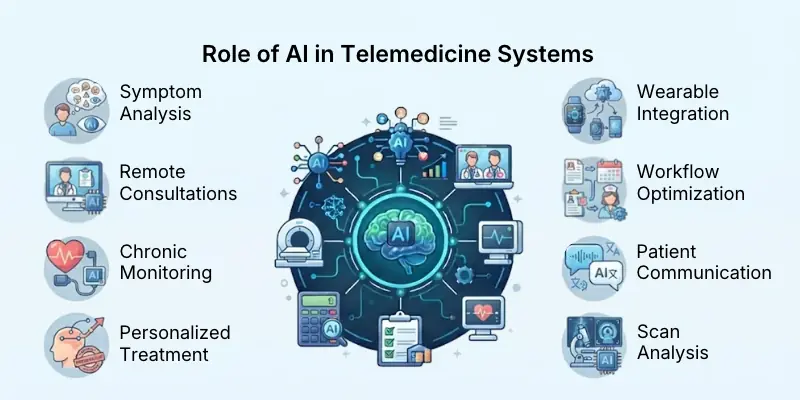
Here are the major roles of AI in telemedicine systems:
- Virtual Patient Triage and Symptom Analysis
- Remote Diagnosis and Consultations
- Chronic Disease Monitoring
- Personalized Treatment Recommendations
- Predictive Health Risk Assessment
- Integration with Wearable Devices
- Telehealth Workflow Optimization
- Natural Language Processing for Patient Communication
- Image and Medical Scan Analysis
- Remote Patient Monitoring Alerts
- Medication Management and Reminders
- Data Driven Decision Support
Let us cover all these roles in detail.
1. Virtual Patient Triage and Symptom Analysis
AI analyzes patient reported symptoms during virtual visits. It identifies urgent cases and prioritizes patients for doctors. This reduces waiting time and prevents complications. AI evaluates severity using historical and clinical data. Doctors confirm AI findings. Patients receive timely advice. Telemedicine becomes faster and safer.
Additional Points
- Assesses symptom severity efficiently
- Prioritizes patients for care
- Reduces emergency risks
- Supports faster consultation
- Improves patient outcomes
By identifying urgent symptoms and prioritizing patients, AI makes virtual triage faster, safer, and more responsive to individual healthcare needs.
2. Remote Diagnosis and Consultations
AI assists doctors in diagnosing conditions remotely. It analyzes patient data, history, and reported symptoms. Doctors review AI recommendations before final diagnosis. Early detection of diseases becomes possible. Patients receive care without traveling. AI reduces diagnostic errors. Remote consultations are accurate and effective.
Additional Points
- Supports remote diagnosis
- Reduces diagnostic errors
- Provides data driven insights
- Improves consultation accuracy
- Enhances patient satisfaction
Ultimately, AI supported remote diagnosis helps doctors deliver more informed consultations, bringing timely medical guidance closer to patients wherever they are.
3. Chronic Disease Monitoring
AI tracks patients with conditions like diabetes, hypertension, or heart disease. It monitors vitals and alerts doctors to abnormalities. Patients receive early interventions. Doctors adjust treatments based on AI insights. AI reduces hospital visits. Chronic diseases are managed effectively. Patients maintain better health.
Additional Points
- Monitors chronic conditions continuously
- Sends alerts for abnormal readings
- Supports treatment adjustments
- Reduces hospitalizations
- Improves disease control
With continuous monitoring and timely alerts, AI empowers doctors to manage chronic conditions proactively while helping patients maintain better long term health.
4. Personalized Treatment Recommendations
AI analyzes patient history, genetics, and lifestyle data. It recommends treatments tailored to individual needs. Doctors validate AI suggestions. Therapy becomes more precise and effective. Patients experience fewer side effects. Treatment adherence improves. AI enhances personalized care in telemedicine.
Additional Points
- Suggests tailored treatment plans
- Considers patient specific factors
- Reduces side effects
- Improves therapy adherence
- Enhances treatment effectiveness
By adapting treatment recommendations to individual patient needs, AI makes telemedicine more personalized, precise, and supportive of effective healthcare decisions.
5. Predictive Health Risk Assessment
AI predicts potential health risks using patient data. It identifies high risk patients before symptoms worsen. Doctors can intervene early. Patients benefit from preventive care. AI improves outcomes and reduces complications. Risk prediction supports proactive healthcare. Telemedicine becomes more preventive than reactive.
Additional Points
- Predicts potential health risks
- Identifies high risk patients
- Supports preventive care
- Reduces complications
- Enhances early interventions
Through early risk identification and preventive insights, AI helps doctors move beyond reactive treatment toward more proactive and personalized patient care.
6. Integration with Wearable Devices
AI collects data from smartwatches, fitness trackers, and medical sensors. It monitors heart rate, blood pressure, glucose levels, and more. Doctors receive continuous patient data. AI analyzes trends and alerts clinicians to changes. Remote monitoring becomes real time. Patients maintain health without frequent hospital visits. Care delivery improves overall.
Additional Points
- Integrates wearable health data
- Tracks vital signs continuously
- Provides real time alerts
- Supports preventive interventions
- Enhances patient engagement
By turning wearable data into meaningful health insights, AI strengthens remote monitoring and helps doctors respond more effectively to changes in patient health.
7. Telehealth Workflow Optimization
AI automates scheduling, patient reminders, and follow ups. It reduces administrative burden on staff. Doctors focus on clinical decisions rather than paperwork. AI ensures smooth operation of telemedicine platforms. Patients experience faster service. Efficiency improves overall. Healthcare delivery becomes seamless.
Additional Points
- Automates appointments and reminders
- Reduces administrative workload
- Optimizes telemedicine workflow
- Improves patient satisfaction
- Enhances operational efficiency
By automating routine tasks and streamlining appointments, AI allows healthcare teams to focus more on patients and deliver smoother, more efficient telemedicine services.
8. Natural Language Processing for Patient Communication
AI interprets patient queries, chat messages, and voice inputs. It provides instant responses and triages queries efficiently. Doctors receive structured summaries of patient concerns. AI enhances communication clarity. Patients feel heard and supported. Remote consultations become more interactive. Miscommunication reduces significantly.
Additional Points
- Understands patient questions
- Provides instant responses
- Summarizes patient information for doctors
- Enhances remote communication
- Reduces misunderstandings
With clearer communication and faster responses, AI powered language tools make virtual consultations more interactive, accessible, and patient centered.
9. Image and Medical Scan Analysis
AI analyzes X-rays, MRIs, CT scans, and other imaging remotely. It identifies abnormalities early. Doctors review AI findings before making decisions. Diagnosis becomes faster and accurate. AI supports remote radiology services. Patients avoid travel delays. Early intervention improves outcomes.
Additional Points
- Processes medical images remotely
- Detects abnormalities accurately
- Supports radiologist decisions
- Improves diagnostic speed
- Enhances patient care
By supporting faster image analysis and highlighting potential abnormalities, AI helps clinicians make more informed decisions and strengthen remote diagnostic services.
10. Remote Patient Monitoring Alerts
AI sends real time alerts for abnormal vitals or symptoms. Doctors can intervene immediately. Patients receive timely support without visiting hospitals. Emergency situations are reduced. Monitoring becomes continuous and reliable. Patient safety improves. Telemedicine becomes proactive and responsive.
Additional Points
- Sends instant alerts
- Supports timely medical intervention
- Reduces hospital visits
- Enhances patient safety
- Improves continuous monitoring
Through timely alerts and continuous observation, AI helps healthcare providers identify concerning changes earlier and deliver more responsive remote care.
11. Medication Management and Reminders
AI tracks patient medications and reminds them about doses. It prevents missed doses and overdosing. Doctors monitor adherence remotely. AI ensures treatments are followed correctly. Patients stay healthy and safe. Therapy effectiveness increases. Compliance improves overall outcomes.
Additional Points
- Tracks medication adherence
- Sends dose reminders
- Prevents errors and overdose
- Supports doctors remotely
- Enhances therapy success
By supporting medication reminders and adherence tracking, AI helps patients follow treatment plans more consistently and enables doctors to monitor therapy remotely.
12. Data Driven Decision Support
AI analyzes patient data to provide actionable insights. It helps doctors make evidence based decisions remotely. Treatment plans become more accurate. Resource allocation improves. AI reduces errors and increases efficiency. Patients benefit from precise and timely care. Telemedicine becomes smarter and more effective.
Additional Points
- Provides actionable insights
- Supports evidence based decisions
- Improves treatment accuracy
- Reduces errors
- Enhances patient care
Ultimately, AI powered decision support transforms patient data into actionable insights, helping doctors make informed decisions and deliver smarter, more personalized telemedicine care.
Future of AI in Telemedicine Systems
The future of the role of AI in telemedicine systems is very promising. By next year, AI is expected to support over 75 percent of telemedicine consultations globally. AI will improve remote diagnostics, chronic disease management, and personalized therapy recommendations.
Real time monitoring will reduce hospital visits and emergency interventions. Telemedicine systems will become more efficient, accessible, and patient centered. AI will transform remote healthcare delivery worldwide.
Final Note
In this guide, we covered the role of AI in telemedicine systems and explained how it supports remote diagnosis, chronic disease monitoring, personalized therapy, and workflow optimization. We discussed all major roles in detail. Now here I am just sharing my personal thoughts. I believe AI will make healthcare more accessible, accurate, and proactive. It will save time, reduce complications, and improve patient experiences.
Thank you for reading, goodbye, and now see the FAQs below.
FAQs About the Role of AI in Telemedicine Systems
Here are some frequently asked questions about the role of AI in telemedicine systems and how artificial intelligence supports remote diagnosis, patient monitoring, personalized treatment, and virtual healthcare.
1. What is AI in telemedicine systems?
AI in telemedicine uses artificial intelligence to analyze patient data, support remote diagnosis, and identify potential health risks. It helps doctors make informed decisions and provides patients with faster, more efficient healthcare.
2. How does AI help in remote consultations?
AI improves remote consultations through the following steps:
- Analyzes patient symptoms and medical history.
- Identifies possible health conditions.
- Provides useful insights for doctors.
- Supports clinical decisions after doctors review the findings.
This makes virtual consultations more informed and efficient.
3. Can AI monitor chronic diseases remotely?
Yes, AI supports remote monitoring of chronic conditions such as diabetes, hypertension, and heart disease.
- Tracks vital signs and relevant health data
- Identifies abnormal readings
- Alerts healthcare providers to potential concerns
- Supports timely medical interventions
This helps doctors manage chronic diseases more proactively.
4. Does AI replace doctors in telemedicine?
No, AI does not replace doctors. It supports healthcare professionals by analyzing patient information and providing recommendations.
| AI’s Role | Doctor’s Role |
| Analyzes patient data | Reviews AI findings |
| Identifies potential risks | Makes clinical judgments |
| Provides recommendations | Determines treatment decisions |
AI assists healthcare professionals, while doctors remain responsible for clinical decisions.
5. How does AI help with personalized therapy in telemedicine?
AI supports personalized therapy by analyzing individual patient information.
- Reviews medical history and health data
- Considers lifestyle and patient specific factors
- Suggests suitable treatment options
- Helps doctors tailor therapy plans
Doctors evaluate these recommendations to provide appropriate, individualized care.
6. Can AI integrate with wearable devices?
Yes, AI can integrate with compatible wearable devices to support continuous remote monitoring.
How it works:
- Wearable devices collect health information.
- AI analyzes vital signs and patient trends.
- Potential abnormalities are identified.
- Relevant alerts and insights are shared with healthcare providers.
This supports ongoing monitoring and timely medical attention.
7. Is AI useful for medication management?
Yes, AI can support medication management in telemedicine by helping patients follow their prescribed treatment plans.
- Sends medication reminders
- Tracks reported medication adherence
- Helps identify missed doses
- Supports remote monitoring by healthcare providers
These features may improve treatment adherence and support patient safety.
8. How does AI optimize telemedicine workflow?
AI streamlines telemedicine operations by automating routine administrative tasks.
| Workflow Task | How AI Helps |
| Scheduling | Supports appointment management |
| Reminders | Sends patient notifications |
| Follow ups | Helps organize follow up communication |
| Documentation | Supports clinical information summaries |
By reducing administrative workload, AI allows healthcare teams to focus more on patient care.
9. Can AI analyze medical images remotely?
Yes, AI can analyze medical images such as X-rays, MRIs, and CT scans to identify potential abnormalities.
Key benefits include:
- Processes medical images remotely
- Highlights possible abnormalities
- Supports doctors and radiologists in reviewing findings
- Helps improve diagnostic workflow
Doctors review AI generated findings before making clinical decisions.
10. What is the future of AI in telemedicine systems?
The future of AI in telemedicine is expected to include:
- Smarter remote diagnosis and clinical support
- More personalized healthcare recommendations
- Improved remote patient monitoring
- Better integration with wearable devices
- More efficient virtual consultations
As AI technology advances, it may help make telemedicine more accessible, proactive, and patient centered while keeping healthcare professionals involved in clinical decisions.






- Be Respectful
- Stay Relevant
- Stay Positive
- True Feedback
- Encourage Discussion
- Avoid Spamming
- No Fake News
- Don't Copy-Paste
- No Personal Attacks
- Be Respectful
- Stay Relevant
- Stay Positive
- True Feedback
- Encourage Discussion
- Avoid Spamming
- No Fake News
- Don't Copy-Paste
- No Personal Attacks
