Role of AI in DNA Analysis – Discover the Future of Genetic Science
Published: 18 Nov 2026
The role of artificial intelligence in DNA analysis is transforming genetics and medical research. DNA analysis studies genetic material to understand hereditary traits, disease risks, and biological functions.
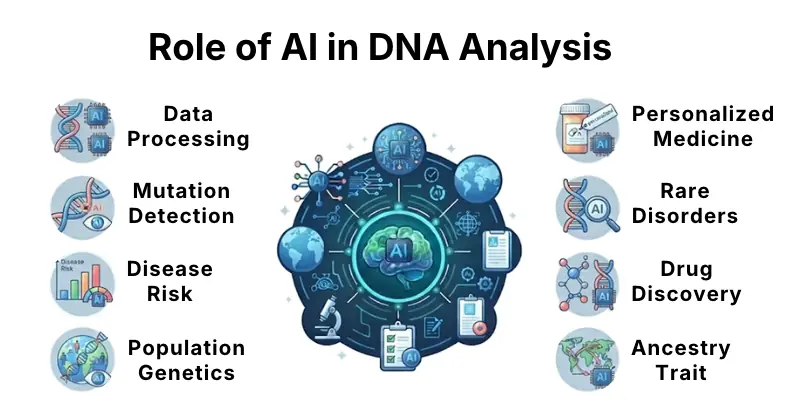
AI helps analyze vast DNA sequences faster and more accurately than humans. It identifies patterns, predicts disease risks, and supports precision medicine. AI also reduces errors and accelerates research. In this guide, we will cover all major roles of AI in DNA analysis and explain each role in detail.
Let us cover everything in detail.
Impact of AI in DNA Analysis
AI strengthens DNA analysis by processing large genetic datasets, detecting patterns, and predicting biological outcomes. It supports faster genetic research, disease detection, and personalized medicine.
Here are some of the major roles of AI in DNA Analysis:
- DNA Sequencing and Data Processing
- Genetic Mutation Detection
- Predictive Analysis for Disease Risk
- Genome Wide Association Studies (GWAS)
- Personalized Medicine and Therapy Planning
- Identification of Rare Genetic Disorders
- Functional Genomics and Gene Expression Analysis
- Epigenetic Pattern Analysis
- Integration with Clinical Data
- Drug Discovery Based on Genetic Data
- Ancestry and Trait Prediction
- Research Workflow Optimization
Let us cover all these roles in detail.
1. DNA Sequencing and Data Processing
AI processes massive DNA sequences efficiently. It assembles fragments and interprets complex data. Researchers identify genes and regulatory regions faster. AI reduces errors from manual analysis. It improves sequencing accuracy. Scientists gain insights into genetic structure. AI accelerates genome research.
Additional Points
- Processes large DNA datasets
- Improves sequencing accuracy
- Reduces manual errors
- Identifies genes and regulatory regions
- Speeds up genome analysis
Ultimately, AI is making DNA sequencing faster, more accurate, and more efficient, opening new possibilities for advanced genetic research.
2. Genetic Mutation Detection
AI identifies mutations in DNA sequences. It detects single nucleotide changes, insertions, and deletions. Doctors and researchers use these insights to predict disease risks. AI flags mutations that may lead to genetic disorders. Early detection supports preventive care. Scientists confirm findings experimentally. This improves understanding of genetic diseases.
Additional Points
- Detects DNA mutations accurately
- Supports disease risk prediction
- Flags potential genetic disorders
- Enhances preventive medicine
- Accelerates research
By identifying genetic mutations earlier and more accurately, AI is helping researchers uncover disease risks and advance the future of genetic healthcare.
3. Predictive Analysis for Disease Risk
AI predicts a patient’s risk of developing genetic diseases. It analyzes mutations, family history, and genomic patterns. Doctors plan preventive care based on AI insights. AI reduces late stage disease diagnosis. Patients receive personalized interventions. Early prediction improves health outcomes. Risk assessment becomes precise and reliable.
Additional Points
- Predicts genetic disease risks
- Analyzes mutations and patterns
- Supports preventive care
- Reduces late diagnosis
- Improves patient outcomes
Ultimately, AI powered risk prediction is transforming genetic insights into opportunities for earlier intervention and more personalized preventive care.
4. Genome Wide Association Studies (GWAS)
AI analyzes large population DNA data to identify disease linked genes. It finds correlations between traits and genetic variants. Researchers use AI to uncover new genetic associations. This accelerates understanding of complex diseases. AI reduces analysis time significantly. Studies become more accurate. It supports large scale genomics research.
Additional Points
- Identifies disease associated genes
- Finds correlations between traits and genes
- Supports large scale population studies
- Reduces analysis time
- Improves research accuracy
AI is making large scale genetic discoveries more efficient, helping scientists uncover valuable connections between genetic variations and complex diseases.
5. Personalized Medicine and Therapy Planning
AI uses DNA analysis to recommend personalized therapies. It identifies genetic markers that affect treatment response. Doctors tailor medication and therapy plans for each patient. AI predicts effectiveness and side effects. Therapy becomes more precise. Patients experience better outcomes. Personalized medicine improves safety and efficiency.
Additional Points
- Identifies therapy related genetic markers
- Supports personalized treatment
- Reduces side effects
- Improves therapy effectiveness
- Enhances patient outcomes
With AI driven genetic insights, personalized medicine is moving toward more targeted treatments, better informed decisions, and improved patient care.
6. Identification of Rare Genetic Disorders
AI detects rare genetic disorders from DNA data. It compares patient sequences with large genomic databases. Doctors confirm rare mutations for early intervention. AI reduces misdiagnosis. Patients receive timely care. Research on rare diseases advances faster. AI improves diagnostic accuracy.
Additional Points
- Detects rare genetic disorders
- Compares with large genomic datasets
- Supports early diagnosis
- Reduces misdiagnosis
- Improves patient care
AI is bringing new hope to rare disease research by helping identify hidden genetic conditions and supporting earlier, more informed diagnosis.
7. Functional Genomics and Gene Expression Analysis
AI analyzes which genes are active and how they function. It studies gene expression under different conditions. Researchers understand cellular processes better. AI identifies disease related expression patterns. This supports targeted therapy and research. Functional genomics insights improve precision medicine. Patients benefit from more accurate treatments.
Additional Points
- Analyzes gene activity
- Identifies expression patterns
- Supports targeted therapy
- Improves research insights
- Enhances precision medicine
By revealing how genes behave and interact, AI is helping scientists understand biological processes and develop more targeted healthcare solutions.
8. Epigenetic Pattern Analysis
AI studies chemical modifications that regulate gene activity. It identifies epigenetic changes linked to diseases. Doctors and researchers use these insights for therapy and prevention. AI supports early detection of epigenetic related conditions. This improves personalized care. Epigenetic analysis becomes faster. Research outcomes improve.
Additional Points
- Detects epigenetic modifications
- Links patterns to disease
- Supports therapy and prevention
- Improves personalized care
- Accelerates research
AI is opening new doors in epigenetic research, helping scientists understand how changes in gene regulation influence health and disease.
9. Integration with Clinical Data
AI combines DNA analysis with medical history and lab results. It provides a complete view of patient health. Doctors make informed treatment decisions. AI identifies genetic risks alongside lifestyle and clinical data. Patients receive more effective care. Decision making improves. Therapy outcomes become more precise.
Additional Points
- Integrates genomic and clinical data
- Supports informed decisions
- Improves treatment planning
- Enhances patient outcomes
- Provides holistic patient analysis
Combining genetic insights with clinical information allows AI to support a more comprehensive approach to healthcare and personalized treatment planning.
10. Drug Discovery Based on Genetic Data
AI identifies potential drug targets from DNA sequences. It predicts how patients respond to new drugs. Researchers design therapies more efficiently. AI reduces trial and error in drug development. Patients receive safer and more effective medications. Drug discovery becomes faster. Precision medicine advances significantly.
Additional Points
- Identifies drug targets from DNA
- Predicts treatment response
- Reduces development time
- Improves medication safety
- Supports precision medicine
AI is accelerating genetics driven drug discovery, bringing researchers closer to developing targeted therapies and more effective treatment options.
11. Ancestry and Trait Prediction
AI analyzes DNA to predict ancestry and inherited traits. It traces genetic lineage and population origins. Doctors and researchers understand hereditary patterns better. AI supports studies in evolution and population genetics. Trait prediction informs personalized health guidance. Patients learn about genetic predispositions. Insights support preventive care.
Additional Points
- Predicts ancestry and traits
- Supports genetic research
- Identifies hereditary risks
- Guides personalized health
- Enhances preventive medicine
By uncovering inherited patterns and ancestral connections, AI is helping people and researchers gain deeper insights into human genetic diversity.
12. Research Workflow Optimization
AI automates repetitive genomic analysis tasks. It accelerates DNA data processing. Researchers focus on interpretation and discovery. AI reduces errors and saves time. Genomic research becomes more efficient. Collaboration improves. AI advances genetic discoveries faster.
Additional Points
- Automates DNA data processing
- Reduces errors in research
- Speeds up genomic studies
- Improves workflow efficiency
- Supports faster discoveries
Ultimately, AI is transforming genomic research workflows, allowing scientists to spend less time on repetitive tasks and more time making meaningful discoveries.
Future of AI in DNA Analysis
The future of the role of AI in DNA analysis is very promising. By 2026, AI is expected to support over 70 percent of genome sequencing and interpretation workflows in research and healthcare. AI will improve early disease prediction, rare disorder detection, and personalized medicine. DNA based drug discovery will accelerate. Genomic research will become faster, safer, and more precise. AI will reshape genetics and precision healthcare globally.
Final Note
In this guide, we covered the role of AI in DNA analysis and explained how it supports sequencing, mutation detection, disease prediction, and personalized medicine. We discussed all major roles in detail.
Now here I am just sharing my personal thoughts. I believe AI will make DNA research faster and more accurate than ever before. It will improve patient care and enable earlier interventions. Thank you for reading, goodbye, and now see the FAQs below.
FAQs About the Role of AI in DNA Analysis
Artificial intelligence is transforming DNA analysis by helping researchers identify genetic patterns, detect mutations, and understand disease risks. Here are some common questions about its applications, benefits, and future in genetic research.
1. What is AI in DNA analysis?
AI in DNA analysis uses intelligent algorithms to examine genetic sequences and identify important biological patterns. It helps researchers and doctors:
- Identify genes and genetic mutations.
- Analyze complex DNA sequences.
- Reduce manual analysis errors.
- Generate faster and more accurate genetic insights.
2. How does AI detect genetic mutations?
AI examines DNA sequences to identify changes that may affect human health.
The process involves:
- DNA analysis: AI examines genetic sequences.
- Pattern recognition: It identifies substitutions, insertions, and deletions.
- Mutation detection: It flags potentially harmful genetic changes.
- Expert confirmation: Genetic specialists review the findings.
This supports genetic research and helps improve early diagnosis.
3. Can AI predict disease risk from DNA?
Yes, AI can estimate genetic disease risks by analyzing inherited variations and genomic patterns. It can:
- Identify genetic markers associated with diseases.
- Analyze hereditary risk patterns.
- Support early risk assessment.
- Help doctors plan preventive care.
However, genetic risk predictions do not guarantee that someone will develop a particular disease.
4. Does AI replace geneticists?
No, AI does not replace geneticists. It acts as a supportive tool that makes genetic research and DNA analysis more efficient.
| AI’s Role | Geneticist’s Role |
| Analyzes large DNA datasets | Interprets clinical significance |
| Identifies genetic patterns | Reviews and validates findings |
| Highlights possible mutations | Makes expert judgments |
| Provides analytical insights | Guides clinical decisions |
Human expertise remains essential for accurate interpretation and patient care.
5. How does AI support personalized medicine?
AI helps doctors develop personalized treatment plans by analyzing genetic information and identifying markers that influence drug response.
Key benefits include:
- Predicting potential medication responses.
- Identifying genetic factors affecting treatment.
- Supporting personalized therapy planning.
- Helping reduce avoidable side effects.
This makes treatment decisions more targeted and patient focused.
6. Can AI detect rare genetic disorders?
Yes, AI can help identify rare genetic disorders by comparing patient DNA with large genomic databases.
How it works:
- Examines patient DNA sequences.
- Searches for unusual genetic variations.
- Identifies mutations associated with rare disorders.
- Helps specialists investigate possible diagnoses.
Doctors must confirm the findings before making a diagnosis.
7. Is AI used in functional genomics?
Yes, AI plays an important role in functional genomics by studying gene activity and understanding how genes influence biological processes.
It helps researchers:
- Analyze gene expression patterns.
- Identify disease related gene activity.
- Understand cellular processes.
- Explore potential targets for personalized therapies.
These insights support advanced genetic research and precision medicine.
8. How does AI help with epigenetic analysis?
AI identifies epigenetic patterns that influence how genes are activated or suppressed without changing the underlying DNA sequence.
| AI Application | Purpose |
| DNA methylation analysis | Studies chemical changes affecting gene activity |
| Histone modification analysis | Examines changes in DNA packaging |
| Pattern recognition | Identifies disease associated epigenetic patterns |
| Data interpretation | Supports genetic and medical research |
These applications help scientists understand gene regulation and its relationship with diseases.
9. Can AI integrate DNA data with clinical records?
Yes, AI can combine genetic information with other medical data to provide a broader understanding of patient health.
The process includes:
- Collecting relevant DNA information.
- Analyzing medical history and laboratory results.
- Combining genetic and clinical insights.
- Supporting doctors in treatment planning.
This integration helps healthcare professionals make more informed and personalized decisions.
10. What is the future of AI in DNA analysis?
The future of AI in DNA analysis looks promising, with continued developments in genomic research and personalized healthcare.
Some important developments include:
- Faster DNA sequencing and interpretation.
- Improved genetic mutation detection.
- More advanced disease risk prediction.
- Better personalized treatment planning.
- Greater support for rare disease research.
As AI technology advances, it is expected to play an increasingly important role in genetic discoveries and precision medicine.





- Be Respectful
- Stay Relevant
- Stay Positive
- True Feedback
- Encourage Discussion
- Avoid Spamming
- No Fake News
- Don't Copy-Paste
- No Personal Attacks
- Be Respectful
- Stay Relevant
- Stay Positive
- True Feedback
- Encourage Discussion
- Avoid Spamming
- No Fake News
- Don't Copy-Paste
- No Personal Attacks
