Role of AI in Insurance in 2026: Boosting Speed, Safety, and Accuracy
Published: 20 Nov 2026
So guys, to understand the role of AI in insurance means to explore how technology is changing the insurance industry. I want to show how AI is making work faster, safer, and smarter for insurers, agents, and clients.
We will see how tasks that used to take hours can now be done with speed and accuracy.
So, guys, without wasting any time, let’s dig in with me!
Impact of AI in Insurance
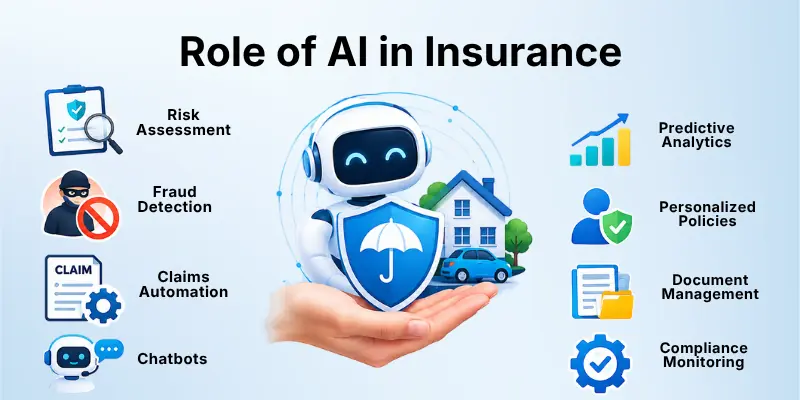
Let’s explore the main roles of AI in insurance. Here is the list of all the applications of artificial intelligence in the insurance industry:
- Risk Assessment and Underwriting
- Fraud Detection and Prevention
- Claims Processing Automation
- Customer Support Chatbots
- Predictive Analytics for Policy Pricing
- Personalized Policy Recommendations
- Document and Policy Management
- Customer Behavior Analysis
- Regulatory Compliance Monitoring
- Insurance Marketing Optimization
- Damage Assessment Using AI Imaging
- Automated Reporting and Insights
- Policy Renewal Reminders
- Customer Feedback Analysis
- Investment and Portfolio Management
Let’s cover all these use cases in detail.
1. Risk Assessment and Underwriting
I have seen AI help insurers evaluate risks much faster. It can analyze data from multiple sources, like health records or driving history. I feel more confident making decisions about who qualifies for a policy. AI can spot patterns humans might miss. It calculates risk scores accurately. This makes underwriting faster and more reliable.
Benefits:
- Speeds up risk evaluation
- Reduces human errors
- Provides accurate risk scores
- Improves decision making
Examples:
- AI tools analyze driver behavior for car insurance
- Health insurers use AI to assess medical history
With AI, insurers can evaluate risks more accurately and efficiently. This leads to faster policy decisions and a smoother insurance experience.
2. Fraud Detection and Prevention
I notice AI can detect suspicious claims quickly. It reviews patterns in past claims to find anomalies. I feel safer knowing fraudulent claims are flagged. AI helps insurers save money and protect honest clients. It continuously learns from new cases.
Benefits:
- Detects fraudulent claims efficiently
- Reduces losses for insurers
- Improves claim accuracy
- Saves time and resources
Examples:
- AI flags duplicate or unusual claims automatically
- Insurance firms use AI to monitor suspicious behavior
By identifying unusual claim patterns, AI makes insurance fraud easier to detect. It helps reduce financial losses and improves trust in the insurance industry.
3. Claims Processing Automation
I see AI handling claims faster than humans. It can verify details, process documents, and approve small claims instantly. I feel less stress as processing delays reduce. Customers also get faster payouts. AI ensures consistency and reduces mistakes.
Benefits:
- Speeds up claims processing
- Reduces human errors
- Improves customer satisfaction
- Saves operational costs
Examples:
- AI approves minor claims automatically
- Platforms process claims documents and validate information
AI makes claims processing faster by reducing paperwork and manual tasks. As a result, customers can receive decisions and payouts more quickly.
4. Customer Support Chatbots
I like using AI chatbots to answer customer questions. They work 24/7 and provide instant help. Clients can ask about policies, claims, or payments anytime. I feel less overwhelmed managing routine queries. It also improves the customer experience.
Benefits:
- Provides instant customer support
- Works around the clock
- Reduces pressure on human agents
- Improves satisfaction and engagement
Examples:
- Chatbots answer FAQs about policy coverage
- AI platforms help schedule appointments with agents
AI chatbots make insurance support available whenever customers need help. They provide quick answers and allow human agents to focus on complex issues.
5. Predictive Analytics for Policy Pricing
I notice AI predicts the right pricing for insurance policies. It uses data like age, habits, location, and history. I feel more confident that prices are fair. Insurers can balance risk and affordability. AI also helps offer personalized policies.
Benefits:
- Sets accurate policy prices
- Reduces risk of losses
- Personalizes offerings for clients
- Supports fair and competitive pricing
Examples:
- AI calculates premiums for auto and health insurance
- Insurers predict high risk clients for pricing adjustment
Predictive analytics allows insurers to estimate risks and calculate premiums more effectively. It helps businesses balance pricing, affordability, and financial stability.
6. Personalized Policy Recommendations
I see AI analyze client needs and suggest policies they might need. It considers lifestyle, health, and financial goals. I feel clients are happier with tailored recommendations. AI increases the chance of policy adoption. It also builds trust with customers.
Benefits:
- Provides relevant policy suggestions
- Improves customer engagement
- Increases sales and retention
- Builds trust with clients
Examples:
- Platforms suggest life insurance based on family data
- Auto insurers recommend coverage based on driving habits
By understanding customer needs, AI makes insurance recommendations more relevant. This can increase customer satisfaction, policy adoption, and long term loyalty.
7. Document and Policy Management
I notice AI organizes large volumes of policies and documents. It can find specific files quickly. I feel less stressed managing paperwork. AI ensures policies are up to date and accurate. This improves operational efficiency.
Benefits:
- Organizes documents efficiently
- Reduces errors in policy management
- Saves time finding records
- Ensures updated information
Examples:
- AI platforms store and retrieve insurance documents
- Policy updates are tracked automatically
AI simplifies insurance document management by organizing and retrieving records quickly. This reduces paperwork, saves time, and improves operational efficiency.
8. Customer Behavior Analysis
I see AI tracking how clients interact with apps or websites. It can predict renewal likelihood or policy upgrades. I feel better prepared to approach clients with relevant offers. AI helps understand preferences and behavior patterns. This improves engagement and satisfaction.
Benefits:
- Understands client habits
- Predicts renewal and buying behavior
- Helps target offers effectively
- Improves retention rates
Examples:
- AI analyzes app usage for insurance products
- Platforms detect customer trends for policy suggestions
AI helps insurers understand customer preferences and predict future needs. These insights support targeted offers and stronger customer retention.
9. Regulatory Compliance Monitoring
I notice AI helps insurers stay compliant with laws and regulations. It tracks policy requirements and updates automatically. I feel confident in reducing legal risks. AI ensures insurers avoid penalties. It monitors multiple regulations in real time.
Benefits:
- Keeps insurers compliant
- Reduces regulatory risk
- Saves time checking regulations
- Improves operational safety
Examples:
- Platforms alert about insurance law changes
- AI verifies claims and policies against legal standards
AI helps insurance companies monitor regulatory requirements and identify potential compliance issues. This reduces legal risks and supports more responsible operations.
10. Insurance Marketing Optimization
I see AI improving marketing campaigns for insurance products. It identifies target audiences and suggests messages. I feel campaigns are more effective and reach the right clients. AI predicts what offers clients respond to. This increases conversion and sales.
Benefits:
- Improves targeting and marketing
- Increases policy sales
- Reduces marketing costs
- Predicts customer preferences
Examples:
- AI optimizes online ad campaigns for insurance products
- Platforms segment clients for personalized emails
By analysing customer preferences, AI makes insurance marketing more effective. It helps businesses deliver relevant offers and attract potential policyholders.
11. Damage Assessment Using AI Imaging
I have seen AI help insurers assess damages quickly. It can analyze photos of vehicles, properties, or accidents. I feel more confident approving claims faster and accurately. AI detects issues humans might miss. It speeds up repairs and payouts. This makes the whole claims process smoother.
Benefits:
- Quickly evaluates damages
- Reduces human errors in assessment
- Speeds up claim approvals
- Improves customer satisfaction
Examples:
- AI analyzes car accident photos to estimate repair costs
- Platforms assess property damage from uploaded images
With AI imaging, insurers can estimate damage and identify visible issues more efficiently. This supports faster claims processing and more consistent assessments.
12. Automated Reporting and Insights
I see AI generate reports automatically from claims and policies. It summarizes trends, risks, and key metrics. I feel better informed to make decisions. AI can spot patterns I might overlook. It helps insurers improve operations and planning. Reports are faster and more accurate than manual work.
Benefits:
- Saves time generating reports
- Improves decision making with data insights
- Highlights trends and risks
- Reduces human errors
Examples:
- Platforms produce automated claims and risk reports
- AI tracks policy performance and operational efficiency
AI turns insurance data into useful reports and actionable insights. This helps insurers identify trends, manage risks, and make informed decisions.
13. Policy Renewal Reminders
I notice AI helps remind clients about upcoming renewals. It can send emails or notifications automatically. I feel clients are more likely to continue their coverage. AI ensures timely follow ups and reduces missed renewals. This helps retain clients and improve satisfaction.
Benefits:
- Improves policy renewal rates
- Reduces missed renewals
- Enhances customer engagement
- Saves manual follow up time
Examples:
- Automated emails notify clients of policy expiration
- AI alerts agents to contact clients before renewal deadlines
Automated renewal notifications make it easier for insurers to follow up with customers on time. This encourages policy continuity and creates a more convenient experience.
14. Customer Feedback Analysis
I see AI analyze feedback from surveys, emails, or social media. It identifies trends, complaints, and satisfaction levels. I feel better prepared to improve services. AI helps insurers understand clients’ needs. It also guides product or process improvements. Insights are faster and more actionable than manual review.
Benefits:
- Understands customer sentiment
- Identifies service issues quickly
- Guides improvements in policies and processes
- Increases client satisfaction
Examples:
- AI analyzes social media comments for client feedback
- Platforms categorize customer complaints for faster response
By analysing customer feedback, AI reveals what customers like and where improvements are needed. Insurers can use this information to build trust and improve their services.
15. Investment and Portfolio Management
I notice AI helps insurance companies manage investments. It analyzes market trends and risks to optimize portfolios. I feel insurers can make better financial decisions. AI predicts returns and alerts about potential losses. It helps balance risk and profit effectively. This supports long term growth and stability.
Benefits:
- Improves investment decisions
- Reduces financial risk
- Provides market trend analysis
- Supports portfolio optimization
Examples:
- AI predicts stock or bond performance for insurer portfolios
- Platforms recommend risk adjusted investment strategies
AI helps insurers analyse market trends and assess investment risks more effectively. This supports informed portfolio decisions and long term financial stability.
Benefits of AI in Insurance
I have seen how AI helps insurers, agents, and clients every day. It makes work faster, smarter, and more accurate.
Benefits (Overall):
- AI speeds up risk assessment and underwriting work.
- It reduces mistakes in claims, policies, and documents.
- AI detects fraud quickly and effectively every time.
- It automates repetitive administrative tasks for insurers.
- AI improves customer service with chatbots support.
- It offers personalized policy recommendations and pricing.
- AI organizes documents and data efficiently for use.
- It ensures compliance with laws and regulations.
- AI enhances marketing and sales strategies successfully.
- It provides actionable insights for better decision making.
Overall, AI helps insurance companies save time, reduce errors, and provide faster, smarter, and more personalized services to their customers.
Challenges of AI in Insurance
I have noticed that AI also brings challenges for insurers and agents. It needs careful use and oversight to be effective.
Challenges (Overall):
- AI tools can be expensive to implement fully.
- It always requires high quality and accurate data.
- AI cannot fully replace human judgment or expertise.
- Privacy and security concerns exist for sensitive data.
- Some staff resist adopting new AI technology.
- AI may misinterpret complex or unusual cases.
- Ethical concerns exist in automated decision making processes.
- AI has limited understanding of rare events.
Overall, insurance companies must address these challenges carefully to use AI safely, fairly, and effectively while maintaining human oversight.
Future of AI in Insurance
I believe AI will continue to grow in insurance. It will handle more claims, improve risk predictions, and personalize policies. Studies show that by 2030, AI could automate up to 40% of insurance operations. I see insurers using AI for smarter pricing, better fraud detection, and enhanced customer experience. Firms that adopt AI will stay competitive and efficient.
Final Note
In this guide, we have explored the role of AI in insurance, covering its main applications, benefits, challenges, and future potential. We explained how AI supports insurers, agents, and clients, and shared practical examples. AI is here to assist, not replace humans, in making insurance work faster and smarter. To learn more, see the FAQs below. Goodbye!
FAQs: AI Insurance
Here are some of the most commonly asked questions related to artificial intelligence in insurance industry:
1. What Is Artificial Intelligence and Insurance?
Artificial intelligence in insurance means using smart technology to improve insurance operations. It helps insurers assess risks, process claims, detect fraud, and make faster, more accurate decisions.
2. How Does AI in Insurance Improve Customer Service?
AI improves customer service through several features:
- 24/7 chatbots: Answer common questions instantly.
- Personalized support: Understand customer preferences.
- Faster responses: Reduce waiting times for assistance.
These features improve customer satisfaction and build trust.
3. What Is an AI Insurance Company?
An AI insurance company uses artificial intelligence to automate tasks and improve decision making. Its main applications include:
- Managing policies and documents.
- Processing claims more efficiently.
- Assessing risks and detecting fraud.
- Providing faster customer support.
4. How Does Predictive Analytics in the Insurance Industry Work?
Predictive analytics uses historical data and AI models to estimate future risks and claim probabilities.
| Step | How It Works |
| 1. Collect data | Gather claims, customer, and policy information. |
| 2. Analyse patterns | Identify trends and potential risks. |
| 3. Predict outcomes | Estimate claims and risk probabilities. |
| 4. Support decisions | Help insurers improve pricing and risk management. |
5. What Is Insurance and Machine Learning?
Insurance and machine learning involve using algorithms that learn from data to improve insurance operations. Machine learning helps insurers predict risks, automate claims, identify suspicious activities, and make better decisions while reducing manual work.
6. How Is an AI in Insurance Conference Changing the Industry?
An AI in insurance conference helps industry professionals discover new technologies and practical solutions. Attendees can:
- Explore the latest AI trends.
- Learn about fraud detection and claims automation.
- Discuss customer service improvements.
- Discover best practices for adopting AI.
These events help insurers understand emerging opportunities and challenges.
7. Can AI Replace Human Insurance Agents?
No, AI is unlikely to replace all human insurance agents. Instead, it supports their work by automating repetitive tasks and analysing data.
- AI handles: Routine queries, data analysis, and basic automation.
- Human agents handle: Personal advice, complex decisions, and customer relationships.
Together, AI and human expertise can improve insurance services.
8. How Does AI Detect Fraud in Insurance?
AI detects insurance fraud through a simple process:
- Reviews claims: Analyses new and historical claim data.
- Identifies anomalies: Flags unusual patterns or inconsistencies.
- Highlights suspicious cases: Alerts investigators for further review.
- Supports investigation: Helps insurers decide which claims need closer examination.
This process can reduce fraud related losses and protect honest policyholders.
9. Can AI Help With Personalized Policy Recommendations?
Yes, AI can recommend insurance policies based on customer needs and available data.
For example, it may consider lifestyle, coverage requirements, risk factors, and previous interactions to suggest relevant options. This makes policy selection more convenient and can improve customer engagement.
10. How Does AI Improve Efficiency in Insurance Companies?
AI improves insurance efficiency by automating time consuming tasks and helping employees make informed decisions.
Key benefits include:
- Faster claims processing.
- More efficient document management.
- Fewer manual errors.
- Automated reporting and data analysis.
- Improved productivity and customer service.
As a result, insurance companies can streamline operations and manage resources more effectively.




- Be Respectful
- Stay Relevant
- Stay Positive
- True Feedback
- Encourage Discussion
- Avoid Spamming
- No Fake News
- Don't Copy-Paste
- No Personal Attacks
- Be Respectful
- Stay Relevant
- Stay Positive
- True Feedback
- Encourage Discussion
- Avoid Spamming
- No Fake News
- Don't Copy-Paste
- No Personal Attacks
