Role of AI in Automotive Industry in 2026: How AI Is Making Cars Smarter
Published: 12 Nov 2026
The automotive industry is changing quickly with smart systems and modern machines. These systems help cars become safer, faster, and more reliable. They manage everything from design and production to road performance.
I’ve seen how they save time, cut costs, and reduce mistakes in car manufacturing. They also make driving more comfortable and help keep roads safe.
In this tutorial, we will cover the complete concept of the role of AI in the automotive industry, discuss its key roles, benefits, challenges, and the future of this field.
Impact of AI in Automotive Industry
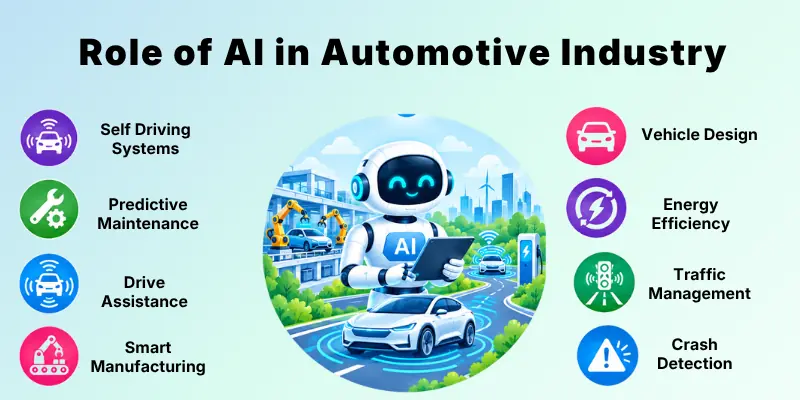
So in this section we will cover how AI is used in the automotive industry. These are the major roles of AI in automotive industry:
- Self Driving Systems
- Predictive Maintenance
- Quality Control
- Driver Assistance
- Smart Manufacturing
- Vehicle Design
- Supply Chain Optimization
- Energy Efficiency
- Traffic Management
- In Vehicle Personalization
- Crash Detection
- Safety Monitoring
- Voice and Gesture Control
- Predictive Sales Analytics
- Vehicle Testing and Simulation
Let us learn about each use of AI in the automotive industry.
1. Self Driving Systems
Self driving systems help cars move on roads without human control. They use sensors, cameras, and maps to read the surroundings. I’ve seen how these systems handle speed, distance, and signals perfectly. They react faster than humans to avoid accidents. They make travel safer and more reliable for everyone.
Benefits:
- Reduces driving errors
- Improves road safety
- Saves fuel with smooth driving
Example: Tesla and Waymo use advanced self driving systems in their vehicles.
2. Predictive Maintenance
Predictive maintenance finds problems before they cause breakdowns. It checks the car’s data to detect engine, brake, or tire issues. I find this system helpful for keeping vehicles in good shape. It saves drivers from unexpected repairs and extra costs. It also extends the car’s lifespan.
Benefits:
- Prevents sudden failures
- Reduces repair costs
- Extends vehicle life
Example: BMW uses predictive systems to notify owners before parts wear out.
3. Quality Control
Quality control checks every stage of car manufacturing. Cameras and sensors watch for even the smallest errors in parts or painting. I’ve noticed this keeps car quality high and waste low. It ensures that each car leaving the factory meets safety and design standards. It helps brands keep their trust strong.
Benefits:
- Finds defects early
- Maintains product quality
- Reduces waste and costs
Example: Toyota uses smart cameras to inspect vehicles on the production line.
4. Driver Assistance
Driver assistance systems make driving easier and safer. They help with lane keeping, parking, and collision warnings. I’ve used cars with these systems and they make a big difference in comfort. They guide drivers when roads get busy or visibility is low. They also prevent many road accidents.
Benefits:
- Improves safety
- Reduces driver stress
- Makes long drives easier
Example: Many cars use Adaptive Cruise Control to keep a safe distance on highways.
5. Smart Manufacturing
Smart manufacturing connects machines and systems on the factory floor. It helps make cars faster and with fewer errors. I like how this system saves energy and improves quality. It allows real time monitoring of production lines. It keeps output steady and efficient.
Benefits:
- Boosts production speed
- Cuts power waste
- Improves accuracy
Example: Ford uses connected robots to build cars faster and more safely.
6. Vehicle Design
Vehicle design tools create and test car models before production. Designers can see how cars look and perform in virtual space. I’ve seen how this saves time and reduces errors. It helps make cars safer, stronger, and more efficient. It makes design faster and more creative.
Benefits:
- Speeds up design work
- Reduces testing cost
- Improves car looks and safety
Example: Audi uses virtual tools to test aerodynamics of new models.
7. Supply Chain Optimization
Supply chain systems manage parts, transport, and delivery. They help companies track every step of production easily. I’ve seen how this avoids shortages and delays. It keeps work running smoothly and lowers storage costs. It makes the whole process faster and cleaner.
Benefits:
- Reduces delays
- Improves planning
- Cuts storage waste
Example: Toyota uses real time tracking to manage its global supply chain.
8. Energy Efficiency
Energy control systems make sure power is used properly in vehicles. They balance fuel use and battery output. I find this useful for electric and hybrid cars. It helps extend range and cut pollution. It makes driving more eco-friendly and affordable.
Benefits:
- Saves fuel and energy
- Reduces emissions
- Extends battery life
Example: Tesla cars adjust power automatically for better mileage.
9. Traffic Management
Traffic management systems study road conditions and vehicle movement. They suggest the best routes and reduce jams. I think these systems make daily travel smoother for everyone. They also help cities lower fuel waste and pollution. They are key to better road planning.
Benefits:
- Cuts travel time
- Reduces congestion
- Improves city flow
Example: Smart city systems use live traffic data to control signals.
10. In Vehicle Personalization
Personalization tools make cars adjust to each driver automatically. They remember seat position, mirror angle, and favorite music. I like how this makes every drive more comfortable. It creates a personalized experience for every user. It also builds stronger customer satisfaction.
Benefits:
- Improves comfort
- Saves user settings
- Makes driving fun
Example: Mercedes cars adjust lighting and seats based on user profile.
11. Crash Detection
Crash detection systems sense when a collision happens. They send quick alerts to emergency services. I’ve seen how they save lives by reducing response time. These systems track force, speed, and direction during accidents. They are now a must for modern cars.
Benefits:
- Saves lives
- Speeds up rescue help
- Increases passenger safety
Example: Many cars automatically call for help after a crash.
12. Safety Monitoring
Safety systems check how cars and drivers behave. They spot signs of fatigue or risky driving. I like how they warn drivers early and help prevent accidents. These systems also monitor car parts for faults. They make driving much safer.
Benefits:
- Prevents unsafe driving
- Keeps car health in check
- Builds driver awareness
Example: Volvo cars use sensors to monitor driver alertness.
13. Voice and Gesture Control
Voice and gesture systems let drivers control features without touching buttons. I find this makes driving easier and less distracting. It helps change music, call someone, or adjust temperature safely. It improves comfort and focus on the road. It adds a modern touch to driving.
Benefits:
- Reduces distraction
- Improves control
- Enhances comfort
Example: BMW cars let users control music with hand gestures.
14. Predictive Sales Analytics
Predictive sales tools study customer interest and demand. They help brands plan production and pricing better. I’ve seen how this avoids overproduction and waste. It helps companies meet real market needs quickly. It supports smart decision making.
Benefits:
- Improves business planning
- Cuts stock waste
- Boosts profit margins
Example: Dealerships use predictive tools to plan car inventory.
15. Vehicle Testing and Simulation
Vehicle testing systems run digital tests before building real cars. They check safety, balance, and design early. I’ve seen how this saves money and time. It allows faster upgrades and safer cars. It improves vehicle quality overall.
Benefits:
- Reduces testing cost
- Saves development time
- Improves reliability
Example: Honda uses simulation tools to test new engines virtually.
Benefits of AI in Automotive Industry
Guys, in this section we will learn the main benefits that come from these systems. These benefits show how manufacturers, drivers, and customers all gain from smarter operations.
Main Benefits:
- It reduces car manufacturing cost and saves time.
- It improves driver comfort and overall road safety.
- It finds faults early and prevents serious damage.
- It saves both energy and fuel during driving.
- It supports cleaner and more eco-friendly transport.
- It helps factories work faster with better results.
- It improves how cars perform on the road.
- It makes the driving and buying experience better.
- It builds stronger trust between users and brands.
- It helps companies plan and grow their business wisely.
Overall, AI in the automotive industry helps reduce costs, improve safety, and boost efficiency. These benefits make vehicles smarter, driving easier, and transportation more sustainable.
Challenges of Implementing AI in the Automobile Industry
Guys, in this section we will learn the main challenges this industry faces.
Main Challenges:
- It needs a high setup cost and special tools.
- It lacks enough skilled and trained experts.
- It faces data safety and privacy concerns.
- It is hard to upgrade old vehicle models.
- It faces cyber risks in connected car systems.
- It must follow complex government safety rules.
- It struggles with limited power in some regions.
- It can fail due to software or system errors.
- It is hard to connect new and old systems together.
- It faces low public trust in automatic vehicles.
Overall, overcoming these challenges is essential to making AI in the automotive industry safer, more reliable, and accessible for the future.
Future of AI in the Auto Industry
The future of the automotive world looks more connected and safe. Cars will talk to each other and share road data. They will drive on their own, plan routes, and avoid danger. I believe the focus will be on clean energy, smart control, and comfort. Production will get faster and greener with fewer errors. The industry is moving toward safe, smart, and sustainable driving for all.
Conclusion
In this guide, we have covered the detailed concept of the role of AI in the automotive industry. We learned how smart systems help in car design, safety, and performance. From self driving cars to predictive maintenance, each role shapes the future of transport. These systems make driving safer, cleaner, and more enjoyable. Now, to learn more, check the FAQs below for common questions about this growing industry.
Frequently asked question AI and Automotive Industry
Here are some of the most commonly asked questions related to AI in the automotive industry:
1. What is automotive artificial intelligence?
Automotive artificial intelligence uses smart computer systems to improve vehicle functions. It supports driving, parking, and vehicle monitoring, helping cars make faster and safer decisions.
2. How does automotive AI help in daily driving?
Automotive AI makes everyday driving easier through features such as:
- Lane detection: Helps drivers stay in their lanes.
- Collision alerts: Warns drivers about potential dangers.
- Smart parking: Assists with parking in tight spaces.
- Route suggestions: Helps drivers choose suitable routes.
3. What is the role of the artificial intelligence automotive industry today?
AI plays several important roles in today’s automotive industry:
| Application | Main purpose |
| Car design | Improves vehicle development |
| Factory automation | Speeds up production |
| Connected vehicles | Improves communication and monitoring |
| Safety systems | Helps prevent accidents |
4. How is artificial intelligence in car manufacturing used?
AI improves car manufacturing through a simple process:
- Inspect parts: Detects defects during production.
- Automate assembly: Helps robots build vehicles accurately.
- Monitor quality: Identifies errors before cars leave the factory.
This approach reduces waste, saves time, and improves product quality.
5. What can vehicle artificial intelligence do for safety?
Vehicle AI helps protect drivers, passengers, and pedestrians by detecting potential hazards and providing early warnings. Depending on the system, it can also assist with braking or steering to reduce collision risks.
6. What are the main benefits of artificial intelligence in automotive?
The main benefits of AI in the automotive industry include:
- Reduced manufacturing costs and fewer errors.
- Better fuel efficiency and vehicle performance.
- Faster fault detection and repairs.
- Improved driving comfort and road safety.
- More efficient production and customer experiences.
7. How is AI in vehicles used for self driving cars?
Self driving technology uses AI in a series of steps:
- Sense: Cameras and sensors collect information about the surroundings.
- Understand: AI identifies roads, signs, vehicles, and pedestrians.
- Plan: The system selects a suitable driving path.
- Act: The vehicle controls steering, braking, and acceleration within its capabilities.
The level of automation varies, and many vehicles still require driver supervision.
8. How does machine learning in the automotive industry support car makers?
Machine learning helps car manufacturers analyse vehicle and production data to identify patterns and predict potential problems. It can improve maintenance planning, vehicle design, quality control, and performance over time.
9. What are the latest technology trends in the automotive industry?
Key automotive technology trends include:
- AI-powered driver assistance: Supports safer driving.
- Electric vehicles: Help reduce tailpipe emissions.
- Smart sensors: Improve vehicle monitoring.
- Connected cars: Enable real time data sharing.
- Predictive maintenance: Helps detect problems early.
10. What is the future of automotive AI companies and the market?
The future of automotive AI is shaped by innovation in connected vehicles, automated manufacturing, driver assistance, and electric mobility. Automotive AI companies are developing technologies to improve safety and efficiency, while market growth depends on adoption, costs, regulations, and consumer demand.




- Be Respectful
- Stay Relevant
- Stay Positive
- True Feedback
- Encourage Discussion
- Avoid Spamming
- No Fake News
- Don't Copy-Paste
- No Personal Attacks
- Be Respectful
- Stay Relevant
- Stay Positive
- True Feedback
- Encourage Discussion
- Avoid Spamming
- No Fake News
- Don't Copy-Paste
- No Personal Attacks
